You rewrote the email. You revised the report. You edited the essay. And somewhere in the middle of all that, you typed “change for the better” for the third time in four paragraphs.
It happens to everyone. But here’s the thing: the words you choose around improvement actually shape how your reader feels about the change. “She underwent a transformation” lands differently than “she made some adjustments.” Same basic idea. Completely different emotional weight.
This guide breaks down 40+ alternatives, explains the real differences between them, and helps you pick the right word for the right moment.
So What Does “Change for the Better” Really Mean?
At its core, it describes a shift from a worse state to a better one. But it carries something extra: a sense of intention, of something becoming more right than it was before. The emotional baseline is hopeful. The tone is forward-looking.
That’s why the word you swap in matters. Some synonyms carry struggle. Some carry polish. Some carry quiet growth.
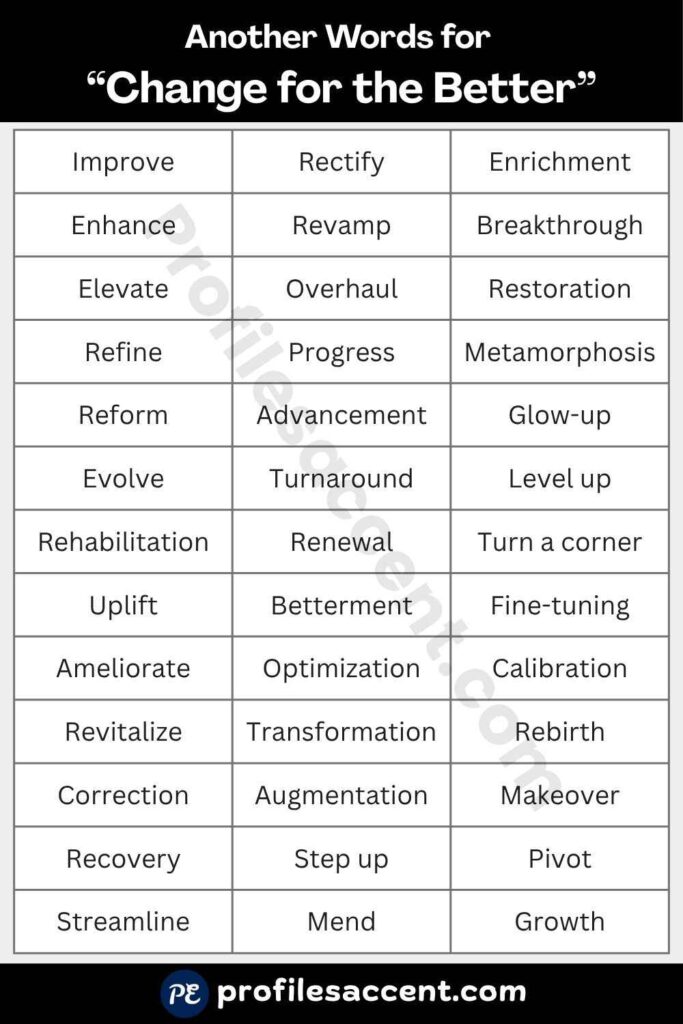
40+ Synonyms for Change for the Better: Quick Table
| Word / Phrase | Tone | Best Used When | Quick Example |
| Improve | Neutral | General situations, any context | The plan improved over time. |
| Enhance | Positive, polished | Adding quality to something already decent | They enhanced the user experience. |
| Elevate | Formal, aspirational | Professional or creative contexts | Her feedback elevated the project. |
| Refine | Precise, subtle | Small but meaningful adjustments | He refined his approach after feedback. |
| Reform | Serious, systemic | Fixing broken systems or habits | The school reformed its grading policy. |
| Evolve | Natural, gradual | Personal or organizational growth | Her leadership style evolved. |
| Rectify | Corrective, direct | Fixing a specific mistake | They moved quickly to rectify the error. |
| Revamp | Energetic, modern | Redesigning or rebuilding something | The team revamped the onboarding process. |
| Overhaul | Strong, thorough | Major structural changes | The system needed a complete overhaul. |
| Progress | Ongoing, hopeful | Describing movement forward | He made real progress this semester. |
| Advancement | Formal, positive | Career or knowledge growth | Her advancement in the field was steady. |
| Turnaround | Dramatic, clear | A reversal from bad to good | The company made an impressive turnaround. |
| Rehabilitation | Restorative | Recovery after setback or failure | The neighborhood went through rehabilitation. |
| Renewal | Fresh, clean | Starting again with new energy | Spring felt like a renewal for their relationship. |
| Uplift | Warm, emotional | Personal or community improvement | The program brought real uplift to the community. |
| Betterment | Formal, broad | General improvement across areas | She worked toward her own betterment. |
| Ameliorate | Formal, heavy | Easing a painful or severe condition | The medicine helped ameliorate her symptoms. |
| Optimization | Technical, efficient | Improving systems or processes | Process optimization cut costs by 30%. |
| Revitalize | Energetic, hopeful | Bringing something back to life | The grant helped revitalize the arts program. |
| Transformation | Powerful, sweeping | Deep, visible, lasting change | His transformation over two years was remarkable. |
| Correction | Straightforward | Fixing what was wrong | A simple correction improved the document. |
| Augmentation | Technical | Adding to improve | The augmentation of resources made a difference. |
| Recovery | Emotional, medical | Coming back from difficulty | Her recovery was steady and inspiring. |
| Enrichment | Warm, meaningful | Adding value or depth | The course offered real intellectual enrichment. |
| Breakthrough | Exciting, sudden | A moment of major discovery or shift | The team had a breakthrough in negotiations. |
| Restoration | Careful, deliberate | Returning to a good prior state | The restoration of trust took time. |
| Metamorphosis | Vivid, literary | Total and visible personal change | The character undergoes a full metamorphosis. |
| Glow-up | Casual, modern slang | Personal improvement (especially appearance or life) | Her glow-up over the past year was noticeable. |
| Level up | Informal, energetic | Gaining skills or moving to a higher stage | He decided to level up his communication skills. |
| Turn a corner | Idiomatic | Passing through a hard period into better days | After months of struggle, they finally turned a corner. |
| Fine-tuning | Light, technical | Minor improvements that sharpen performance | A little fine-tuning made the pitch much stronger. |
| Calibration | Precise | Adjusting something with care | The strategy needed recalibration mid-project. |
| Rebirth | Spiritual, dramatic | A complete new beginning | The town experienced a kind of cultural rebirth. |
| Makeover | Casual, visual | A noticeable surface or personal improvement | The brand needed a full makeover. |
| Step up | Informal, action-based | Taking initiative to improve | She decided it was time to step up her efforts. |
| Pivot | Business, modern | Changing direction toward something better | The startup had to pivot after early setbacks. |
| Streamline | Professional | Making something more efficient and clean | They streamlined the approval process. |
| Mend | Gentle, relational | Fixing something damaged | It took time to mend the broken trust. |
| Growth | Broad, warm | Positive development over time | Personal growth is rarely a straight line. |
| Flourishing | Rich, expressive | A state of thriving after improvement | The garden, like her confidence, was flourishing. |
The Difference Nobody Explains: Improve, Enhance, and Ameliorate
Most writers treat improve, ameliorate, and enhance like they mean the same thing. They don’t.
Ameliorate is for hard situations. It implies something was genuinely painful or broken. You wouldn’t say “she ameliorated her morning routine.” You would say “the new shelter ameliorated conditions for families in crisis.” It carries weight.
Enhance expects something already decent. It adds shine. It lifts quality upward. You enhance a design, a performance, a user experience.
Improve is your safe, flexible word. It works everywhere, which is exactly why overusing it makes writing feel lazy.
Getting this difference right makes your writing feel considered, not just filled in.
Are You Describing the Change or the Result? (Process vs. Outcome Words)
Here’s a distinction most synonym guides skip completely.
Some words describe the act of improving. Others describe what you arrive at.
Process words (the doing):
- Refine, calibrate, overhaul, adjust, tweak, revamp, mend, streamline
Outcome words (the result):
- Transformation, breakthrough, recovery, renewal, flourishing, metamorphosis, turnaround
This matters in your writing. If you’re describing what someone did, use a process word. If you’re describing what they became, use an outcome word.
- “She spent a year refining her habits” describes the journey.
- “The transformation she experienced was hard to explain” describes the result.
Using them in the right place makes your sentences feel precise, not accidental.
Change for the Better Synonyms Ranked by Emotional Weight
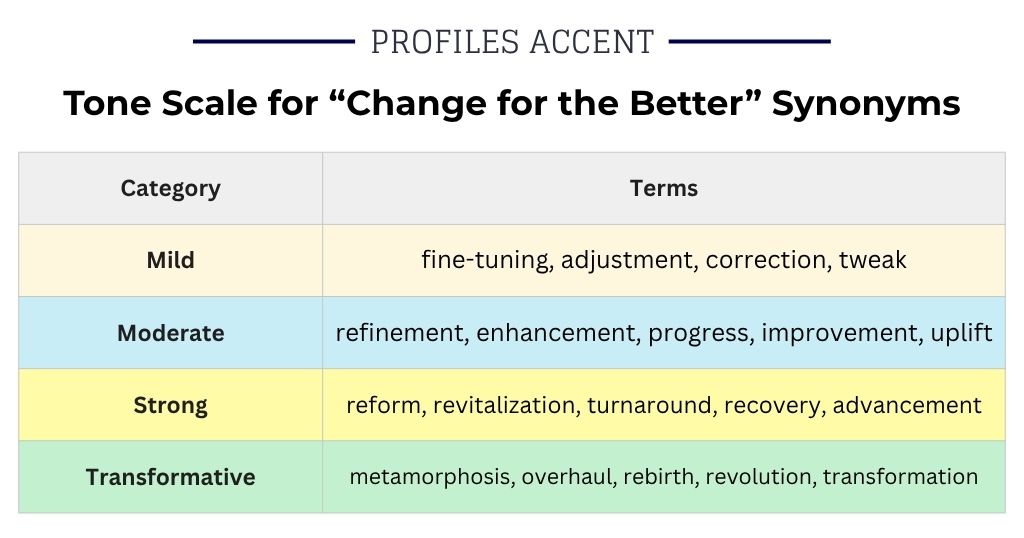
Some changes are gentle. Some shake the ground. Here’s how these words stack up by emotional weight:
- Mild: fine-tuning, adjustment, correction, tweak
- Moderate: refinement, enhancement, progress, improvement, uplift
- Strong: reform, revitalization, turnaround, recovery, advancement
- Transformative: metamorphosis, overhaul, rebirth, revolution, transformation
If you’re writing about a small product update, “fine-tuning” works. If you’re writing about a person who rebuilt their life from nothing, “transformation” or “rebirth” earns its place. Match the word to the actual size of the change.
Same Sentence, Four Different Voices: Rewrites in Action
Original (flat): “The company went through a change for the better last year.”
- Formal: “The organization underwent a significant operational transformation in the past fiscal year.”
- Casual: “Honestly, the company finally got its act together last year.”
- Academic: “The company demonstrated measurable advancement across key performance indicators.”
- Creative: “Something shifted inside the company last year, like a window finally opened after a long winter.”
Notice how each version changes not just the word, but the entire feel of the sentence. The casual version implies the change was overdue. The creative version gives it texture. The academic version signals evidence.
Word choice is tone control.
Change for the Better Synonym Slang: When Casual Language Actually Fits
Modern writing, especially in blogs, social media, and casual content, has its own vocabulary for positive change.
- Glow-up describes a visible personal improvement. It started in youth culture and is now used widely, even in marketing.
- Level up comes from gaming but now means growing in skill, status, or quality. It’s energetic and forward-moving.
- Pivot is a business term that now means shifting direction intentionally and with purpose. It implies the change was smart, not desperate.
- Get your act together is informal and slightly critical. It implies the change was needed and perhaps delayed.
Use these in casual pieces, social writing, or informal emails. Avoid them in formal essays, reports, or academic work.
Another Word for Change for the Better Person vs. Change in a System
This is a gap that shows up in real writing decisions.
When you’re writing about a person who changed for the better:
- evolve, grow, transform, rehabilitate, renew, turn a corner, flourish, become
When you’re writing about a system, policy, or organization:
- reform, overhaul, restructure, modernize, revamp, rectify, optimize, streamline
Mixing these up sounds odd. You wouldn’t say a policy “glowed up.” And saying a person “underwent optimization” feels cold and mechanical.
Context shapes which category makes sense.
Mistakes Writers Make When Choosing a Positive Change Synonym
Using “ameliorate” casually. It sounds impressive, but it’s heavy. It belongs in writing about social problems, suffering, or serious hardship. Using it to describe a slightly better morning commute reads as overdone.
Stacking synonyms. “She improved, enhanced, and refined her skills” doesn’t emphasize, it just repeats. Pick one word and let it do its job.
Confusing “reform” and “improve.” Reform implies something was flawed in a structural or moral way. Improve is neutral. Saying you “reformed your lunch habits” sounds like your lunches were ethically questionable.
Treating “progress” as a synonym for “change.” Progress implies movement in a positive direction over time. Change is neutral. A change can be good or bad. Progress is always forward.
Overusing “transformation.” It’s a strong word. If everything in your essay is a “transformation,” nothing is.
Related Words to “Change for the Better” and How They Differ
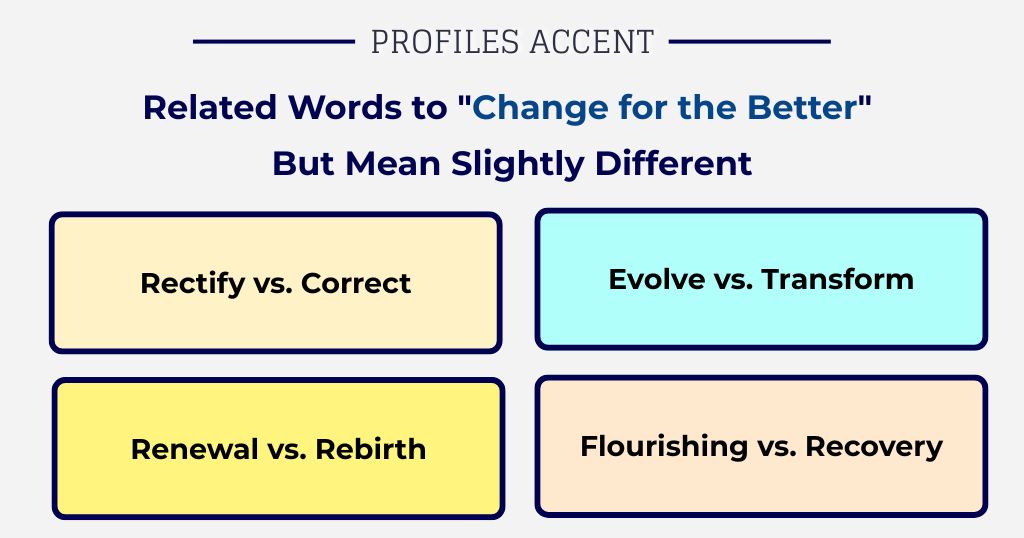
Rectify vs. Correct: Both fix mistakes. Rectify is more formal and suggests the error had real consequences. Correct is lighter and more everyday.
Evolve vs. Transform: Evolve is gradual and natural. Transform is sudden and complete. One is a river changing course over years; the other is a storm that reshapes the landscape overnight.
Renewal vs. Rebirth: Renewal refreshes something that still exists. Rebirth implies the old version is gone and something entirely new has taken its place.
Flourishing vs. Recovery: Recovery is about coming back from a low point. Flourishing is about thriving well beyond that point.
Pick the Word That Fits the Truth of the Change
- If something barely shifted, don’t call it a transformation.
- If something broke someone open and rebuilt them, “adjustment” undersells it.
The best synonym isn’t the fanciest one. It’s the one that matches the actual scale, tone, and emotional truth of what you’re describing. Look at your sentence. Ask what really happened. Then choose from this list.
That’s how writing gets sharper, not just longer.
Discover More Articles:

I’m Rowan, a language addict who loves exploring how words work in everyday communication. I’ve spent years studying English vocabulary and helping others express themselves more clearly. My goal is simple: make learning new words easy and practical. I focus on real-life examples that show when and how to use different terms. Through clear explanations and honest guidance, I help readers choose the right words for any situation with confidence.