There’s a moment every writer knows. You finish a sentence, read it back, and wince. Ultimately again. You just used it two lines ago. You search for a replacement and land on a thesaurus page that throws fifteen words at you without explaining which one actually fits.
That’s the real problem. It’s not finding another word. It’s finding the right word for your exact sentence.
This guide fixes that.
What Does “Ultimately” Really Mean? (It’s Not Just One Thing)
Before picking a synonym, know what the word is carrying. “Ultimately” does two different jobs, and mixing them up is where most writers go wrong.
Job 1: It marks the final point in a sequence of events. Something happened, then more things happened, and ultimately this was the result.
Job 2: It points to the deepest, most essential truth. Not what something looks like on the surface, but what it really is at its core.
These two jobs need different replacements. A word that works for one meaning can quietly wreck a sentence built on the other.
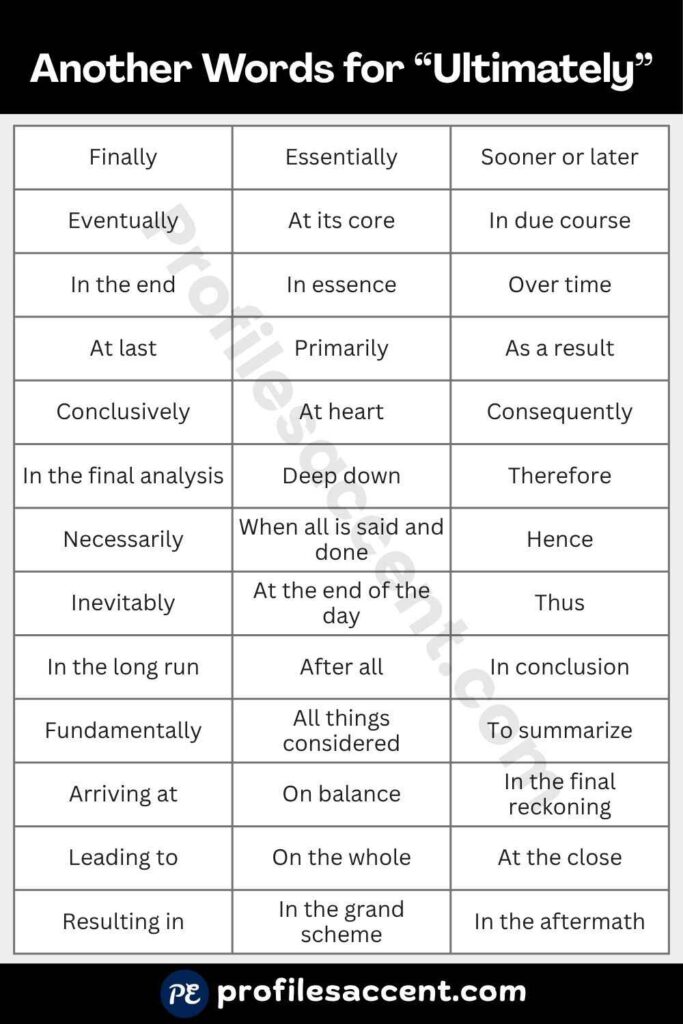
35+ Quick Synonyms for “Ultimately” at a Glance
| Word or Phrase | Tone | Best For | Mini Example |
| Finally | Neutral | End of a sequence | She finally accepted the offer. |
| Eventually | Neutral | After a delay | He eventually came around. |
| In the end | Conversational | Summarizing outcomes | In the end, it worked out. |
| At last | Warm, relieved | After long waiting | At last, the results arrived. |
| Conclusively | Formal | Settling a debate | The trial ended conclusively. |
| In the final analysis | Academic | Research conclusions | In the final analysis, costs rose. |
| Necessarily | Neutral/formal | Logical outcomes | This will necessarily change things. |
| Inevitably | Certain tone | Unstoppable results | It inevitably collapsed. |
| In the long run | Strategic | Finance, planning | It saves money in the long run. |
| Fundamentally | Serious | Core truth statements | They are fundamentally different. |
| Essentially | Neutral | Stripping to basics | It is essentially a shortcut. |
| At its core | Thoughtful | Deep explanations | At its core, it’s about trust. |
| In essence | Refined | Formal simplification | In essence, the deal failed. |
| Primarily | Direct | Most important factor | This is primarily a budget issue. |
| At heart | Personal, warm | Character or motive | He is, at heart, a kind person. |
| Deep down | Casual, emotional | Feelings or hidden truth | Deep down, she already knew. |
| When all is said and done | Informal | Casual wrap-ups | When all is said and done, it mattered. |
| At the end of the day | Very casual | Spoken or blog tone | At the end of the day, results count. |
| After all | Mild, reflective | Reconsidering something | After all, we had tried our best. |
| All things considered | Balanced | Weighing pros and cons | All things considered, it was fair. |
| On balance | Measured | Academic or analytical | On balance, the policy succeeded. |
| On the whole | Broad view | General conclusions | On the whole, the plan worked. |
| In the grand scheme | Reflective | Big-picture thinking | In the grand scheme, it was minor. |
| Sooner or later | Casual/certain | Inevitable timing | Sooner or later, this will surface. |
| In due course | Formal, patient | Official or legal writing | Details will follow in due course. |
| Over time | Gradual | Slow-changing situations | Over time, habits shift. |
| As a result | Causal | Cause-effect writing | As a result, the policy changed. |
| Consequently | Formal/causal | Academic papers | Consequently, production declined. |
| Therefore | Logical | Conclusions in arguments | Therefore, the claim holds true. |
| Hence | Formal, brief | Research, legal | Hence, the contract was void. |
| Thus | Concise, formal | Essays, academic | Thus, the study supports the theory. |
| In conclusion | Essay-specific | Closing paragraphs | In conclusion, the data is clear. |
| To summarize | Wrap-up | Reports, presentations | To summarize, three points matter. |
| In the final reckoning | Literary | Narrative or essays | In the final reckoning, truth won. |
| At the close | Narrative | Story or speech endings | At the close of the trial, all agreed. |
| In the aftermath | Contextual | Post-event results | In the aftermath, the city recovered. |
| Culminating in | Active phrase | Cause-and-effect chains | Years of work, culminating in success. |
| Resulting in | Direct | Outcome statements | Budget cuts, resulting in layoffs. |
| Leading to | Simple, active | Transitions | Poor planning, leading to delays. |
| Arriving at | Process-based | Decision conclusions | Years of debate, arriving at reform. |
Two Meanings, Two Different Word Groups
Most synonym lists ignore this. They toss “eventually” and “fundamentally” into the same pile. But these words are not interchangeable. At all.
Time and Sequence
These words belong in sentences where something happens after a chain of events. There is a process, a wait, a series of steps, and then a final outcome.
Words like eventually, in the long run, sooner or later, and in the end live here. They carry a sense of movement through time.
- If you write: “The project was delayed three times and ultimately delivered in March,” you are talking about a timeline.
- Replace “ultimately” with “eventually” or “finally” and the sentence flows perfectly.
Core Truth and Essence
These words strip away the surface to reveal what something really is. There is no timeline involved. It is about the nature of a thing.
Words like fundamentally, essentially, at its core, and in essence live here. They point inward, not forward.
- If you write: “The disagreement was ultimately about respect,” you are exposing the real cause.
- Replace “ultimately” with “fundamentally” or “at heart” and the sentence becomes even stronger.
Mixing clusters causes sentences to feel slightly off. Readers cannot always explain why, but they feel it.
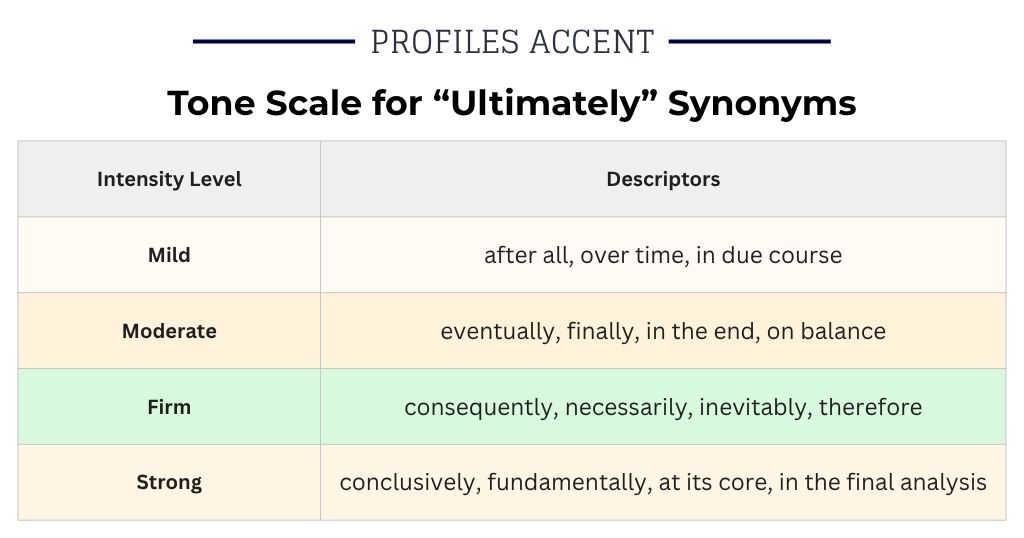
How Strong Is Your Synonym? A Tone Scale for “Ultimately”
Not every synonym carries the same weight. Some whisper. Some announce.
Here is how they rank, from lightest to most forceful:
- Mild: after all, over time, in due course
These are gentle. They do not demand attention. Good for casual writing or when you want the point to land softly.
- Moderate: eventually, finally, in the end, on balance
Solid and clear. These work across most writing styles without sounding stiff or overdramatic.
- Firm: consequently, necessarily, inevitably, therefore
These carry logical weight. Readers feel the certainty behind these words. Good for arguments and analysis.
- Strong: conclusively, fundamentally, at its core, in the final analysis
These signal authority. Use them when you want to close a point with confidence, especially in formal or academic writing.
Same Sentence, Four Different Synonyms for “Ultimately”
Take one base sentence. Watch what happens when the synonym shifts.
Original: The company ultimately failed because of poor leadership.
- Formal version: The company’s collapse was, in the final analysis, a leadership failure. (Shifts blame clearly. Works in a business report.)
- Casual version: At the end of the day, bad leadership sank the company. (Relaxed. Works in a blog post or conversation.)
- Academic version: Organizational decline was fundamentally rooted in leadership deficiency. (Clinical and precise. Works in a research paper.)
- Narrative version: Years of mismanagement culminated in the company’s inevitable downfall. (“Culminated in” adds drama and motion. Works in long-form storytelling.)
Each version says the same thing. Each one feels different. That is the whole point of choosing carefully.
Other Words for “Ultimately” in Essays and Research Writing
Students often search for another word for “ultimately” when writing conclusions. The real issue is that “ultimately” can feel lazy at the start of a closing paragraph. It signals nothing new is coming.
For essay conclusions, try these instead:
On balance works when you have weighed two sides and are giving a measured final view.
In the final analysis signals that you have thought deeply and arrived at a reasoned position. It is one of the strongest choices for academic conclusions.
Consequently or therefore work well when your conclusion follows logically from your evidence.
All things considered is slightly softer but still appropriate for essays where you want to acknowledge complexity before landing on a point.
Avoid at the end of the day and when all is said and done in formal academic writing. They belong in conversation, not research papers.
Synonyms That Look Right But Will Break Your Sentence
“Lastly” is not the same as “ultimately.” Lastly introduces the final item in a list. It does not summarize meaning or reveal core truth. Dropping “ultimately” and typing “lastly” in its place will confuse readers.
“Certainly” overlaps in feel but points to confidence, not finality or essence. These are different things.
“Generally” points to broad patterns, not final outcomes. It is nearly the opposite of what “ultimately” signals.
“Basically” can replace the essence-meaning of “ultimately” in casual writing, but it sounds weak in formal contexts. If you are writing a report or academic paper, reach for “fundamentally” instead.
“In conclusion” only fits the ending of an essay or speech. Do not use it mid-paragraph as a transition. It sounds like a red flag to any teacher or editor.
Ultimately Antonyms: The Other Side of the Word
Understanding what sits on the other side of “ultimately” actually helps you use its synonyms more accurately.
For the time-based meaning, the opposite is initially or at the outset. These mark beginnings. When you pair them with an “ultimately” synonym, the contrast becomes sharp and effective.
Initially the drug showed promise, but in the final analysis, it failed every clinical measure.
For the essence-based meaning, the opposite is superficially or on the surface. These signal appearances. Pairing them with an essence-synonym creates a strong contrast that makes your point land harder.
On the surface it looked like a fair deal, but at its core it was a transfer of liability.
Words That Live Near “Ultimately” But Mean Something Different
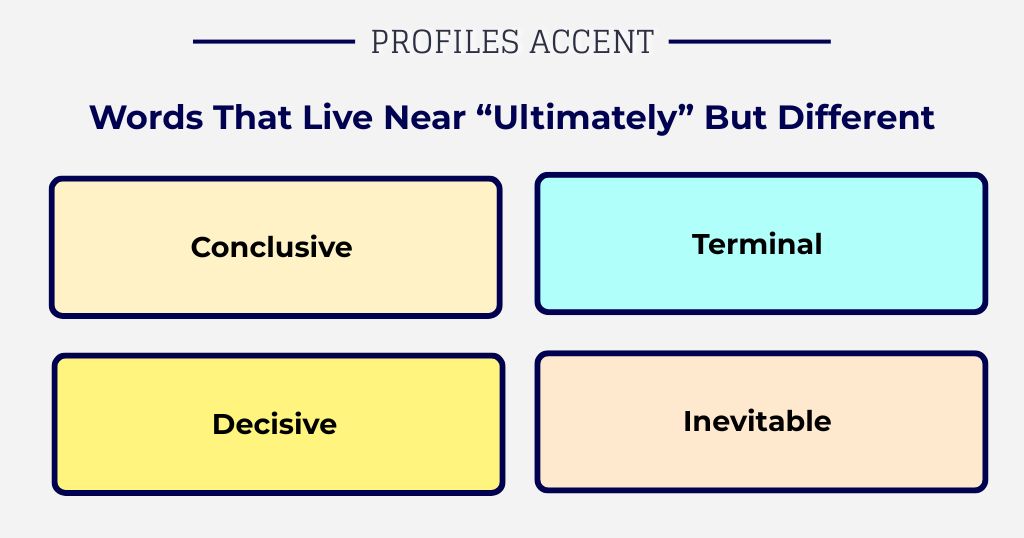
- Conclusive (adjective): Describes evidence or results that settle things definitively. The conclusive test ended the debate.
- Terminal (adjective): Points to a final stage or endpoint in a process. Less common but precise in medical or technical writing.
- Decisive (adjective): Describes a moment or factor that determined the final outcome. The decisive vote came from the smaller states.
- Inevitable (adjective/adverb form): What could not have been stopped. Slightly fatalistic in tone.
- Net result (noun phrase): The final figure or outcome after all factors cancel out. Common in finance and analysis.
Which Synonym for “Ultimately” Should You Use?
You are writing and you pause on “ultimately.” Ask yourself one question first:
Am I describing something that happens at the end of a process, or am I pointing to the deepest truth about something?
- If it is about time and sequence, reach for finally, eventually, in the end, or in the long run.
- If it is about core truth or essence, reach for fundamentally, essentially, at its core, or in essence.
- If you are writing formally or academically, prefer consequently, in the final analysis, or on balance.
- If you are writing casually, in the end or after all will almost always feel natural.
The right synonym does not just replace a word. It sharpens what you are actually saying. That is the difference between writing that reads smoothly and writing that makes people stop and reread.
Discover More Articles:

I’m Rowan, a language addict who loves exploring how words work in everyday communication. I’ve spent years studying English vocabulary and helping others express themselves more clearly. My goal is simple: make learning new words easy and practical. I focus on real-life examples that show when and how to use different terms. Through clear explanations and honest guidance, I help readers choose the right words for any situation with confidence.