You wrote “risk” three times in two paragraphs. Now you’re staring at the screen, knowing it sounds repetitive, but nothing else feels quite right. “Danger” sounds too dramatic. “Hazard” sounds like a warning sign. “Threat” points fingers at someone.
This is the problem most synonym guides never solve. They hand you a list and walk away. But picking the wrong replacement can shift your whole meaning, accidentally sound alarming, or simply feel out of place in a professional email or academic paper.
This guide goes further. It helps you understand why one word fits better than another in your specific situation.
What Risk Actually Carries
At its core, risk means the possibility that something unwanted might happen. But here is the part most people miss: risk implies a choice is involved. When someone takes a risk, they are aware of what could go wrong and they move forward anyway.
That is what separates “risk” from plain “danger.” Danger exists whether you choose it or not. Risk usually comes with decision-making attached. This small difference matters more than you might think, especially in writing where precision builds credibility.
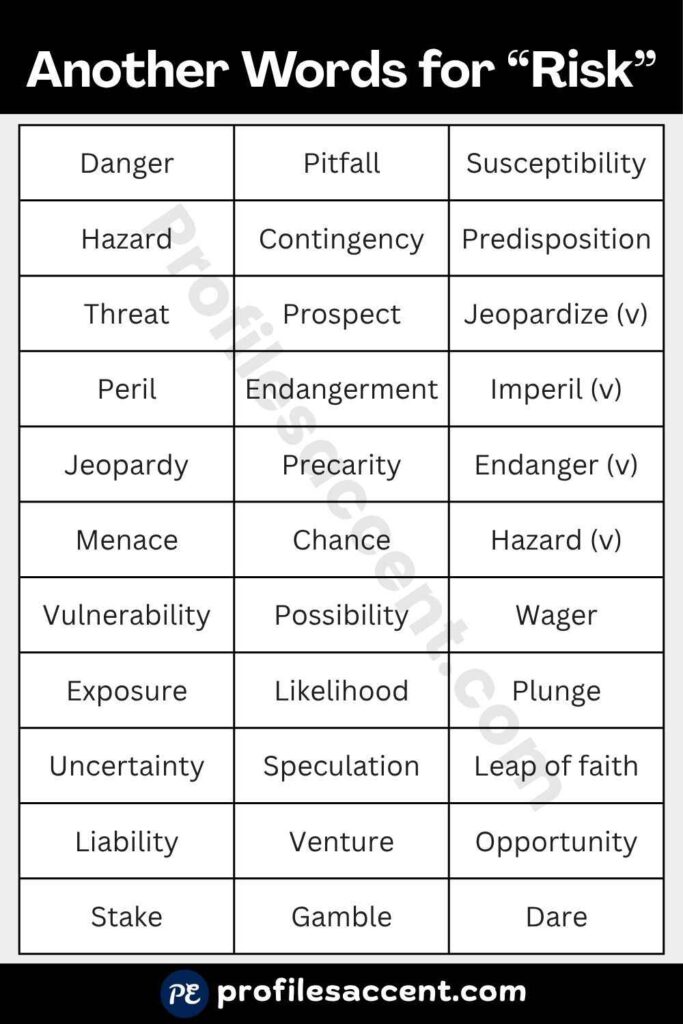
35+ Quick Risk Synonyms Table
| Word | Tone | Best Used When | Short Example |
| Danger | Serious, general | Describing a real threat with no choice implied | “The danger was immediate.” |
| Hazard | Neutral, specific | Pointing to a particular source of harm | “That loose wire is a hazard.” |
| Threat | Urgent, directional | Something aimed at someone or something | “A growing threat to the supply chain.” |
| Peril | Dramatic, formal | Literary or legal contexts, serious situations | “The crew sailed into peril.” |
| Jeopardy | Formal, legal | When something valuable is at stake | “The funding is now in jeopardy.” |
| Menace | Intense, often external | A persistent or serious source of harm | “Reckless drivers are a road menace.” |
| Vulnerability | Soft, analytical | Describing a weakness that could be exploited | “We found a vulnerability in the process.” |
| Exposure | Neutral, financial/health | Contact with a risk factor over time | “Limit your sun exposure.” |
| Uncertainty | Calm, intellectual | When outcomes are genuinely unknown | “There is uncertainty in every forecast.” |
| Liability | Professional, legal | When potential loss carries responsibility | “This clause creates a serious liability.” |
| Gamble | Casual, bold | When someone chooses to risk something big | “Starting that business was a real gamble.” |
| Venture | Positive, ambitious | A risky move with upside potential | “Their new venture paid off well.” |
| Speculation | Finance-focused | Risky decisions made for potential gain | “This is pure speculation, not strategy.” |
| Pitfall | Cautionary, practical | Hidden or easily missed dangers | “One pitfall is ignoring the fine print.” |
| Contingency | Technical, planning | A risk that may or may not occur | “Budget for every contingency.” |
| Prospect | Forward-looking | A possible future outcome (good or bad) | “The prospect of failure loomed.” |
| Endangerment | Legal, serious | Formally putting something at risk | “Child endangerment is a criminal charge.” |
| Precarity | Academic, social | A state of insecurity or instability | “The precarity of her situation was clear.” |
| Chance | Light, everyday | Informal possibility | “There is a chance things go wrong.” |
| Possibility | Open, neutral | Something that might happen | “The possibility of error exists.” |
| Likelihood | Analytical | Probability in measured terms | “The likelihood of delay is high.” |
| Susceptibility | Medical, soft | Natural tendency to be affected | “His susceptibility to stress is high.” |
| Predisposition | Medical, genetic | An existing lean toward a condition | “A genetic predisposition to migraines.” |
| Jeopardize (v) | Formal | To put something valuable at risk | “This could jeopardize our contract.” |
| Imperil (v) | Literary, strong | To place in serious danger | “The storm imperiled the whole village.” |
| Endanger (v) | Moderate, serious | To actively put something in danger | “Overwork can endanger your health.” |
| Hazard (v) | Thoughtful, careful | To attempt something uncertain | “Let me hazard a guess.” |
| Wager | Informal, bold | A risky bet or bold attempt | “He wagered his reputation on that call.” |
| Plunge | Colloquial | Committing suddenly to something risky | “She took the plunge and quit her job.” |
| Leap of faith | Figurative, warm | A trusting risk with no clear safety net | “Moving abroad was a leap of faith.” |
| Opportunity | Positive framing | When the risk points toward growth | “Every challenge carries an opportunity.” |
| Dare | Energetic, challenging | To boldly face something uncertain | “It takes courage to dare something new.” |
| Stake | Dramatic | Something at risk or on the line | “The stakes could not have been higher.” |
| Shot in the dark | Informal, playful | A risky guess with little information | “Calling that number was a shot in the dark.” |
Synonyms for Risk That Overlap But Don’t Mean the Same Thing
This is the section most skip entirely.
Danger, Hazard, or Threat: Pick One and Mean It
These three get mixed up constantly. Here is the real difference.
- Danger is a general condition. You are in danger. The danger is real. It does not point to a specific source.
- A hazard, however, is the thing causing the danger. The wet floor is the hazard. The danger is slipping.
- A threat is different again because it suggests something or someone is actively likely to cause harm. The storm is a threat. That feels more urgent than saying the storm is a hazard.
Risk vs. Peril: Not as Similar as They Look
- Peril is older, heavier, more dramatic. It belongs in literature, insurance documents, and headlines about shipwrecks.
- Risk feels more modern and neutral. In everyday writing, using peril can sound like you are narrating an adventure novel when you really just mean something could go badly.
Uncertainty vs. Precarity: A Subtle but Important Split
- Uncertainty is intellectual. It says: we do not know the outcome yet.
- Precarity is emotional and social. It says: someone is in an unstable, fragile situation that is difficult to escape.
If you are writing about financial markets, use uncertainty. If you are writing about a person’s living conditions, precarity carries more weight and care.
How Strong Is Your Risk Synonym? An Intensity Scale
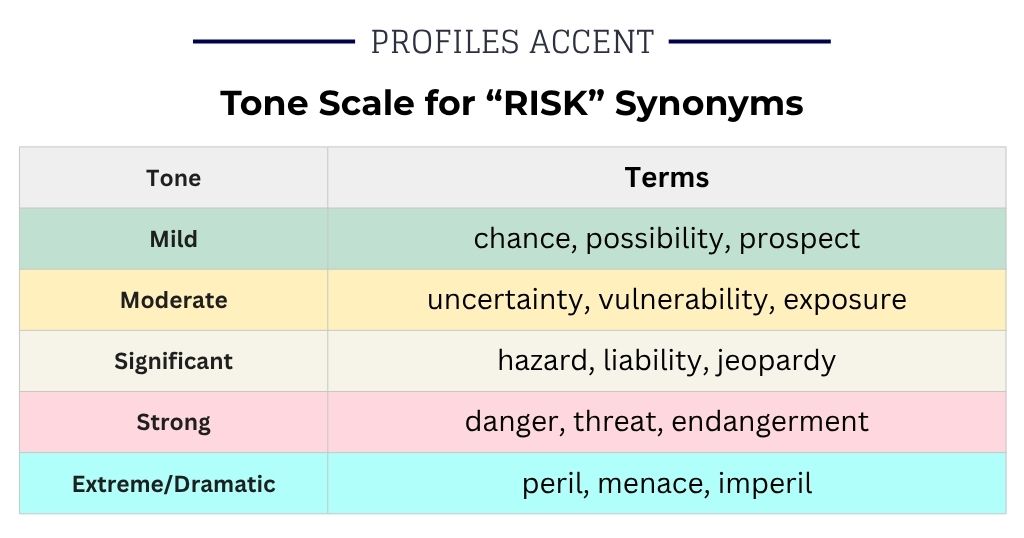
Not all risk synonyms hit at the same level. Here is how they compare by emotional weight:
- Mild: chance, possibility, prospect
- Moderate: uncertainty, vulnerability, exposure
- Significant: hazard, liability, jeopardy
- Strong: danger, threat, endangerment
- Extreme/Dramatic: peril, menace, imperil
If your sentence is calm and factual, reach for the mild tier. If you are writing about something genuinely serious, move toward the strong tier. Mismatching tone and intensity is one of the most common writing errors with these words.
Watch the Shift: Same Sentence, Different Risk Synonyms
Original: “There is a risk of project failure if we miss the deadline.”
- Formal/professional: “Missing the deadline exposes the project to significant liability.”
- Academic: “A contingency plan should account for the probability of schedule deviation.”
- Casual: “Honestly, if we miss that deadline, we are taking a real gamble here.”
- Creative: “Every missed deadline is a slow walk to the edge of a cliff.”
Each version changes how serious, emotional, or personal the situation feels. The facts stay the same. The impact on the reader shifts completely.
Original: “Climate change is a risk to coastal cities.”
- Formal: “Coastal cities face increasing vulnerability to climate-related hazards.”
- Academic: “Exposure to rising sea levels presents a measurable likelihood of infrastructure loss.”
- Casual: “Coastal cities are in serious danger if we do not act.”
- Dramatic: “Coastal cities now live under the constant menace of a warming planet.”
Another Word for Risk Depending on Your Field
Risk Synonyms in Business and Finance
Do not use “peril” in a business report. It sounds out of place. Instead, reach for:
- Liability when talking about financial or legal responsibility
- Exposure when discussing how much is on the line in an investment
- Speculation when someone is making a move with uncertain returns
- Venture when a new project carries potential upside alongside real uncertainty
Medical and Health Synonyms for Risk
Clinical writing avoids the word “risk” when something more specific is available:
- Risk factor is the standard term for something that raises the chances of a health condition
- Susceptibility shows a person’s natural weakness toward something
- Predisposition is used when family history or genetics are involved
- Exposure works when someone has been in contact with something harmful over time
Academic Synonyms for Risk in Research and Writing
Academic writing tends to prefer:
- Probability for anything measurable or statistical
- Likelihood in research findings and conclusions
- Contingency for risks that depend on certain conditions
- Vulnerability when analyzing structural or systemic weaknesses
Avoid “gamble” and “shot in the dark” in academic contexts. They undercut the credibility of your argument.
The Positive Synonym for Risk Most Writers Ignore
Most treat risk as purely negative. But in business, investing, and personal development, risk is often framed as something worth pursuing.
When you want to highlight the upside:
- Opportunity reframes the unknown as a door rather than a cliff
- Venture suggests bold action with intentional reward in mind
- Leap of faith carries warmth and trust along with uncertainty
- Dare brings energy, courage, and forward motion
If your article or pitch is meant to inspire action, these words push the reader toward yes. If you need them to be cautious, return to danger, hazard, or threat.
Common Mistakes When Swapping Synonyms for Risk
Using “peril” casually. Saying “there is some peril in this approach” in a project meeting will raise eyebrows. Peril is for serious or formal writing, not everyday conversation.
Confusing “gamble” with “chance.” A gamble involves something meaningful on the line. A chance is more casual. “He took a chance on the new vendor” is lighter than “He gambled the whole budget on an untested supplier.”
Using “danger” where “risk” fits better. Remember: risk implies agency and choice. If someone is passively caught in a bad situation, “danger” fits. If they chose to proceed despite knowing the downside, “risk” is the right word.
Overusing “vulnerability” in general writing. It is strong in technical, security, or emotional contexts. But in casual business writing, it can feel either too soft or too alarming depending on your audience.
Words That Belong Near Risk but Are Not Risk Synonyms
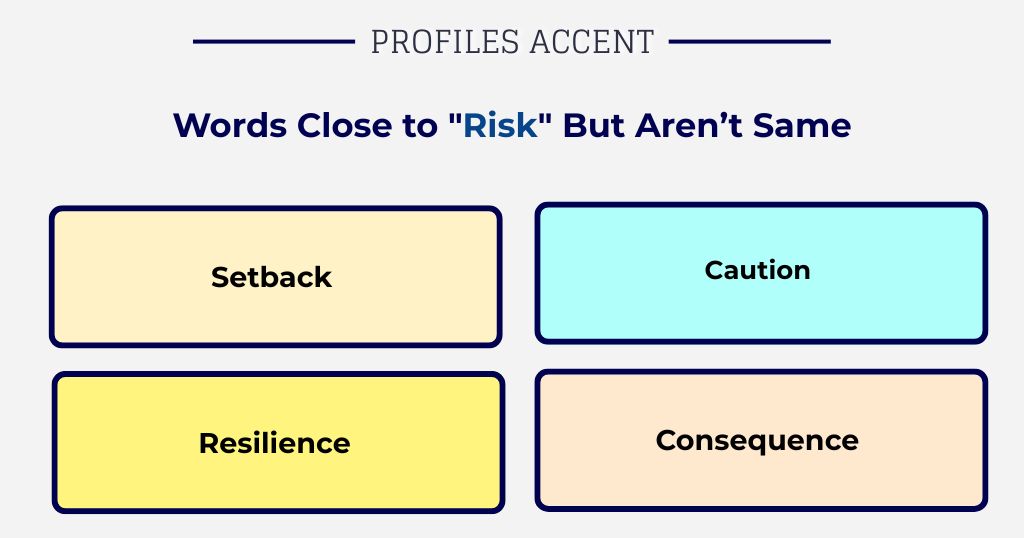
- Setback is not a synonym, but it often follows risk. When the risk happens, a setback is the result.
- Caution sits near risk but represents the response, not the thing itself.
- Resilience pairs naturally with risk in leadership and academic contexts. It is what you build to handle risk.
- Consequence is what the risk leads to if it plays out.
These four words do not replace “risk” directly, but they complete the picture around it in professional and academic writing.
Which Another Word for Risk Actually Fits Your Sentence
Here is the short version. If you are in a formal or professional setting, lean toward exposure, liability, or contingency. If you are writing something that needs emotional weight, consider peril, menace, or endangerment. For everyday clarity, danger, hazard, or chance usually work cleanest.
And when the risk is actually something to embrace? Reach for venture, opportunity, or leap of faith. Because sometimes the best writing does not just describe the risk. It convinces someone to take it.
Discover More Articles:

I’m Rowan, a language addict who loves exploring how words work in everyday communication. I’ve spent years studying English vocabulary and helping others express themselves more clearly. My goal is simple: make learning new words easy and practical. I focus on real-life examples that show when and how to use different terms. Through clear explanations and honest guidance, I help readers choose the right words for any situation with confidence.