You already know the feeling. You finish a sentence, reread it, and something feels off. The word “especially” is sitting there, doing its job, but it sounds tired. Flat. Like you’ve used it three times in the same paragraph without noticing.
That’s not a grammar problem. It’s a word-choice problem. And the fix isn’t just swapping in any synonym. It’s knowing which word fits the moment.
This guide breaks down real alternatives, not just a list you’ll forget. You’ll learn when to use each one, what feeling it creates, and where it can go wrong.
What “Especially” Is Actually Doing in Your Sentence
At its core, “especially” does one of two jobs. It either singles something out from a group (“I love all vegetables, especially broccoli”) or it pushes the intensity of a feeling higher (“She was especially nervous before the interview”).
That distinction matters. Because not every synonym can do both jobs. Choosing the wrong one shifts the meaning without you realizing it.
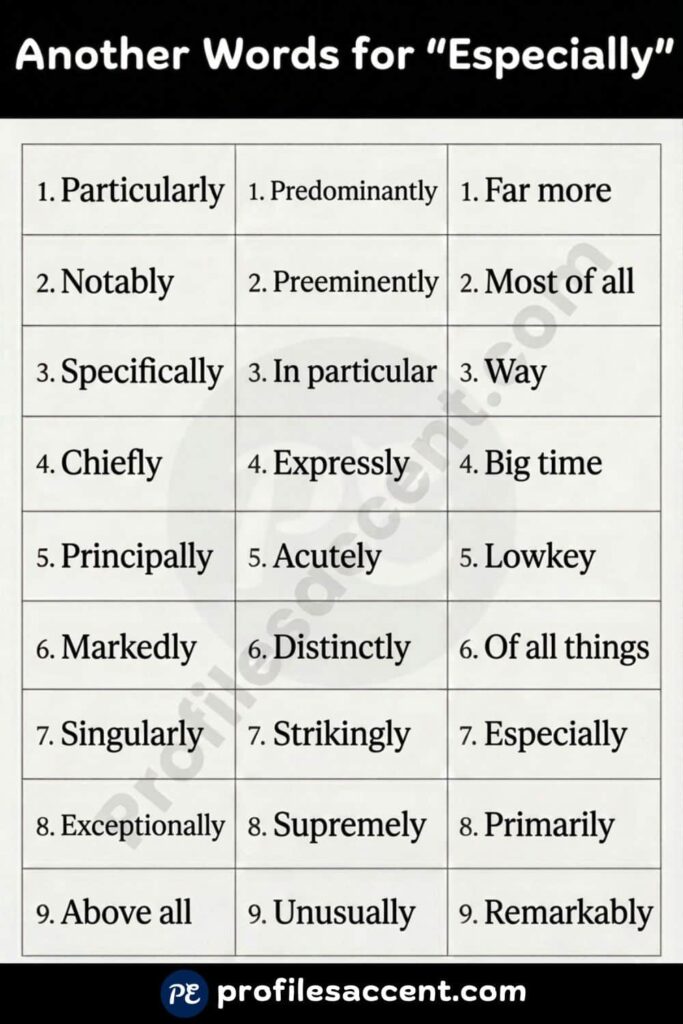
Another Word for Especially: Quick Table of 22+ Synonym
| Word | Tone | Best For | Quick Example |
| Particularly | Neutral | Most writing contexts | Particularly useful in cold weather |
| Notably | Formal | Highlighting standout facts | Notably, the results improved |
| Specifically | Precise | Narrowing down details | Designed specifically for beginners |
| Chiefly | Formal | Stating the main reason | Chiefly used in research labs |
| Principally | Formal/Academic | Primary focus or cause | Principally driven by cost |
| Markedly | Neutral | Visible change or difference | Markedly better than last year |
| Singularly | Literary | One-of-a-kind quality | Singularly focused on the goal |
| Exceptionally | Neutral/Formal | High degree of quality | Exceptionally well written |
| Above all | Formal/Speech | Closing emphasis in a list | Above all, stay honest |
| Predominantly | Neutral | What mostly applies | Predominantly used in cities |
| Preeminently | Elevated | Stands above everything else | Preeminently the best option |
| In particular | Neutral | Calling out one item | In particular, the third chapter |
| Expressly | Formal | Done for a clear purpose | Expressly written for teachers |
| Acutely | Neutral | Sharp emotional intensity | Acutely aware of the tension |
| Distinctly | Neutral | A clear and obvious degree | Distinctly different in approach |
| Strikingly | Neutral/Creative | Something that grabs attention | Strikingly similar to the original |
| Supremely | Strong | Very high degree | Supremely confident on stage |
| Unusually | Neutral | Something outside the norm | Unusually quiet for a Monday |
| Far more | Casual | Comparative emphasis | Far more effective than expected |
| Most of all | Casual | Personal preference or feeling | Most of all, I missed the food |
| Way (slang) | Informal | Casual speech only | That was way harder than I thought |
| Big time (slang) | Informal | Spoken/text only | I messed up, big time |
| Lowkey | Modern slang | Gen Z/informal digital speech | It’s lowkey cold today |
| Of all things | Conversational | Surprising emphasis | He missed it, of all things |
Two Jobs, Two Synonym Sets
Most people treat these synonyms as interchangeable. They’re not. Here’s why.
When You Mean Intensity
You’re saying something is more than average. More than expected. Words like exceptionally, markedly, acutely, and singularly work here. They all push something upward on a scale.
“She was acutely aware of every sound in the room.” That word “acutely” signals sharpness, alertness, a heightened state. You couldn’t swap in “specifically” there. It would break the sentence.
When You Mean “This One in Particular”
You’re picking one thing from a larger set. Words like particularly, notably, in particular, and specifically live here. They point a finger at one item and say: this one matters more.
“He struggled with most subjects, particularly math.” Here, “particularly” works. “Exceptionally” would not.
Knowing which job you need done solves half the problem before you even open a thesaurus.
How Strong Do You Need to Go? A Tone Scale
Some synonyms carry more weight than others. If you place them on a scale from mild to extreme, this is roughly how it looks:
- Mild: predominantly, mainly, chiefly
- Moderate: particularly, notably, in particular, distinctly
- Strong: markedly, exceptionally, acutely, strikingly
- Extreme: supremely, preeminently, singularly, above all
Using a word that’s too heavy for your sentence sounds dramatic. Using one that’s too light makes your point land softly. Match the word to the weight of your idea.
Watch What Happens When You Swap the Word
Here’s how word choice reshapes the same sentence across different tones.
Original: “The report was especially useful.”
- Formal: “The report proved particularly valuable in assessing the data.”
- Academic: “The findings were notably significant within the scope of the study.”
- Creative: “That report? Strikingly useful. Better than anything else on the shelf.”
- Casual: “Honestly, the report was way more useful than I expected.”
Each version says the same thing. But the reader feels something different every time.
Original: “She was especially good with kids.”
- Professional email: “She works exceptionally well with young learners.”
- Storytelling: “Children just seemed to trust her. Singularly good at putting them at ease.”
- Casual text: “She’s lowkey amazing with kids.”
The idea stays intact. The tone shifts completely.
Where Each Alternative to “Especially” Actually Belongs
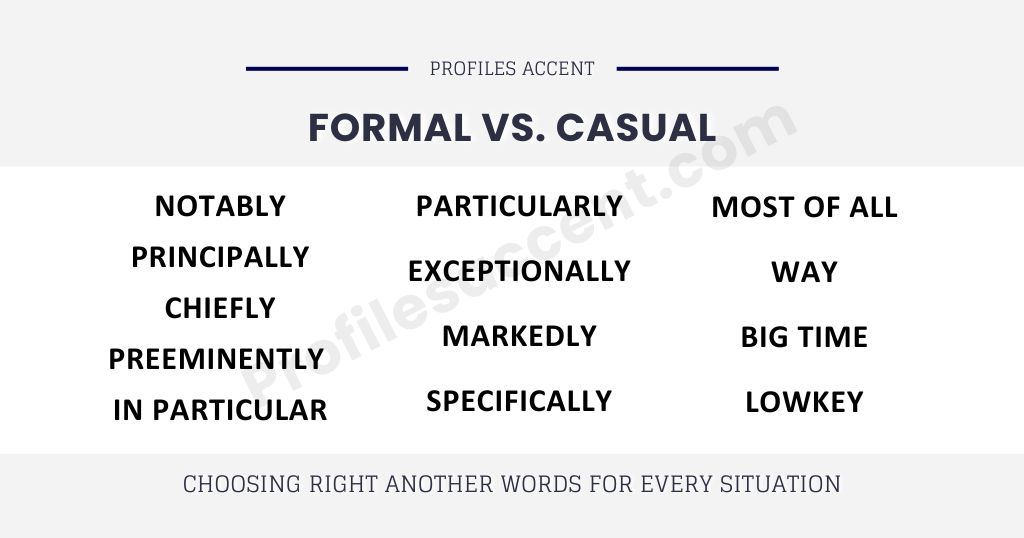
For essays and research writing, use: notably, principally, chiefly, preeminently, in particular, expressly. These carry academic weight and won’t feel out of place next to technical language.
For professional emails, use: particularly, exceptionally, markedly, specifically. Clean, confident, and professional without sounding stiff.
For creative writing and storytelling, try: singularly, acutely, strikingly, distinctly, above all. These carry emotional texture and rhythm.
For casual conversation or social media, use: most of all, way, big time, lowkey, far more. Save these strictly for informal contexts. “Lowkey” in a cover letter is a red flag. “Notably” in a text message sounds like a robot.
Specially or Especially? They Are Not the Same Word
This one trips up even careful writers. They look similar. They are not the same.
Specially describes purpose. It answers the question: why was this made or done? “The course was specially designed for night-shift workers.”
Especially describes degree or highlights one thing among many. “The night-shift schedule is especially hard in winter.”
Swapping them creates a subtle meaning error that readers notice even if they can’t explain why.
Mistakes People Make When Replacing “Especially”
Using “most especially”: This phrase exists, but most grammar guides flag it as wordy. “Above all” or simply “especially” says the same thing in fewer words.
Placing the word in the wrong spot: When “particularly” or any of its cousins modifies a verb, it goes before the verb, not after it.
Correct: “He particularly enjoys long walks.” Awkward: “He enjoys particularly long walks.” (Now it means unusually long, not that he enjoys them more.)
Choosing “specifically” when you mean “exceptionally”: Specificity and intensity are not the same emotion. “She was specifically tired” sounds like a robot. “She was exceptionally tired” actually communicates something real.
Overusing “notably” in casual writing: It’s a formal word. In an email to a friend, “notably, the pizza was cold” sounds unnatural and slightly odd.
Another Word for Especially Important (This One Needs Its Own Answer)
When people search for another word for “especially important,” they often land on vague answers. Here’s something more useful.
The word you need depends on what kind of importance you mean.
- If something will cause failure without it: use crucial or vital
- If it ranks above everything else: use paramount
- If it changes the direction of something: use pivotal
- If it carries the most weight in a decision: use decisive
Saying “especially vital” is fine. But often, just picking the right single adjective does the job better than stacking two words together.
Words That Live in the Same Neighborhood
Predominantly: Overlaps with “mainly” but suggests a large percentage, not just priority. Good when something is true for most of a group.
Acutely: Has a physical and emotional edge. Often used with awareness, pain, or sensitivity. More intense than “particularly.”
Distinctly: Good when you want to highlight a difference rather than a preference. “Distinctly uncomfortable” works better than “especially uncomfortable” in some literary contexts.
Expressly: Useful when something was done intentionally for a reason. Carries a legal or formal flavor.
Strikingly: Best when something visually or mentally stands out. Adds a sense of surprise to the emphasis.
Above all: Technically a phrase, not one word. But it earns its place here because it replaces “especially” powerfully at the end of a list or argument. It signals: this one matters most.
So Which Synonym for “Especially” Should You Use?
Before you replace “especially,” ask yourself one question: am I picking something out from a group, or am I saying something is more intense than usual?
If you’re singling something out, go with particularly, notably, or in particular.
If you’re pushing intensity, try exceptionally, markedly, or acutely.
If you’re writing formally, stay away from lowkey and big time. If you’re texting a friend, skip preeminently.
Word choice is not about sounding smart. It’s about making your reader feel exactly what you intended. Get that right, and the synonym almost picks itself.
Discover More Articles:

I’m Rowan, a language addict who loves exploring how words work in everyday communication. I’ve spent years studying English vocabulary and helping others express themselves more clearly. My goal is simple: make learning new words easy and practical. I focus on real-life examples that show when and how to use different terms. Through clear explanations and honest guidance, I help readers choose the right words for any situation with confidence.