You’ve written a solid paragraph. The ideas are good. But when you read it back, you notice it. “Also” appears three times. Then a fourth. Suddenly your writing feels flat, like someone reading a grocery list out loud.
The fix isn’t just grabbing any synonym. The real problem is picking the wrong replacement and making things worse. “Moreover” dropped into a casual email sounds stiff. “Plus” sitting inside a research paper sounds lazy. Word choice is not just about meaning. It’s about fit.
This guide gives you the right word for the right moment, not just a list to skim.
What “Also” Is Really Doing in Your Sentence
“Also” is an adverb. It signals addition. It tells the reader: there’s more, and it connects to what I just said. That’s its whole job.
It carries no emotion. It has no strong opinion. It’s neutral, which is both its strength and its weakness. Neutral gets boring fast.
Quick 30+ Synonyms for Also By Tone and Context
| Word | Tone | Best Used When | Example |
| Additionally | Formal | Professional emails, reports | Additionally, the report covers Q3 data. |
| Furthermore | Formal | Essays, adding weight to a point | Furthermore, the results were consistent. |
| Moreover | Formal | Making a stronger follow-up point | Moreover, this affects all departments. |
| Besides | Casual | Adding an extra reason or thought | Besides, we already have enough. |
| Too | Casual | End of a sentence | I’d like to come too. |
| As well | Casual | End of a sentence | She wants a copy as well. |
| Plus | Informal | Quick adds, team messages | Plus, it saves us time. |
| On top of that | Conversational | Stacking advantages or problems | On top of that, shipping is free. |
| Likewise | Comparative | Drawing a parallel | Likewise, the second test passed. |
| Similarly | Comparative | Showing resemblance | Similarly, other teams noticed this. |
| Equally | Balanced | Giving equal weight to a point | Equally, safety must be considered. |
| In addition | Neutral | Formal lists, documents | In addition, three files are attached. |
| Correspondingly | Academic | Linking matched ideas | Correspondingly, costs went down. |
| Along with | Connective | Joining items or ideas | Along with the invoice, I’ve sent the receipt. |
| Coupled with | Connective | Pairing two related things | Coupled with strong sales, morale improved. |
| Not only that | Emphatic | Building excitement or surprise | Not only that, she won three awards. |
| To boot | Informal | Fun or light writing | It was cheap and stylish to boot. |
| Withal | Archaic/Formal | Crossword clues, old-style writing | A wise and withal humble leader. |
| Either | Negative context | Agreeing in negative sentences | I didn’t go, and she didn’t either. |
| Included | Neutral | Lists and documents | Included is the signed agreement. |
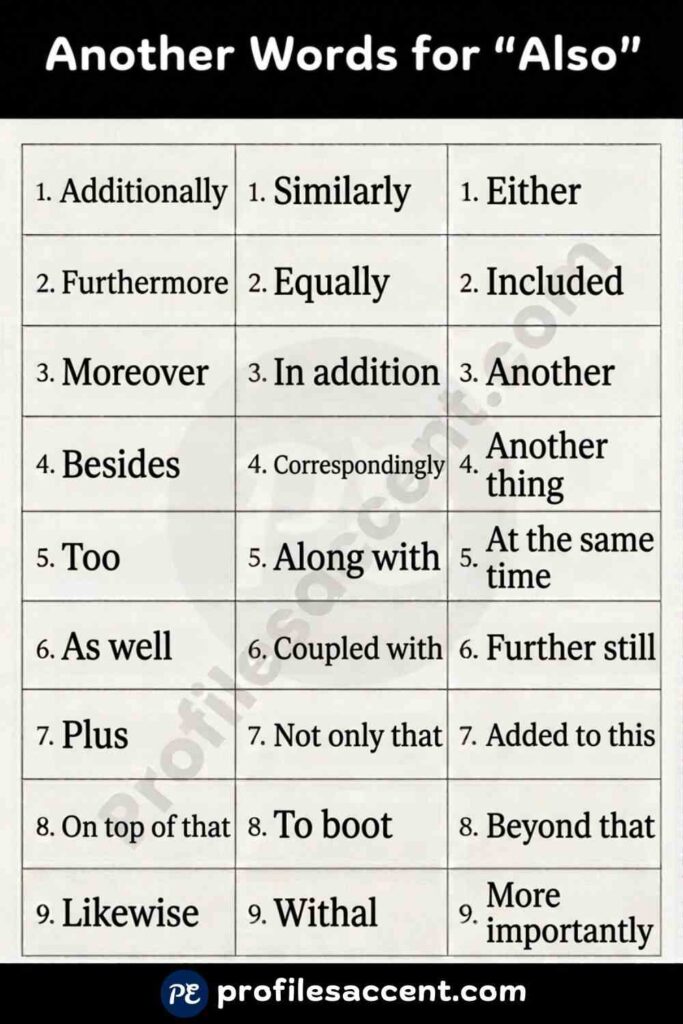
Another Word for Also Based on What You’re Trying to Say
Synonym for Also When You’re Building a Point
Some words do more than add. They push your argument forward.
Furthermore keeps the same line of thinking going. You’re adding another brick to the same wall. Use it when the next sentence supports the same point, not a new one.
Moreover goes one step further. It says: not only is this true, but here’s something even stronger. If “furthermore” is adding evidence, “moreover” is delivering the punchline.
In addition is the safe, clean choice. No drama. No implication. Just: here’s another thing.
Another Word for Also in an Email or Casual Message
Emails to colleagues, texts, internal messages, these need a different feel.
Plus works great here. It’s quick, warm, and reads naturally. “The meeting got moved, plus the agenda changed” sounds like a real person wrote it.
On top of that adds some personality. It fits when you’re stacking items, good or bad. “The project ran over budget, and on top of that, the deadline shifted.”
Too and as well belong at the tail end of a sentence. Don’t move them to the front. “I enjoyed the presentation too” works. “Too, I enjoyed the presentation” does not.
Synonym for Also When You’re Comparing Two Things
Likewise and similarly are often used interchangeably, but they’re slightly different. “Likewise” usually mirrors an action: you do this, and I do the same. “Similarly” describes a situation that resembles another one.
Equally carries balance. It tells the reader: this next point deserves the same attention as the last one. It’s especially useful in persuasive writing.
The Placement Rule Nobody Talks About
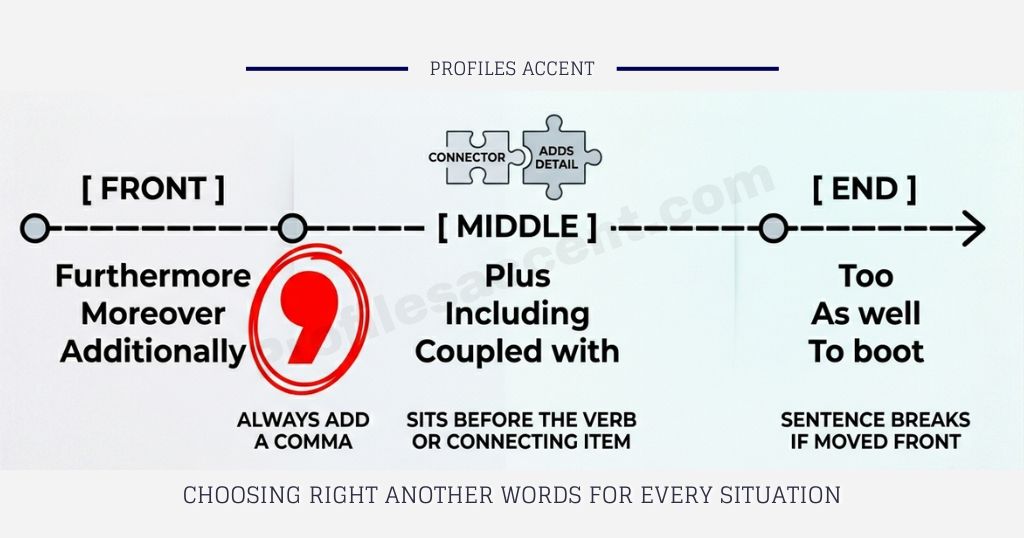
This is where writers quietly go wrong. The synonym sounds right in your head, but it lands awkwardly on the page. Here’s why: each word has a preferred position in a sentence.
- Front of the sentence: Furthermore, Moreover, Additionally, In addition, Correspondingly. Always follow these with a comma.
- Middle of the sentence: Also, plus, including, along with, coupled with. These sit right before the verb or the item they’re connecting.
- End of the sentence: Too, as well, to boot, either (in negative contexts). Move these to the front and the sentence breaks.
Quick example. “She handles design as well” reads fine. “As well, she handles design” reads strange. Small difference, big impact on flow.
How to Drop “Also” Completely and Rewrite the Sentence
Sometimes the best fix is removing “also” entirely and rebuilding the sentence around a stronger verb. This is the upgrade most writers don’t consider.
Original: The app also has a dark mode feature.
- Rewrite (formal): The app includes a dark mode feature built for low-light use.
- Rewrite (casual): Dark mode is in there too, which is a nice touch.
- Rewrite (action-driven): The app incorporates dark mode alongside its core tools.
Original: She also writes the weekly newsletter.
- Rewrite (professional): She manages the weekly newsletter in addition to her primary duties.
- Rewrite (conversational): Plus, she writes the newsletter every week.
- Rewrite (vivid): Beyond her main role, she crafts the newsletter that goes out every Friday.
Notice how the verb does the work now. You don’t need “also” when the sentence structure itself shows addition.
Another Word for Also Starting with E (Solved)
This is one of the most searched puzzles around this topic, and most sites answer it badly.
Equally is your cleanest option. “Equally, the economic factors deserve attention.” It starts with E, reads naturally, and works at the front of a sentence.
Either works only in negative constructions. “He didn’t apply, and she didn’t either.” It fits a very specific pattern.
There is no common, everyday synonym for “also” that starts with E and ends with R. If you’ve seen that puzzle, the answer people often land on is “either” or they’re thinking of a structural word like “further” which begins with F but sounds similar in speech.
Synonym for Also Known As: A Separate Case
When “also” appears inside the phrase “also known as,” it shifts meaning. You’re no longer adding a point. You’re naming an alternative identity.
Better options for this specific use:
- Alias works for people or characters. “The author, alias A.K. Fields, published under that name for a decade.”
- Otherwise fits objects, theories, or concepts. “The compound, otherwise called baking soda, reacts with acid.”
- Alternatively called is clean and professional. “The region, alternatively called the Gulf Coast, spans several states.”
Don’t use “furthermore” or “moreover” here. They belong to logical addition, not labeling.
Common Mistakes When Swapping Out Also
Using “moreover” for minor points. “Moreover” carries weight. Using it to add a small detail feels like arriving in a tuxedo to pick up takeout. Save it for points that actually strengthen your argument.
Dropping “furthermore” into casual writing. It will make your email read like a legal brief. Stick to “additionally” or “plus” depending on your register.
Piling up synonyms in one paragraph. Switching from “also” to “moreover” to “additionally” to “furthermore” in the same section doesn’t solve the problem. It just hides it. Space your transitions out.
Treating “too” as flexible. It’s not. It belongs at the end. Most readers will feel the jolt if you put it anywhere else.
Another Word for Also with 6 Letters (Crossword Answer)
If you’re stuck on a crossword clue asking for “also” in six letters, the answer is WITHAL. It’s an old-fashioned adverb meaning “in addition” or “as well.” You won’t use it in daily writing, but it solves the grid.
Related Words Worth Adding to Your Writing Toolkit
- Beyond that signals you’re moving past what was already said, not just adding to it.
- Aside from that introduces something slightly off the main track.
- What’s more is punchy and conversational, good for emphasis without formality.
- Including works when “also” is introducing a member of a group, not a separate idea.
Each of these fills a slightly different gap. Knowing which gap you’re in helps you pick the right one.
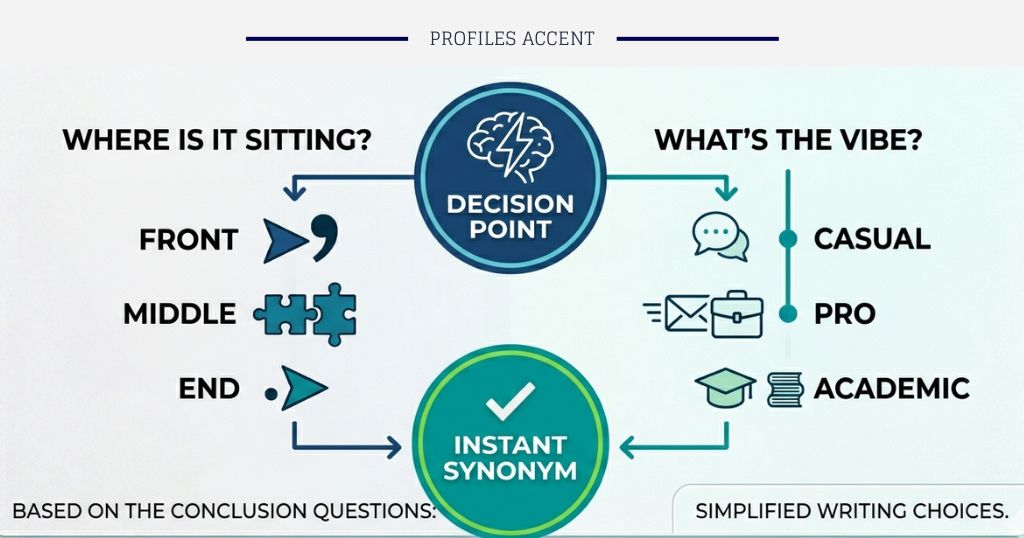
How to Choose the Right Also Synonym Without Overthinking It
Before you swap “also” for something else, ask yourself two things. First: where is the word sitting in the sentence? Front, middle, or end? Second: what kind of writing is this? Academic, casual, professional, or creative?
Those two answers alone will eliminate most wrong choices. The table above covers the rest. Good word choice isn’t about sounding smarter. It’s about being clearer, and making the reader feel like the writing was made for them.
Discover More Articles:

I’m Rowan, a language addict who loves exploring how words work in everyday communication. I’ve spent years studying English vocabulary and helping others express themselves more clearly. My goal is simple: make learning new words easy and practical. I focus on real-life examples that show when and how to use different terms. Through clear explanations and honest guidance, I help readers choose the right words for any situation with confidence.