Picture this: you’re writing a message to a friend after a frustrating day. You type “I’m so mad.” Then you pause. It feels flat. Too simple. Almost childlike. But nothing better comes to mind, so you leave it.
That’s the problem with “mad.” It’s one of those words that gets used for everything. You’re mad at your boss. You’re mad about that new TV show. Your neighbor thinks you’re mad for starting a garden on your balcony. Three completely different meanings, one tired word.
Word choice shapes how people feel when they read you. Swap “mad” for the right alternative, and your writing suddenly has weight, color, and precision.
What Does “Mad” Actually Cover?
“Mad” carries at least four distinct meanings depending on context. It can describe anger, mental instability, deep enthusiasm, or reckless foolishness. Its emotional weight ranges from playfully light to seriously intense. That’s exactly why replacing it requires thought, not just a thesaurus click.
Another Word for Mad: 30+ Synonyms at a Glance
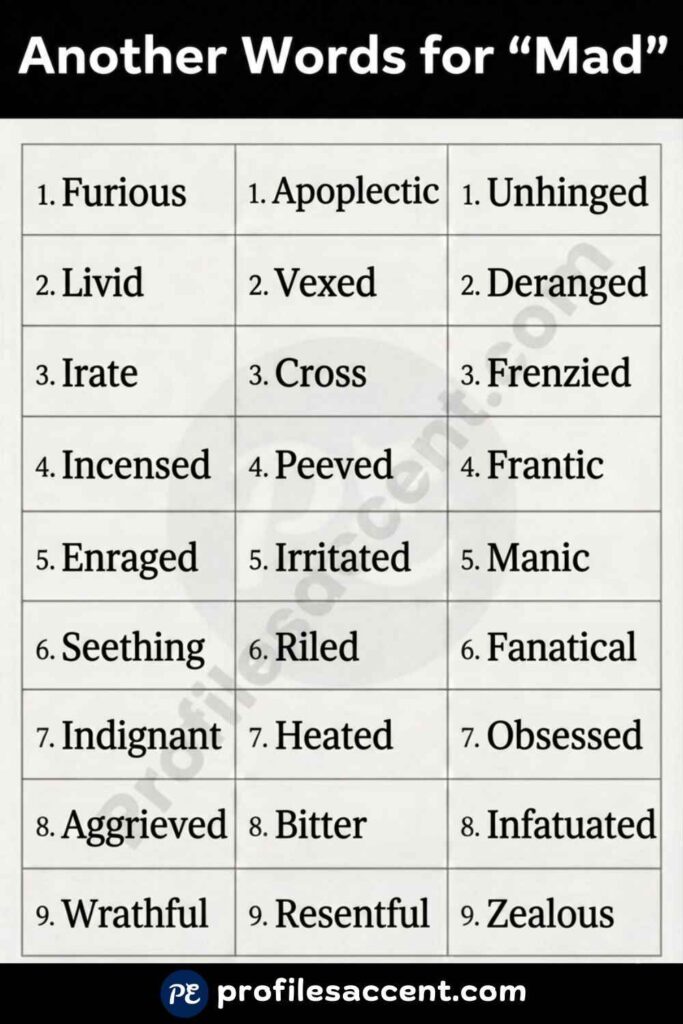
| Word | Tone | Best Used When | Example |
| Furious | Strong/Formal | Serious, visible rage | “She was furious after the betrayal.” |
| Livid | Extreme/Formal | Controlled but explosive anger | “He was livid when the deal collapsed.” |
| Irate | Formal | Complaints, professional conflict | “The irate customer demanded a refund.” |
| Incensed | Formal/Literary | Righteous or provoked anger | “She was incensed by the unfair ruling.” |
| Enraged | Strong | Loss of emotional control | “The crowd grew enraged.” |
| Seething | Quiet/Intense | Hidden, boiling anger | “He sat seething in the back row.” |
| Indignant | Formal | Feeling wronged or disrespected | “She gave an indignant reply.” |
| Aggrieved | Formal | Feeling victimized | “He felt aggrieved by the decision.” |
| Wrathful | Literary/Archaic | Storytelling, dramatic writing | “The wrathful king issued a decree.” |
| Apoplectic | Extreme/Vivid | Over-the-top rage | “The director was apoplectic at the delay.” |
| Vexed | Mild/Formal | Mild frustration, polite context | “She was vexed by the constant interruptions.” |
| Cross | Mild/British | Everyday irritation, UK tone | “He was cross about missing the bus.” |
| Peeved | Mild/Casual | Minor annoyance | “She was peeved he forgot again.” |
| Irritated | Neutral/Mild | Low-level frustration | “He was irritated by the noise.” |
| Riled | Casual | Someone pushed into anger | “That comment really riled her up.” |
| Heated | Casual/Neutral | Arguments, debates | “The conversation got heated quickly.” |
| Bitter | Emotional | Long-held resentment | “He grew bitter after years of being overlooked.” |
| Resentful | Emotional | Suppressed, ongoing anger | “She was resentful of the praise others received.” |
| Unhinged | Literary/Informal | Erratic, unstable behavior | “The villain seemed completely unhinged.” |
| Deranged | Literary/Strong | Extreme psychological instability | “The plot featured a deranged character.” |
| Frenzied | Vivid/Neutral | Wild activity or chaotic state | “It was a frenzied rush to the finish.” |
| Frantic | Neutral | Hurried, anxious chaos | “She was frantic trying to meet the deadline.” |
| Manic | Medical/Casual | Intense, uncontrolled energy | “His manic energy exhausted everyone around him.” |
| Fanatical | Neutral/Positive | Deep enthusiasm | “He is fanatical about vintage motorcycles.” |
| Obsessed | Neutral | Strong fixation on something | “She is obsessed with true crime podcasts.” |
| Infatuated | Positive | Strong admiration or love | “He was completely infatuated with the idea.” |
| Zealous | Formal/Positive | Passionate dedication | “She was zealous about environmental causes.” |
| Foolhardy | Neutral/Negative | Reckless decisions | “It was foolhardy to invest everything at once.” |
| Absurd | Neutral | Describing senseless behavior | “That plan sounds completely absurd.” |
| Preposterous | Formal/Emphatic | Rejecting a ridiculous idea | “The suggestion was utterly preposterous.” |
| Daft | Informal/British | Light foolishness | “Don’t be daft, it was just a joke.” |
| Bonkers | Casual/Playful | Silly or chaotic situations | “The whole situation was absolutely bonkers.” |
| Nuts | Casual | Disbelief or craziness | “You think I’ll agree to that? You’re nuts.” |
Four Ways “Mad” Works (And Why Your Synonym Choice Depends on It)
Getting the right synonym starts with knowing which version of “mad” you’re actually using.
Mad as anger is the most common modern meaning. Someone cut you off in traffic. Your teammate missed the deadline. A politician said something infuriating. This is the “mad” most writers reach for first.
Mad as instability is the older, literary meaning. Think classic novels, dramatic characters, gothic fiction. Words here like unhinged or deranged carry serious weight and should be used carefully, especially when writing about real people.
Mad as enthusiasm is the one people forget. “She’s football mad.” “He’s gone completely mad about sourdough baking.” Here, “mad” is almost affectionate. Synonyms like fanatical, obsessed, or infatuated keep that warmth intact.
Mad as foolishness describes decisions more than emotions. “That’s a mad plan.” Reach for absurd, reckless, or preposterous here.
Intensity Scale for Mad Synonyms: From Annoyed to Apoplectic
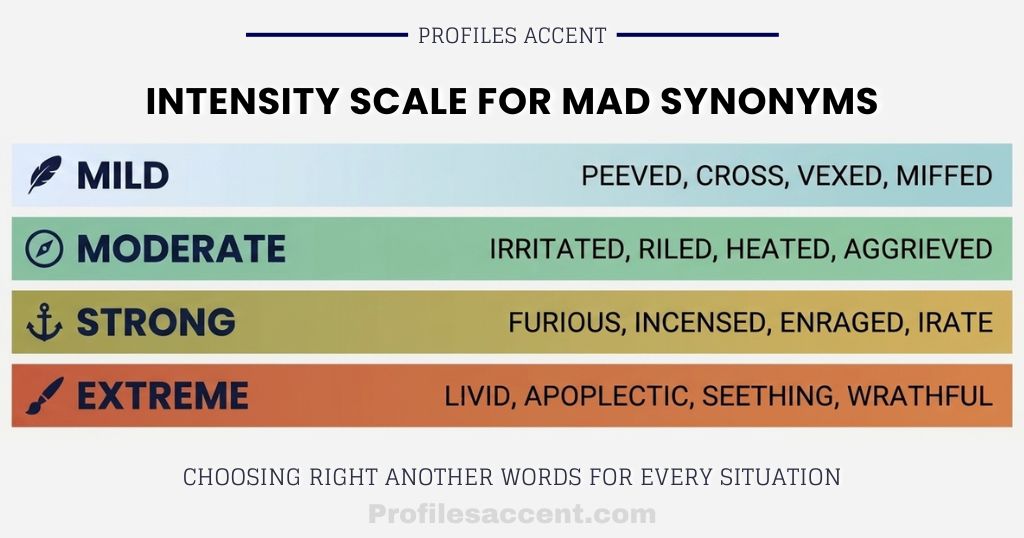
Not all anger is equal. Here’s how the words stack up in terms of emotional heat:
- Mild: Peeved, Cross, Vexed, Miffed
- Moderate: Irritated, Riled, Heated, Aggrieved
- Strong: Furious, Incensed, Enraged, Irate
- Extreme: Livid, Apoplectic, Seething, Wrathful
The gap between vexed and apoplectic is enormous. One sounds like a raised eyebrow. The other sounds like someone about to flip a table. Picking the wrong intensity ruins the tone of an entire paragraph.
Watch How Mad Synonyms Reshape the Same Sentence
Here’s how swapping one word reshapes the entire sentence:
Original: “She was mad when she found out.”
- Formal: “She was incensed upon discovering the truth.”
- Casual: “She was absolutely riled when she found out.”
- Storytelling: “A quiet, seething fury settled over her.”
- Professional email: “I was quite displeased to learn of this outcome.”
Original: “He’s mad about cars.”
- Enthusiastic/Casual: “He’s completely obsessed with cars.”
- Warm and vivid: “Cars are his one true passion.”
- Formal: “He holds a deep, fanatical interest in automobiles.”
The base information doesn’t change. But the reader’s experience does, completely.
Mad Synonyms for Formal vs. Casual Writing: What Goes Where
Some of these synonyms belong in specific settings only.
- For formal writing or professional emails: irate, incensed, indignant, aggrieved, displeased, vexed. These carry weight without sounding aggressive or unprofessional.
- For storytelling and creative writing: livid, seething, wrathful, frenzied, unhinged, apoplectic. These are vivid and dramatic, perfect for building emotional scenes.
- For casual conversation or dialogue: riled, peeved, cross, heated, bonkers, nuts. They feel natural in speech and relaxed writing.
Words to avoid in formal contexts: bonkers, nuts, ballistic, losing it. These belong in casual dialogue only. Dropping them into a business report or academic paper reads as unprofessional.
When Some Mad Synonyms Deserve a Second Thought
Several historical synonyms for “mad” in the mental instability sense, such as lunatic, maniac, and imbecile, were once used as clinical medical terms. Today, they’ve shifted into slang territory, and using them to describe actual people with mental health conditions is considered harmful and disrespectful.
When writing fiction or using these words metaphorically, the context usually makes intent clear. But describing a real person as “deranged” or “unhinged” in a news article or public post carries real consequences. Use them thoughtfully.
Similarly, the slang use of “mad” as an intensifier, as in “that concert had mad energy,” comes from Black American vernacular and carries cultural roots. Borrowing it casually without awareness of that history is worth a moment’s thought.
Three Mistakes Writers Make When Replacing “Mad”
Confusing seething with furious. Furious is loud and explosive. Seething is quiet and contained. A character who speaks calmly but grips the table edge isn’t furious. They’re seething. Mixing these two kills the mood of a scene.
Using “livid” too casually. It’s one of the strongest anger words in English. Dropping it on a situation like “she was livid her coffee got cold” drains its power entirely. Save it for moments that actually justify that level of heat.
Swapping “indignant” for “angry.” Indignant has a specific flavor. It’s anger rooted in injustice or disrespect, not just frustration. Someone who lost their keys might be annoyed. Someone falsely accused of something is indignant. The distinction matters.
Words Related to Mad
- Antagonized: Pushed or provoked into anger by someone’s deliberate actions. Slightly different from just “mad” because it implies the other person caused it on purpose.
- Choleric: An older term meaning quick to anger by nature, a personality trait rather than a reaction to one specific event.
- Turbulent: Describes a chaotic mental or emotional state, useful when the situation itself feels unstable rather than any one person.
- Disgruntled: That low-level, ongoing dissatisfaction. Not explosive, just chronically unhappy about something. Think employees, not explosions.
- Rabid: In its truest sense, this is the closest synonym to the original use of “mad” meaning afflicted with rabies. In figurative use, it describes extreme, almost irrational intensity: “a rabid fan base.”
So Which Other Words for Mad Actually Fits Your Sentence?
Ask yourself two questions before you choose a synonym. First, how intense is this emotion on a scale of mild irritation to full rage? Second, what kind of writing is this sitting inside?
A character in a novel can be wrathful. A customer complaint email calls for displeased. A text to a friend can absolutely say riled or peeved.
The right word doesn’t just mean the same thing. It creates the right feeling in whoever is reading. That’s the real job of a synonym.
Discover More Articles:

I’m Rowan, a language addict who loves exploring how words work in everyday communication. I’ve spent years studying English vocabulary and helping others express themselves more clearly. My goal is simple: make learning new words easy and practical. I focus on real-life examples that show when and how to use different terms. Through clear explanations and honest guidance, I help readers choose the right words for any situation with confidence.