You probably don’t notice how often you write the word “having.” It slips into sentences quietly. “I am having a hard time.” “She is having a meeting.” “The report is having errors.” Read those back. Something feels flat, right?
That flatness comes from a word doing too much work. “Having” covers possession, experience, emotion, and description all at once. When one word carries that much weight, your writing loses sharpness. Readers feel it, even if they can’t name it.
The fix is not complicated. It just requires knowing which word to use when.
What “Having” Is Really Doing in Your Sentence
At its core, “having” signals that something belongs to, is happening to, or is part of someone or something. It can describe ownership, an ongoing experience, or a feature. The tone is neutral. It carries no strong emotion. That is both its strength and its biggest weakness.
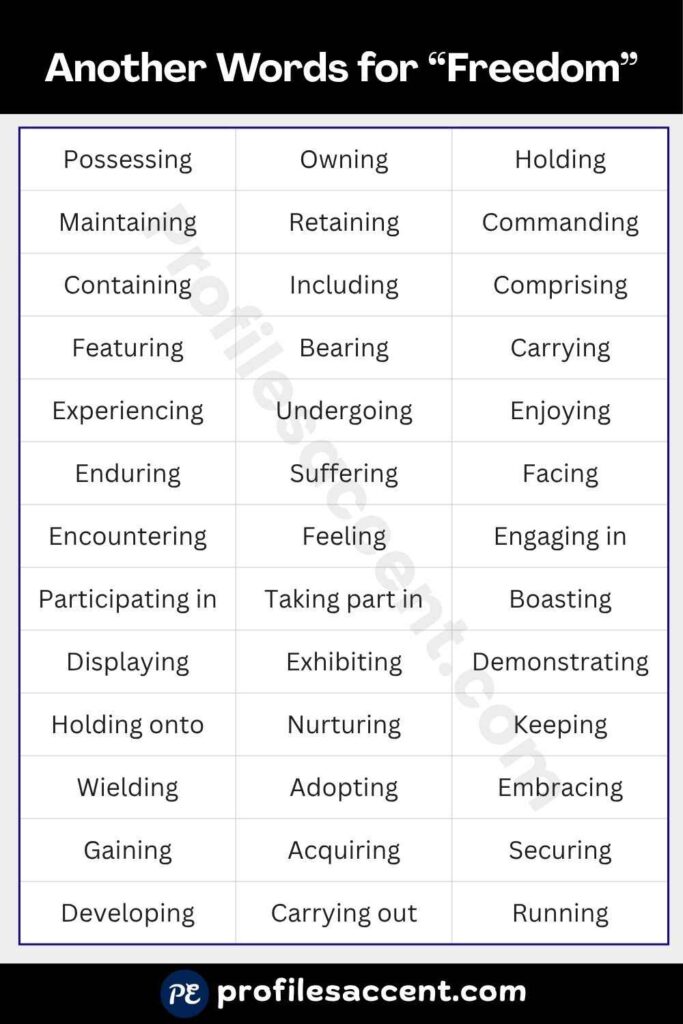
Synonyms for Having at a Glance (35+ Quick Reference Table)
Find your context fast. Pick the word that fits your situation.
| Word | Tone | Best Used When | Quick Example |
| Possessing | Formal | Describing ownership or a trait | She is possessing rare patience |
| Owning | Direct | Legal or physical ownership | He is owning a small farm |
| Holding | Neutral | Physical grip or a position | Holding a degree in science |
| Maintaining | Steady | Keeping something ongoing | Maintaining a healthy routine |
| Retaining | Technical | Keeping without losing | Retaining full control |
| Commanding | Strong | Authority or impressive skill | Commanding a large audience |
| Containing | Descriptive | Listing what is inside something | The box contains three items |
| Including | Inclusive | Adding something to a group | Including all major sections |
| Comprising | Academic | Describing what makes a whole | Comprising five key stages |
| Featuring | Promotional | Highlighting a notable quality | Featuring a built-in camera |
| Bearing | Literary | Carrying a quality or burden | Bearing a strong resemblance |
| Carrying | Physical or metaphor | Holding a load or trait | Carrying a sense of pride |
| Experiencing | Emotional | Going through an event or feeling | Experiencing real growth |
| Undergoing | Medical/Process | A formal or serious process | Undergoing major changes |
| Enjoying | Positive | Pleasure or good moments | Enjoying a peaceful evening |
| Enduring | Negative | Lasting through hardship | Enduring long delays |
| Suffering | Painful | Negative physical or emotional state | Suffering from fatigue |
| Facing | Challenge | Dealing with a difficulty | Facing serious setbacks |
| Encountering | Unexpected | Meeting something unplanned | Encountering a problem |
| Feeling | Emotional | Internal emotional states | Feeling great confidence |
| Engaging in | Active | Participating in something | Engaging in a debate |
| Participating in | Shared | Group or shared activity | Participating in events |
| Taking part in | Casual | Informal group involvement | Taking part in the fun |
| Boasting | Impressive | Highlighting a strong positive | The city boasts clean air |
| Displaying | Visual | Showing a quality or feature | Displaying strong leadership |
| Exhibiting | Formal/Academic | Showing measurable traits | Exhibiting signs of recovery |
| Demonstrating | Evidence-based | Proving through action | Demonstrating clear results |
| Holding onto | Emotional | Clinging to something | Holding onto past memories |
| Nurturing | Caring | Growing or tending something | Nurturing a creative mind |
| Keeping | Simple | Staying in possession | Keeping a daily journal |
| Wielding | Power | Using authority or a tool | Wielding significant power |
| Adopting | Choice | Taking on a new approach | Adopting a new method |
| Embracing | Willing | Accepting something fully | Embracing a new challenge |
| Gaining | Progress | Acquiring something new | Gaining new skills |
| Acquiring | Formal | Getting something intentionally | Acquiring valuable assets |
| Securing | Deliberate | Getting something safely | Securing a strong position |
| Developing | Growth | Building something over time | Developing strong habits |
| Carrying out | Action | Completing a task | Carrying out the plan |
| Running | Management | Operating something | Running a busy household |
| Hosting | Social | Welcoming people or content | Hosting a dinner party |
| Birthing | Creation | Bringing something new to life | Birthing a bold new idea |
Another Word for Having Based on What You Mean
This is where most synonym lists fall short. “Having” does not mean just one thing. It shifts depending on what comes after it. Here is how to think about it in groups.
When You Mean Ownership or Possession
Think about sentences like “He is having a car” or “She is having authority.” These feel off because “having” is too casual for what you mean. Words like owning, possessing, holding, or commanding replace it with more weight and precision. “She commands significant authority” lands harder than “she is having authority.”
When You Mean Going Through Something
“I am having a terrible week.” That is not about owning the week. You are living through it. This group calls for experiencing, enduring, undergoing, or facing. Each one tells the reader something about how hard or easy that thing is. “Enduring a terrible week” carries more pain. “Experiencing a busy week” stays neutral.
When It Describes a Feature or Characteristic
“The app is having a dark mode.” That is weak writing. The app does not experience dark mode. It includes it, features it, or offers it.
- For a formal document: “The application comprises a dark mode option.”
- For a product description: “The app features a built-in dark mode.”
When “Having” Hides Inside an Idiom
This is the gap most synonym articles skip entirely. “Having a baby” does not mean possessing one. It means giving birth. “Having words with someone” does not mean talking pleasantly. It means arguing. “Having someone over” means hosting them, not owning them.
These idioms need full phrase replacements, not single-word swaps:
- Having a baby: giving birth, welcoming a child, bringing a new life into the world
- Having words: exchanging sharp words, clashing with, getting into a dispute
- Having fun: reveling in the moment, delighting in, soaking up the experience
- Having someone: hosting a guest, employing a staff member, or informally, tricking someone
How Strong Is Your Word? A Tone Intensity Scale for Synonyms for Having
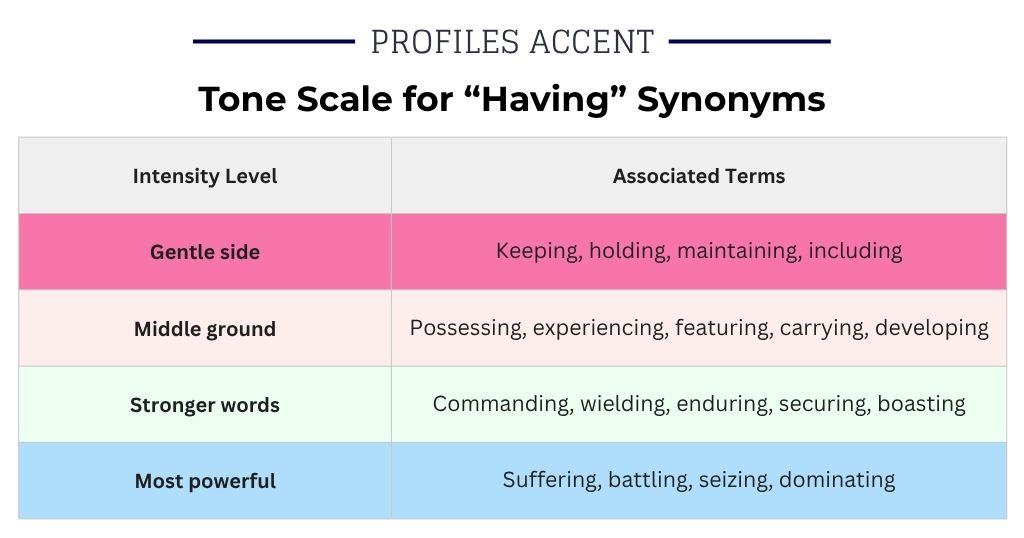
Not every replacement carries the same emotional weight. Some words are quiet. Others hit hard. Here is a rough scale for synonyms tied to experience and possession:
- Gentle side: keeping, holding, maintaining, including
These feel calm and steady. Good for descriptions that do not need drama.
- Middle ground: possessing, experiencing, featuring, carrying, developing
Solid and clear. Most formal writing lives here.
- Stronger words: commanding, wielding, enduring, securing, boasting
These carry confidence, effort, or intensity. Use them when you want the reader to feel something.
- Most powerful: suffering, battling, seizing, dominating
These should be used carefully. They change the mood of the whole sentence.
Sentence Rewrites Using Having Synonyms
Here are five weak sentences using “having,” each rewritten in different tones.
Original: She is having trouble at work.
- Formal: She is encountering difficulties in her professional role.
- Casual: She is going through a rough patch at work.
- Academic: The subject is experiencing workplace challenges.
- Creative: Something at work has started pulling at her focus, quietly but persistently.
Original: The package is having three items inside.
- Correct version: The package contains three items.
- Formal: The package comprises three distinct items.
- Descriptive: Tucked inside the package are three carefully chosen items.
Original: I am having a great time here.
- Casual: I am loving every moment here.
- Formal: I am thoroughly enjoying my time here.
- Creative: This place has given me something I did not expect: genuine joy.
Original: The building is having six floors.
- Standard: The building has six floors.
- Formal: The building consists of six floors.
- Technical: The structure comprises six levels.
Original: They are having a discussion about the plan.
- Professional: They are engaged in a discussion regarding the plan.
- Casual: They are talking through the plan together.
- Academic: The group is deliberating on the proposed course of action.
Each rewrite does not just replace a word. It shifts how the reader feels about the sentence.
Another Word for Having in Formal vs. Casual Writing
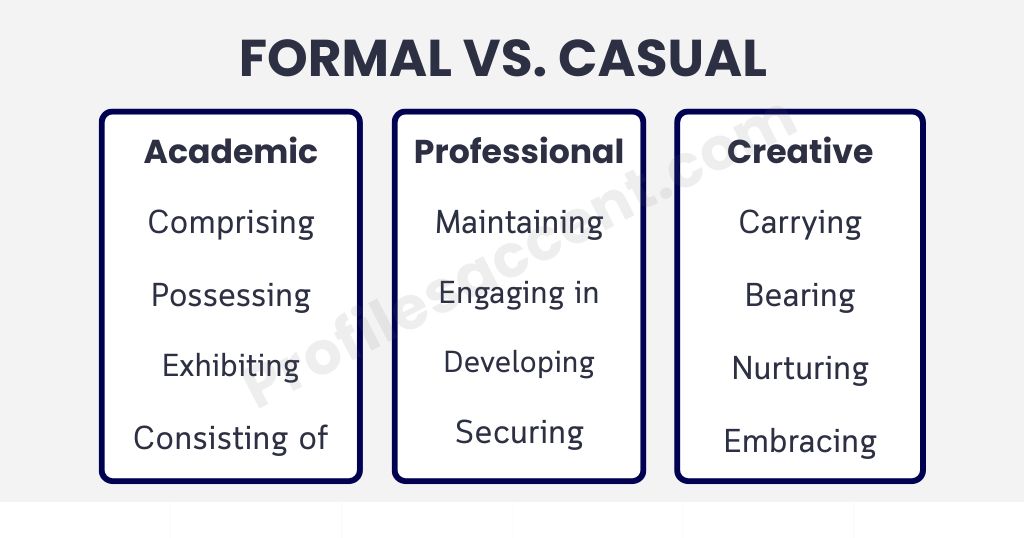
For essays and academic writing, lean toward: comprising, possessing, exhibiting, consisting of, encountering
For professional emails: maintaining, engaging in, developing, securing, carrying out
For storytelling and creative writing: carrying, bearing, nurturing, embracing, reveling in
For everyday speech and casual content: enjoying, going through, picking up, running, hosting
Words to keep out of formal writing: having a blast, having a go, having someone over. These are conversational phrases. They belong in dialogue, not in a business report.
Where Writers Go Wrong with Having Synonyms
A few cautions worth keeping in mind:
“Possessing” in sensitive contexts: If someone is “possessing” a mental health condition in your writing, that phrasing can feel cold or clinical in the wrong way. “Living with” is more respectful and human. “Living with anxiety” reads with far more dignity than “possessing an anxiety disorder.”
“Suffering” should not be the default for illness: Not every health condition involves suffering. Using managing, navigating, or living with shows more awareness.
“Boasting” only works for positives: “The city boasts high pollution levels” sounds strange. Reserve boasting for features someone would be proud of.
Do not force formal synonyms into casual writing. Saying “I am currently comprising a headache” is grammatically absurd. Context governs word choice, always.
A Few Situations Where Word Choice Needs Extra Care
Swapping “having” for “possessing” in every sentence is the most common slip. They are close, but not identical. You possess a quality. You experience a feeling. You contain chapters. Mixing these up makes sentences awkward fast.
Another mistake: using “featuring” when writing about people. Objects and products can feature things. People usually possess, demonstrate, or display qualities.
Also worth noting: “having” as a noun works differently. “The having of power changes people” is grammatically valid but rare. In most cases, switching to “possession” sounds cleaner: “The possession of power changes people.”
Words That Live Near “Having” but Mean Something Different
- Acquisition relates to gaining or getting. Where “having” is a state, acquisition is the action that leads to it.
- Custody specifically describes legal or protective holding. It is narrower than general possession.
- Tenure means having something for a period of time, especially a position or property. It adds a time dimension.
- Ownership is stronger than “having” because it implies legal right, not just physical presence.
- Stewardship means having something under your care with responsibility attached. It adds a duty layer.
- Access means being able to use something without necessarily owning it. Subtle but important difference.
The Practical Takeaway
“Having” is not a bad word. It is just an overworked one. The key is recognizing which version of “having” you are actually using: ownership, experience, description, or idiom. Once you know which category your sentence falls into, the right replacement becomes obvious.
If the sentence is about ownership, try possessing or holding. If it is about going through something, reach for experiencing or enduring. If it is about what something includes, use containing, comprising, or featuring. And if it is an idiom, replace the whole phrase, not just the one word.
That single shift from “having” to the right alternative will make your writing feel more alive, more precise, and more worth reading.
Discover More Articles:

I’m Rowan, a language addict who loves exploring how words work in everyday communication. I’ve spent years studying English vocabulary and helping others express themselves more clearly. My goal is simple: make learning new words easy and practical. I focus on real-life examples that show when and how to use different terms. Through clear explanations and honest guidance, I help readers choose the right words for any situation with confidence.