Picture this: you’re writing something meaningful, and you type the word freedom for the third time in two paragraphs. It starts feeling hollow. Like you’re circling the same idea without actually landing on it.
That’s the real problem with overusing this word. It’s not wrong. It’s just lazy. And readers feel it, even if they can’t name it.
The English language gives you dozens of richer, more precise options. Each one carries a slightly different weight. Picking the right one doesn’t just improve your writing. It sharpens your meaning.
What Freedom Really Carries With It
At its core, freedom means the ability to act, speak, or think without being stopped or controlled. But here’s what most people miss: it carries emotional weight too. It feels hopeful. Sometimes defiant. Always personal.
That emotional charge is exactly why a flat synonym won’t always work. You need a word that fits how you feel, not just what you mean.
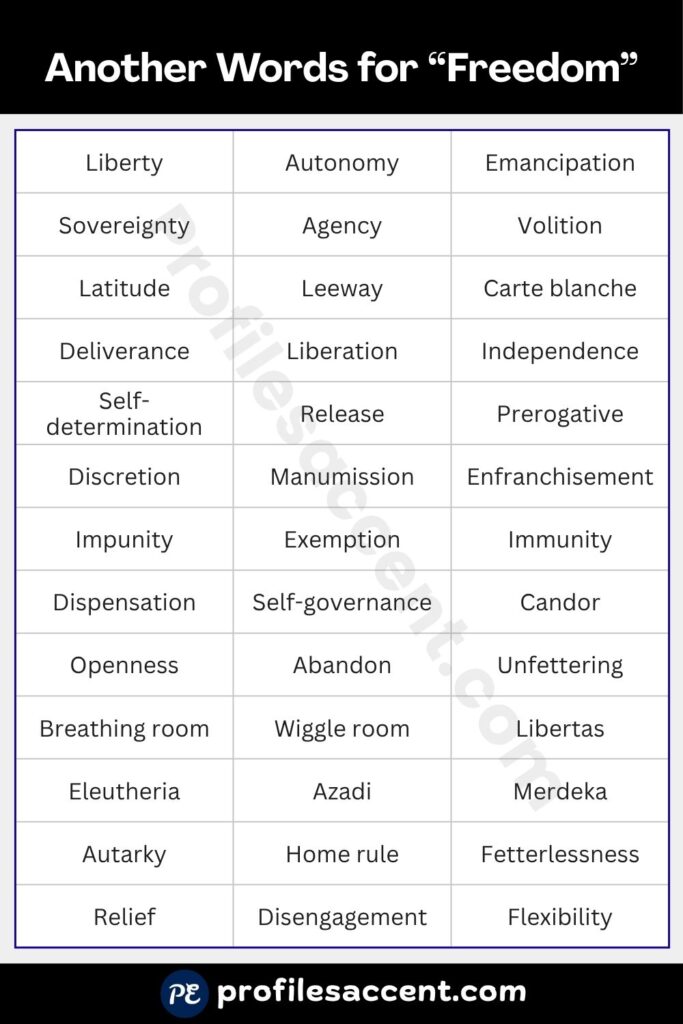
45+ Quick Synonyms for Freedom at a Glance
| Word | Tone | Best Used When | Quick Example |
| Liberty | Formal, civic | Writing about rights or law | Civil liberty must be protected |
| Autonomy | Neutral, structural | Describing self-rule or independence | She valued her autonomy at work |
| Emancipation | Powerful, historical | Escaping control or oppression | The movement sought emancipation |
| Sovereignty | Strong, political | National or personal authority | They declared full sovereignty |
| Agency | Psychological | Focusing on personal power to act | He finally had agency over his life |
| Volition | Formal, mental | Emphasizing conscious choice | She left of her own volition |
| Latitude | Mild, professional | Room to decide within a structure | The teacher gave students some latitude |
| Leeway | Casual | Flexibility in rules or decisions | Give yourself some leeway |
| Carte blanche | Formal, bold | Unlimited permission | He was given carte blanche |
| Deliverance | Poetic, emotional | Rescue from suffering or captivity | They prayed for deliverance |
| Liberation | Strong, social | Being freed from oppression | Liberation came after years of struggle |
| Independence | Neutral, broad | Self-sufficiency or national freedom | They celebrated independence |
| Self-determination | Political | Right to choose one’s own future | Self-determination is a basic right |
| Release | Simple, clean | Physical or emotional freedom | His release brought quiet relief |
| Prerogative | Formal | An exclusive right to choose | It’s her prerogative to decide |
| Discretion | Professional | Freedom to judge a situation | Use your discretion here |
| Manumission | Historical, legal | Formal release from enslavement | The document granted manumission |
| Enfranchisement | Civic | Granting rights, especially voting | Enfranchisement changed the nation |
| Impunity | Negative | Acting without consequence or penalty | They acted with impunity |
| Exemption | Neutral, legal | Freedom from a rule or requirement | She received a tax exemption |
| Immunity | Legal | Protection from prosecution | He was offered immunity |
| Dispensation | Formal, religious | Official exception to a rule | Special dispensation was granted |
| Self-governance | Political | Managing one’s own affairs | The region sought self-governance |
| Candor | Behavioral | Open, fearless expression | She spoke with rare candor |
| Openness | Casual | Unrestricted honesty or access | The team appreciated his openness |
| Abandon | Emotional | Acting without any restraint | She danced with total abandon |
| Unfettering | Poetic | Breaking free from limits | The unfettering of ideas began |
| Breathing room | Conversational | Space to think or act freely | I just need some breathing room |
| Wiggle room | Informal | Flexibility in a tight situation | There’s not much wiggle room left |
| Libertas | Literary, historical | Ancient Roman concept of civic freedom | Libertas was carved in stone |
| Eleutheria | Philosophical | Greek idea of inner or political freedom | Eleutheria guided Athenian thought |
| Azadi | Cultural, poetic | Freedom from oppression (Urdu/Persian) | Azadi rang through the streets |
| Merdeka | Cultural | Liberation from colonial rule (Malay) | Merdeka was declared in 1957 |
| Autarky | Academic | Complete self-sufficiency | Economic autarky rarely works long-term |
| Home rule | Political | Local self-governance | They demanded home rule |
| Fetterlessness | Poetic, rare | State of being completely unbound | Her mind moved in fetterlessness |
| Relief | Emotional | Freedom from pressure or burden | The news brought instant relief |
| Disengagement | Neutral | Withdrawal from control or conflict | Disengagement gave them peace |
| Flexibility | Modern, workplace | Freedom within structured boundaries | Remote work offered real flexibility |
Not All Freedom Synonyms Mean the Same Thing
Other Words for Freedom Tied to Rights and Society
Words like liberty, enfranchisement, and civil rights belong here. They all point toward freedom that exists inside a system. It’s freedom that was fought for, legally defined, and can be taken away.
Liberty carries a civic promise. Enfranchisement is about being included. These aren’t words you’d use in a personal journal. They belong in political writing, history, and formal argument.
When the Word Needs to Center the Person
Agency, volition, and self-determination are about the person making choices. They center the individual, not the system.
If someone left a bad relationship by their own choice, you’d say they acted out of volition. If a story follows a character reclaiming their life after trauma, agency is the more powerful word. It says: they didn’t just escape. They took control.
Synonyms for Freedom That Imply Escape From Something Heavy
Emancipation, deliverance, and liberation all describe being freed from something serious. A system. A belief. A person. A nation.
The key difference: emancipation and manumission are rooted in historical contexts, especially enslavement. Use these carefully and respectfully. Liberation is broader and more flexible. Deliverance carries a spiritual or narrative quality, like being saved at the last moment.
Words That Simply Mean Room to Move
Leeway, latitude, flexibility, and breathing room belong together. These are softer words. They suggest freedom within a boundary, not full liberation. A manager giving latitude. A deadline with wiggle room. They’re practical, everyday words.
How Hard Does the Word “Freedom“ Hit? A Scale of Tone Intensity
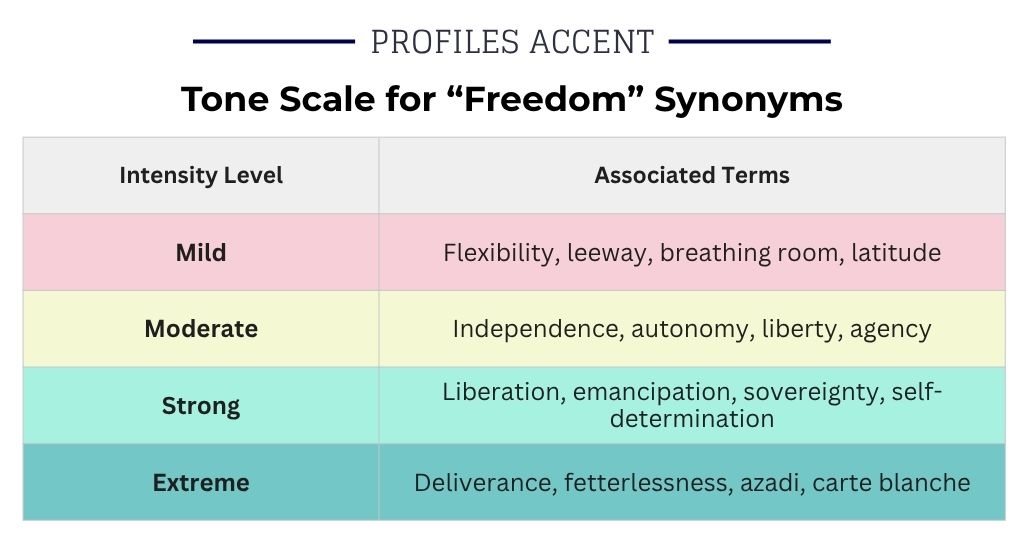
Some freedom words feel mild. Others hit like a declaration. Here’s how they line up:
- Mild: flexibility, leeway, breathing room, latitude
- Moderate: independence, autonomy, liberty, agency
- Strong: liberation, emancipation, sovereignty, self-determination
- Extreme: deliverance, fetterlessness, azadi, carte blanche
As intensity rises, so does the emotional and political charge. Flexibility works in a team meeting. Deliverance belongs in literature or a speech about overcoming something immense.
Watch What Happens When You Swap “Freedom” Out
Original: He finally found freedom after years of struggle.
- Formal: He ultimately achieved emancipation from the constraints that had defined his life for years.
- Casual: He finally had some breathing room after everything he went through.
- Academic: His attainment of personal autonomy followed a prolonged period of systemic restriction.
- Creative: After years of iron-weight silence, deliverance arrived quietly, like a door swinging open on its own.
Each version lands differently. The creative one uses deliverance to suggest something sacred. The casual one is grounded and human. Choose based on who’s reading.
Original: The people wanted freedom from their government.
- Formal: Citizens demanded sovereignty and the right to self-determination.
- Casual: People just wanted independence and the leeway to run things themselves.
- Academic: The population sought structural autonomy, rejecting imposed hegemonic governance.
- Creative: The streets whispered one word: azadi.
Another Word for Freedom of Choice (That Goes Beyond “Option”)
Most lists stop at option or choice. But these words carry more:
- Volition means choosing with full awareness. It highlights the mind behind the decision. Perfect when you want to show that someone meant it.
- Prerogative means it’s your right to choose, not just your ability. It has a slight authority to it. “That’s her prerogative” suggests nobody else gets a vote.
- Discretion fits professional or legal situations where someone is trusted to judge on their own. Judges use it. Doctors use it. It’s earned freedom, not given casually.
Synonyms for Freedom of Expression Worth Using
When writing about expression, these phrases carry distinct meaning:
Candor describes the quality of speaking freely without filters. It’s behavioral, not political.
Latitude of speech describes the structural space allowed for diverse voices. More systemic than personal.
Uncensored discourse points to a state where no voice is blocked or monitored. It’s bold and often used in media and political analysis.
Another Word for Freedom Fighter (And Why It Matters Which One You Pick)
This is one area where word choice has real consequences. These terms are not interchangeable:
- Liberator: Positive. Someone who literally frees people from occupation or captivity.
- Partisan: A resistance fighter defending their homeland from an occupying force. Neutral to positive depending on context.
- Dissident: Someone challenging authority from within a system, often through speech or writing. Not necessarily armed.
- Insurgent / Rebel: These carry political ambiguity. One group’s rebel is another’s criminal. Use carefully in nonfiction.
The word you pick signals whose side you’re on. Know that before you write it.
When Certain Synonyms for Freedom Can Backfire
A few of these words carry weight that can easily go wrong:
Manumission is a historical legal term. Using it casually, outside of accurate historical writing, can feel dismissive of its gravity.
Impunity describes freedom from consequence, usually in a negative sense. It suggests wrongdoing went unpunished. Don’t use it to describe something positive.
Abandon as a synonym for freedom works in creative writing (“she sang with wild abandon”) but sounds strange in formal or civic contexts.
Azadi, Merdeka, and Eleutheria carry deep cultural histories tied to specific peoples and struggles. Using them decoratively, without understanding their context, can feel appropriative.
Mistakes Writers Make With These Words
Treating liberty and freedom as always identical. Liberty usually exists within a legal or social framework. A freed prisoner gets liberty. A free-spirited artist seeks freedom. The emotional resonance differs.
Using emancipation too loosely. Saying someone was “emancipated from their diet” might work humorously, but in serious writing, it can dilute the word’s weight.
Choosing autonomy when independence fits better. Autonomy is about self-governance, often psychological or institutional. Independence is about not being controlled by something external. A child gains independence. A therapist builds autonomy in their client.
Piling on intensity when you don’t need it. Not every moment of freedom is deliverance. Sometimes it’s just latitude. Match your word to the moment.
Related Words That Often Get Confused With Freedom
Sovereignty vs. Independence: Sovereignty is absolute ruling power. Independence is simply freedom from external control. A country can be independent without full sovereignty.
Agency vs. Autonomy: Agency is the ability to act. Autonomy is the structure that allows self-direction. A person can have agency without institutional autonomy, and vice versa.
Relief vs. Release: Relief is emotional. Release is often physical or structural. You feel relief. You receive release.
License vs. Freedom: License pushes toward excess. It often implies rule-breaking. Freedom is neutral. License has an edge.
The Short Answer on Picking Your Word
Here’s how to narrow it down quickly:
- Writing about rights or law? Reach for liberty, sovereignty, or enfranchisement.
- Writing about a person’s inner life? Try agency, volition, or self-determination.
- Writing poetry or fiction? Deliverance, fetterlessness, or abandon will do more work.
- Writing casually? Breathing room, leeway, or flexibility sound natural and real.
- Writing about history or social movements? Emancipation, liberation, and manumission carry the right gravity.
The goal isn’t to sound smarter. It’s to say exactly what you mean, in a tone that fits where you’re saying it.
Discover More Articles:

I’m Rowan, a language addict who loves exploring how words work in everyday communication. I’ve spent years studying English vocabulary and helping others express themselves more clearly. My goal is simple: make learning new words easy and practical. I focus on real-life examples that show when and how to use different terms. Through clear explanations and honest guidance, I help readers choose the right words for any situation with confidence.