You typed “moreover” three times in one paragraph. Now it feels robotic. You know the word is right, but using it again just feels lazy. Sound familiar?
This happens to almost every writer. “Moreover” is powerful, but only the first time. After that, it starts working against you.
The good news? English gives you dozens of ways to say the same thing. Each one carries a slightly different weight, tone, and purpose. Picking the right one is the difference between writing that flows and writing that stumbles.
What “Moreover” Actually Means (And Why It Carries Weight)
It does more than just add a point. It signals that the next thing you say matters more, or at least carries equal force to what came before. Think of it as stacking evidence. You’ve made your case, and now you’re adding another brick.
It belongs to a group called conjunctive adverbs. These words connect two complete thoughts and show the relationship between them. “Moreover” specifically says: this next point strengthens what I just told you.
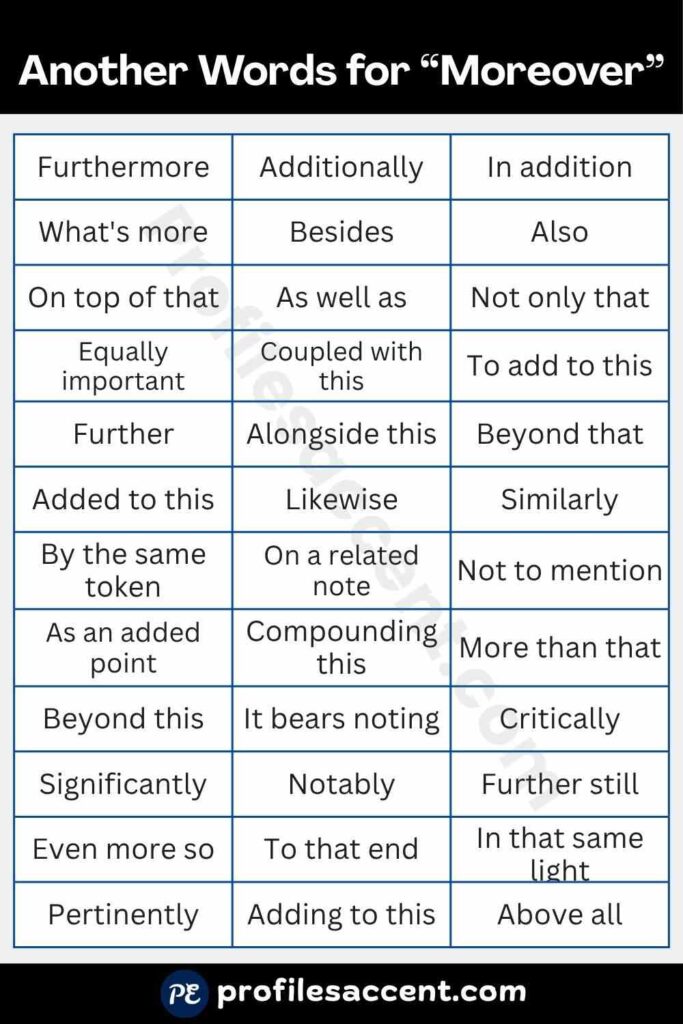
40+ Another Word for Moreover: Quick Synonym Table
Here are 40+ alternatives, grouped by tone so you can match the right word to the right moment.
| Word / Phrase | Tone | Best Used When |
| Furthermore | Formal | Adding a point of equal weight in essays |
| Additionally | Professional | Listing parallel benefits or steps |
| In addition | Neutral | Smooth, clean transitions |
| What’s more | Conversational | Emphasizing a surprising extra point |
| Besides | Semi-formal | Adding a final, clinching reason |
| Also | Casual | Everyday writing or speech |
| On top of that | Informal | Piling on positives or negatives |
| As well as | Neutral | Connecting nouns or clauses |
| Not only that | Emphatic | Highlighting a standout point |
| Equally important | Formal | Academic argument building |
| Coupled with this | Academic | Research and analysis writing |
| To add to this | Conversational | Blog posts or editorial writing |
| Further | Legal/Business | Concise, direct professional writing |
| Alongside this | Descriptive | Narrative or feature writing |
| Beyond that | Transitional | Escalating a point upward |
| Added to this | Neutral | Reports or structured documents |
| Likewise | Comparative | When two ideas mirror each other |
| Similarly | Comparative | When patterns repeat or match |
| Correspondingly | Academic | When data aligns with a prior point |
| Consistently with this | Research | Confirming findings across studies |
| In the same vein | Editorial | Continuing a theme or argument |
| By the same token | Logical | When reasoning extends naturally |
| On a related note | Conversational | Shifting to a connected idea |
| Above and beyond | Emphatic | When the extra point clearly exceeds expectations |
| As an added point | Neutral | Formal lists or structured writing |
| Compounding this | Analytical | When problems or benefits multiply |
| More than that | Emphatic | Informal but punchy additions |
| Beyond this | Formal | Academic and policy writing |
| It bears noting | Academic | Drawing attention to an overlooked point |
| Critically | Research | When a point directly proves a thesis |
| Significantly | Formal | Highlighting importance of added detail |
| Notably | Journalistic | When a fact deserves special attention |
| Further still | Escalating | When building intensity across arguments |
| Even more so | Conversational | Strengthening an emotional point |
| To that end | Purposeful | When the next point supports a goal |
| In that same light | Logical | Extending reasoning naturally |
| Pertinently | Academic | When the added fact is directly relevant |
| Adding to this | Neutral | Simple, clean addition |
| What makes this stronger | Persuasive | Sales, debate, or opinion writing |
| Not to mention | Casual | Conversational, often used for emphasis |
| Above all | Prioritizing | Saving the most important point for last |
Moreover vs. Furthermore: The Difference Nobody Actually Explains
Most synonym lists treat “moreover” and “furthermore” as twins. They are not.
“Moreover” is persuasive. It raises the stakes. When you use it, you’re telling the reader: this next point makes my case even harder to argue against. It adds something heavier.
“Furthermore” is additive but neutral. It says: here is another fact in this same category. It does not necessarily strengthen the argument. It simply extends the list.
Think of it this way. A lawyer says: “My client has a solid alibi. Moreover, the security footage confirms it.” The word “moreover” signals that the second point is the knockout blow.
A researcher might write: “The first study showed increased memory retention. Furthermore, the second study confirmed this across different age groups.” That is neutral continuation, not escalation.
Use “moreover” when you want to persuade. Use “furthermore” when you want to inform.
Synonyms for Moreover Ranked by Tone Intensity
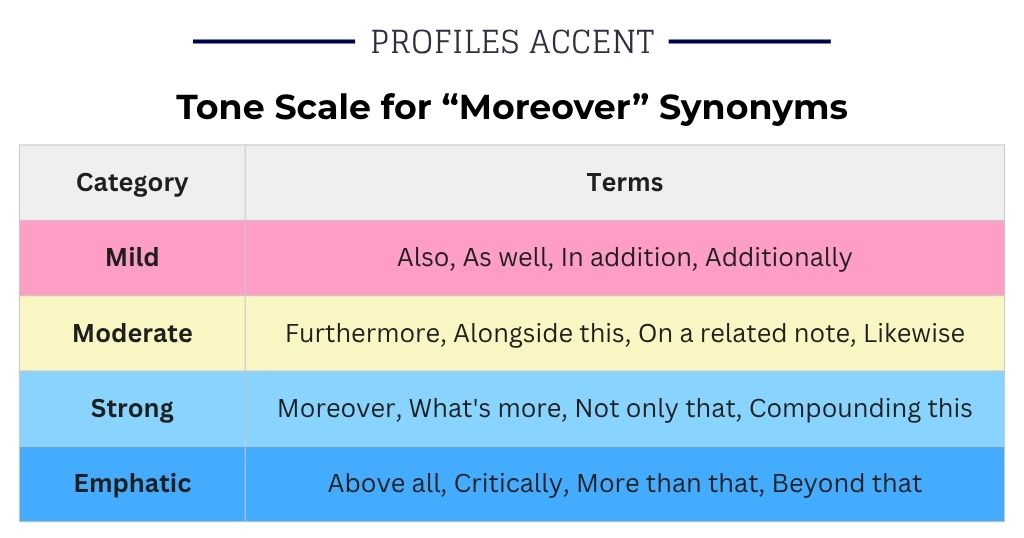
Not every addition needs the same force. Here is a simple scale to guide your choices:
- Mild: Also, As well, In addition, Additionally
These are quiet additions. They do not demand attention. Use them when the point is helpful but not critical.
- Moderate: Furthermore, Alongside this, On a related note, Likewise
These carry a bit more weight. They signal that this next point matters and deserves your attention.
- Strong: Moreover, What’s more, Not only that, Compounding this
These are your persuasion tools. Use them when the next point tips the scales.
- Emphatic: Above all, Critically, More than that, Beyond that
These are reserved for moments when you want the reader to stop and pay attention. Overuse kills their impact.
Same Sentence, Rewritten Four Ways Using Moreover Synonyms
Here is how word choice changes the entire feel of a sentence.
Original: The software is easy to use. Moreover, it saves time.
- Formal: The software offers strong usability. Additionally, it significantly reduces the time required to complete standard tasks.
- Casual: It is super easy to use. And on top of that, it saves you a ton of time.
- Academic: The software demonstrated high usability scores. Correspondingly, participants reported measurable reductions in task completion time.
- Persuasive: The software is easy to use. What’s more, it has already cut processing time by 40% for early users.
See how the tone shifts completely? The facts stay the same. The emotional weight does not.
Other Words for Moreover: Which Ones Fit Formal vs. Everyday Writing
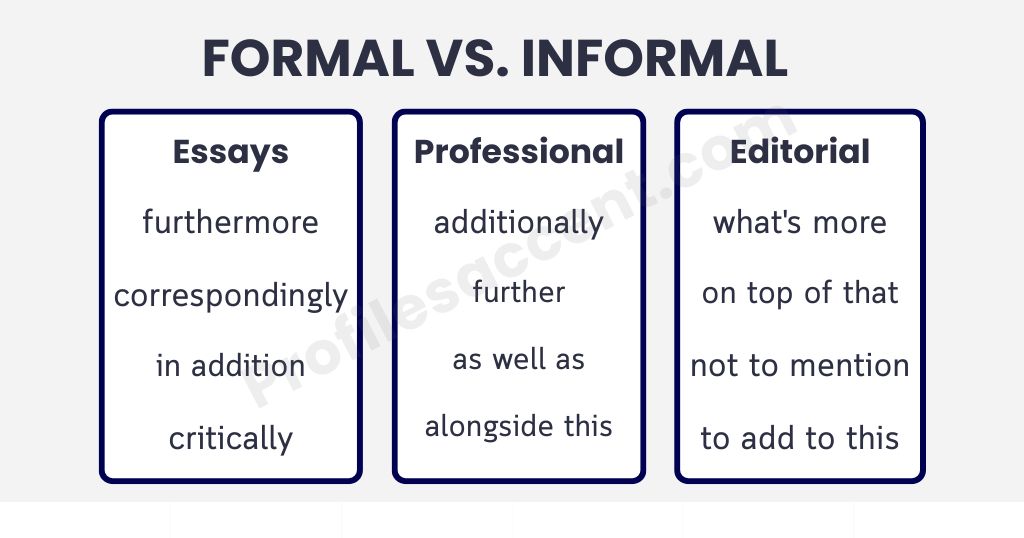
In essays and academic papers, reach for: furthermore, correspondingly, in addition, critically, it bears noting. These feel professional without sounding stiff.
In business emails and reports, try: additionally, further, as well as, alongside this, added to this. Clean and direct.
In blog posts or editorial writing, use: what’s more, on top of that, not to mention, to add to this. These keep readers engaged.
Avoid in formal contexts: “not to mention,” “on top of that,” “also” (when used at the start of a sentence repeatedly), and “more than that.” They feel too casual for academic or legal settings.
Transition Words Like Moreover in French
A lot of writers search for this because they are working on bilingual content or translating essays.
Three French equivalents worth knowing:
- De plus means “in addition.” It is common and neutral, similar to “additionally” in English.
- En outre is the closest match to “moreover” in formal French. It carries the same elevated tone and is used in essays, literature, and official reports.
- Par ailleurs translates roughly to “on another note” or “furthermore.” Use it when you are shifting to a parallel but slightly separate argument.
If you are writing a French essay and want to match the weight of “moreover,” en outre is your word.
Common Mistakes When Using Moreover and Its Synonyms
Using “moreover” to patch weak sentences. If two ideas do not logically connect, no transition word will fix that. The connection needs to exist before the word helps.
Treating “likewise” and “moreover” as identical. “Likewise” signals similarity. “Moreover” signals addition with weight. They serve different logical functions.
Overloading formal transitions in casual writing. If someone says “moreover” in a text message, it lands awkwardly. Match your transition to the register of your writing.
Using “also” at the start of every sentence. It becomes invisible fast. Readers stop registering it as a meaningful transition.
Confusing “nevertheless” with “moreover.” These are near opposites. “Nevertheless” introduces contrast. “Moreover” introduces reinforcement.
Words That Work Alongside Moreover (But Mean Something Different)
A few related words worth knowing:
- Consequently signals cause and effect, not addition. Use it when one thing leads to another.
- Therefore concludes a logical chain. It draws a conclusion from what came before.
- However reverses direction. It is the opposite energy of “moreover.”
- In contrast marks a clear difference between two ideas.
- As a result shows outcome. It follows cause, not addition.
These are not synonyms for “moreover,” but they complete your toolkit. Knowing when not to use an additive transition is just as valuable as knowing which one to pick.
Picking the Right Synonyms for Moreover: A Practical Takeaway
“Moreover” is not a word problem. It is a word that works too well and gets overused because of it.
- When you need weight, use “moreover” or “what’s more.”
- When you need neutral continuation, use “furthermore” or “additionally.”
- When you want to sound natural in casual writing, try “not to mention” or “on top of that.”
The right synonym does not just replace a word. It shapes how the reader feels about your point. That small swap is often what separates writing that convinces from writing that just fills space.
Discover More Articles:

I’m Rowan, a language addict who loves exploring how words work in everyday communication. I’ve spent years studying English vocabulary and helping others express themselves more clearly. My goal is simple: make learning new words easy and practical. I focus on real-life examples that show when and how to use different terms. Through clear explanations and honest guidance, I help readers choose the right words for any situation with confidence.