You finish a sentence and it reads: “She was scared.” It works. But it doesn’t land. The reader moves past it without feeling anything. That’s the real problem with overusing “scared.” It’s not wrong. It’s just hollow after the tenth time.
Fear is one of the most layered human emotions. A child hiding under a blanket feels something different than a soldier frozen at the front line. Both are “scared.” But only one of those words captures what’s actually happening.
Choosing a better word isn’t about sounding smart. It’s about making the reader feel what your character or subject is experiencing.
What “Scared” Is Really Saying
At its core, scared means feeling fear or anxiety in response to a threat, real or imagined. The emotional weight is personal. It’s reactive. And the tone is almost always vulnerable.
It sits in the middle of the fear spectrum. Not mild worry. Not total terror. Just fear, plain and direct. That’s useful sometimes. But writers need the full range.
20+ Synonyms for Scared: Quick-Access Table Another Word for Scared
| Word | Tone | Use It When | Quick Example |
| Frightened | Neutral | General fear, any situation | He looked frightened by the news |
| Terrified | Strong | Extreme, overwhelming fear | She was terrified to open the door |
| Petrified | Extreme | Total physical freeze from fear | He stood petrified at the edge |
| Apprehensive | Soft/Formal | Worry about what’s coming | She felt apprehensive before surgery |
| Uneasy | Mild | Something feels wrong but unclear | The silence made him uneasy |
| Startled | Sudden | Brief shock, quick reaction | The loud bang startled her |
| Rattled | Casual | Shaken by something unexpected | He was clearly rattled after the call |
| Daunted | Moderate | Fear of difficulty or challenge | She felt daunted by the project size |
| Intimidated | Interpersonal | Fear caused by a person | He felt intimidated by his boss |
| Cowed | Formal/Literary | Submission through fear | She was cowed into silence |
| Spooked | Informal | Sudden, eerie, or unknown trigger | The noise spooked the whole group |
| Shaken | Emotional | Post-event distress | He was shaken after the accident |
| Wary | Cautious | Guarded fear based on past experience | She was wary of trusting strangers |
| Aghast | Shock-heavy | Fear mixed with disbelief | They were aghast at the scene |
| Jumpy | Casual | On edge, flinching easily | She’d been jumpy since the break-in |
| Hesitant | Mild | Fear stopping action | He was hesitant to speak up |
| Panicked | Intense | Sudden loss of control from fear | She panicked when the lights went out |
| Hyper-vigilant | Clinical | Constant, scanning alertness | He stayed hyper-vigilant in crowds |
| Timid | Character trait | General fearfulness as personality | The timid boy never raised his hand |
| Dreading | Anticipatory | Fear of a known future event | She had been dreading this conversation |
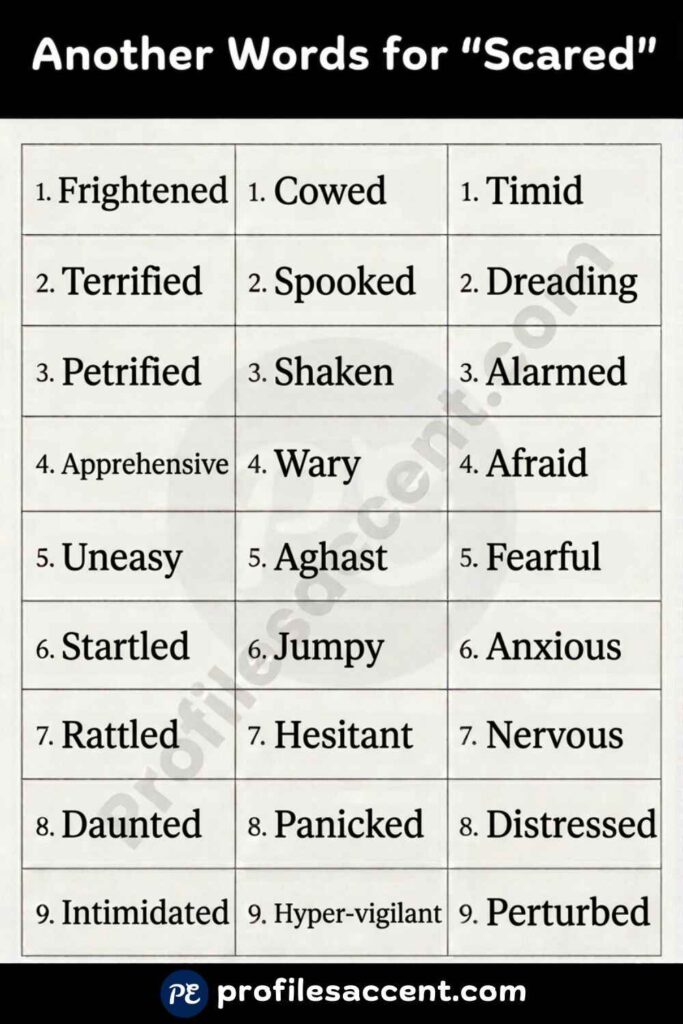
Same Emotion, Different Depth: Fear Word Clusters
Not all fear words work the same way. Some describe a moment. Others describe a person. Some fit a formal essay. Others belong in a text message.
When fear is sudden and physical: Words like startled, rattled, and spooked capture that instant reaction. The body responds before the brain catches up. These are short-lived. Use them for scenes where fear hits fast.
When fear is slow and building: Apprehensive, dreading, and uneasy fit here. The person hasn’t faced the threat yet. They’re anticipating it. This is quieter fear. It simmers. Great for building tension in writing.
When fear becomes overwhelming: Petrified, terrorized, and paralyzed with fear live at this end. The body shuts down. Thought stops. These aren’t everyday words. Use them carefully, because overuse drains their power.
When fear involves another person: This cluster gets ignored most often. There’s a real difference between being scared of something and being scared of someone.
Scared of a storm? You feel exposed, helpless. Scared of a person? You feel watched, threatened, controlled.
Words for this specific fear: intimidated, cowed, browbeaten, coerced. Each one carries a different shade. Cowed implies submission. Intimidated implies awareness of a power gap. Browbeaten implies repeated pressure over time.
The Intensity Scale: Mild to Extreme
Here’s something most synonym lists skip entirely. These words aren’t interchangeable. They exist at different levels of fear intensity.
- Mild: Uneasy, hesitant, wary
- Building: Apprehensive, nervous, unsettled
- Clear fear: Frightened, alarmed, rattled
- Strong: Terrified, petrified, horror-struck
- Total override: Paralyzed, frozen with fear, traumatized
If your character is about to give a class presentation, “petrified” is probably too strong. If they’re watching a building collapse, “uneasy” is wildly understated. Match the word to the actual emotional load of the scene.
Watch What Happens When You Replace “Scared”
See how swapping one word transforms the whole feel:
Original: She was scared to walk in alone.
- Formal: She felt apprehensive about entering unaccompanied.
- Casual: She was totally spooked to walk in by herself.
- Literary: Dread settled over her at the thought of walking in alone.
- Academic: She exhibited signs of acute situational anxiety upon approach.
Original: The boy looked scared.
- Formal: The boy appeared visibly distressed.
- Casual: The kid looked seriously rattled.
- Creative: Fear sat right there in his eyes, wide and still.
Original: He was scared of his father.
- Formal: He was deeply intimidated by his father’s authority.
- Emotional: His father’s presence cowed him into silence every single time.
- Casual: He was honestly terrified of what his dad would say.
Each version sends a different signal. The right choice depends on your audience, your purpose, and the emotional truth you’re going for.
Picking the Right “Scared” Synonym for the Right Setting
Best for academic writing or formal essays: Apprehensive, trepidatious, perturbed, averse, distressed
Best for fiction or creative storytelling: Cowed, aghast, horror-struck, frozen with dread, breathless with fear
Best for casual writing, dialogue, or social posts: Spooked, rattled, jumpy, shook, freaked out
Slang worth knowing: “Shook” has become widely used in informal writing to mean deeply emotionally disturbed by something scary or surprising. “Having kittens” is older British slang for extreme nervousness. These land perfectly in dialogue but would look out of place in a professional report.
Words to avoid in formal writing: Chicken, yellow-bellied, scaredy-cat. These belong in dialogue or humor. Using them in essays or journalism reads as dismissive.
Words for a Scared Person (Not Just Adjectives)
This gap shows up everywhere. People search for synonyms for a scared person and almost every list only gives adjectives.
Here are actual nouns:
- Temporary state: Someone in a nervous wreck, a bundle of nerves, a panicked wreck.
- Personality trait: A timid soul, a shrinking violet, a faint-hearted person.
- Informal/playful: A scaredy-cat, a chicken.
- Archaic/literary: A milksop, a craven.
The difference matters in writing. Calling someone a “nervous wreck” means they’re scared right now, in this moment. Calling them “faint-hearted” means you’re making a comment about who they are as a person.
Mistakes People Make with Fear Synonyms
Using “petrified” too loosely. If someone is petrified, they literally cannot move. It’s an extreme word. Using it for mild discomfort weakens your writing.
Confusing “anxious” with “scared.” Anxiety involves uncertainty and anticipation. Scared is a direct response to a threat. These overlap, but they aren’t the same. Someone anxious before a job interview isn’t exactly scared. Someone scared during a robbery isn’t just anxious.
Mixing up “timid” and “scared.” Timid is a personality trait. Scared is a reaction. A brave person can be scared. A timid person might never even enter the situation.
Overusing “frightened.” It’s clean and neutral, which makes it easy to reach for. But three “frightened” characters on one page flattens the emotion. Rotate your vocabulary.
Treating “wary” as intense fear. Wary is cautious. It’s guarded. It’s not terror. A wary person is watching carefully. A scared person might not be watching at all, just reacting.
The Adverb Nobody Uses: What to Say Instead of “Scaredly”
Writers sometimes search for “scaredly” as an adverb. The word exists, but almost no one uses it naturally. Here are the adverbs that actually work:
- Fearfully describes doing something while filled with dread.
- Timidly means acting in a nervous, shrinking way.
- Apprehensively means acting with a quiet, worried expectation.
- Warily means acting with guarded caution.
Use: She timidly reached for the handle. Not: She scaredly reached for the handle.
Words That Live Near “Scared” But Mean Something Different
Dread sits deeper than scared. It’s heavy, long-lasting, and often tied to something specific you know is coming.
Foreboding is the sense that something bad is about to happen, even without knowing what. It’s more atmospheric than personal.
Phobia is clinical. It describes irrational, specific fear tied to a trigger. Not a casual word.
Awe is fear mixed with respect or wonder. It’s not entirely negative. Standing at the edge of a canyon can bring awe.
Trepidation is gentler than terror. It’s nervous hesitation before walking into something uncertain.
Now You Can Choose with Confidence
Here’s the thing. You don’t need a hundred synonyms. You need to ask one question before choosing: What kind of fear is this?
Is it sudden or slow? Is it personal or situational? Is it a moment or a pattern? Does the body react, or does the mind spiral?
Answer that, and the right word becomes obvious. “Scared” will always have its place. But the words around it are what make the emotion real.
Discover More Articles:

I’m Rowan, a language addict who loves exploring how words work in everyday communication. I’ve spent years studying English vocabulary and helping others express themselves more clearly. My goal is simple: make learning new words easy and practical. I focus on real-life examples that show when and how to use different terms. Through clear explanations and honest guidance, I help readers choose the right words for any situation with confidence.