You wrote “the music was loud.” Then you wrote it again. Then a third time. And now the whole paragraph feels flat.
That’s the real problem with “loud.” It’s not wrong. It’s just tired. Readers feel nothing when they see it for the fourth time in two pages. The word works, but it doesn’t do anything.
Here’s what’s interesting though. “Loud” actually carries three completely different meanings depending on context. A loud crowd. A loud shirt. A loud personality. Each one needs a different replacement, and that’s exactly where most synonym lists fall short. They hand you ten words and call it a day, without telling you which one fits your sentence.
This guide fixes that.
What “Loud” Is Really Doing in Your Sentence
At its simplest, loud means producing a high level of sound. But the word carries emotional weight too. Something loud can feel exciting, aggressive, joyful, painful, or even visually overwhelming. The right synonym captures that feeling, not just the volume.
Another Word for Loud: 30+ Quick Synonym Table
Here are the best synonyms organized by tone and use case.
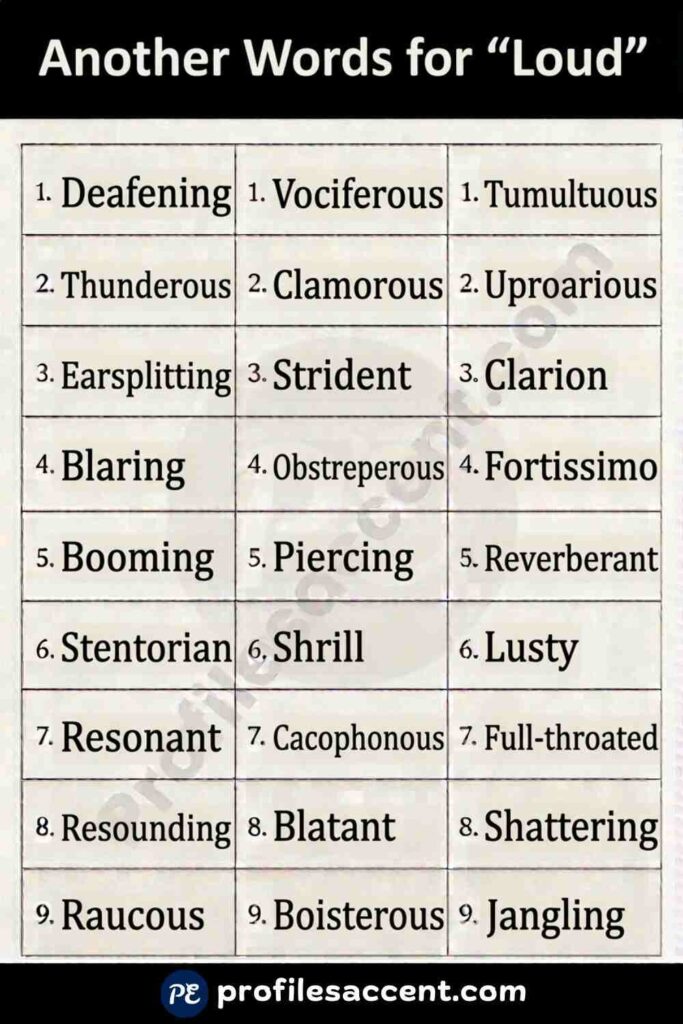
| Word | Tone | Best Used When | Example |
| Deafening | Extreme/Intense | Volume is physically overwhelming | The deafening roar of the engines |
| Thunderous | Powerful/Deep | A deep, heavy sound fills the space | Thunderous applause shook the hall |
| Earsplitting | Painful/Harsh | Sound causes physical discomfort | An earsplitting alarm at 3 a.m. |
| Blaring | Harsh/Continuous | A horn or siren keeps going | Blaring traffic outside the window |
| Booming | Deep/Rich | Low-frequency, resonant sound | His booming voice filled the room |
| Stentorian | Commanding/Formal | A powerful, respected speaking voice | Her stentorian tone ended the argument |
| Resonant | Warm/Positive | Sound is full, deep, and pleasing | A resonant cello note held the air |
| Resounding | Clear/Triumphant | Something succeeds loudly and clearly | A resounding victory for the team |
| Raucous | Rough/Negative | Noisy, uncontrolled, disorderly crowd | Raucous laughter spilled into the hallway |
| Vociferous | Forceful/Behavioral | A person loudly demanding to be heard | Vociferous protesters blocked the entrance |
| Clamorous | Chaotic/Urgent | Many voices demanding at once | Clamorous calls for the coach to resign |
| Strident | Sharp/Irritating | High-pitched and grating tone | Her strident voice cut through the noise |
| Obstreperous | Defiant/Aggressive | A person is noisy and uncontrollable | The obstreperous child refused to sit |
| Piercing | Sharp/Penetrating | A sound cuts through everything else | A piercing whistle from across the field |
| Shrill | High-pitched/Harsh | Thin, uncomfortable high-frequency sound | A shrill cry echoed down the corridor |
| Cacophonous | Clashing/Chaotic | Multiple sounds collide badly | The cacophonous rehearsal was painful to hear |
| Blatant | Offensive/Obvious | Loud in a shameless, disruptive way | A blatant noise violation at midnight |
| Boisterous | Energetic/Cheerful | Loud due to excitement and high energy | A boisterous birthday crowd at the park |
| Tumultuous | Celebratory/Excited | Loud noise from joyful chaos | Tumultuous cheers greeted the players |
| Uproarious | Joyful/Uncontrolled | Loud with shared laughter or excitement | Uproarious laughter broke the tension |
| Clarion | Clear/Inspiring | A loud, clean, motivating sound or call | A clarion call to serve the community |
| Fortissimo | Musical/Technical | Music played at maximum volume | The orchestra hit a fortissimo finish |
| Reverberant | Echoing/Lingering | Sound bounces and keeps filling the space | A reverberant bang in the empty warehouse |
| Lusty | Vigorous/Healthy | Full-throated, energetic expression | Lusty singing at the stadium |
| Full-throated | Passionate/Committed | Unrestrained effort or expression | A full-throated defense of the policy |
| Shattering | Destructive/Extreme | So loud it feels like things will break | A shattering explosion across the valley |
| Jangling | Metallic/Discordant | Clashing metallic noise | The jangling keys were already irritating |
| Tinny | Thin/Unpleasant | High-pitched metallic sound, often poor quality | A tinny speaker at the back of the room |
| Rambunctious | Wild/Playful | Loud due to uncontrolled energy | Rambunctious kids ran through the house |
| In-your-face | Slang/Modern | Aggressively loud and impossible to ignore | The ad was completely in-your-face |
| Blasting | Casual/Slang | Playing something at full, unwanted volume | Someone was blasting music next door |
| Garish | Visual loudness | Colors or patterns that are visually “loud” | A garish outfit that hurt your eyes |
| Ostentatious | Visual/Behavioral | Intentionally drawing attention through excess | Ostentatious jewelry at a quiet dinner |
| Brassy | Showy/Bold | Bold, loud tone with a flashy edge | A brassy performance that divided critics |
| Sonorous | Deep/Rich/Positive | A beautifully full, deep, pleasing sound | His sonorous reading voice held the class |
Loud Isn’t One Thing (And Your Synonym Shouldn’t Be Either)
Most synonym guides treat “loud” as one thing. It isn’t. It lives in three very different spaces, and mixing these up causes real writing problems.
Sound-based loudness is what most people picture. Volume. Decibels. The kind that hurts your ears or fills a room. Words like deafening, thunderous, and earsplitting live here.
Personality-based loudness describes how a person behaves. Someone who dominates every conversation, argues aggressively, or simply never stops talking. “She was loud” in this context means something very different from a loud explosion. Here, vociferous, obstreperous, and boisterous are far more precise.
Visual loudness is where most guides fail completely. A loud shirt. A loud color scheme. This isn’t about sound at all. It’s about visual intensity that overwhelms the eye. Garish, ostentatious, and brassy belong here. Using “deafening” to describe a neon green jacket would make a reader pause. Use the right category.
How Intense Does It Need to Be? A Loud Synonym Scale
Not all loud synonyms hit with equal force. Here’s how they line up from mild to extreme.
- Mild: Boisterous, Resonant, Lusty
- Moderate: Booming, Raucous, Blaring, Clamorous
- Strong: Stentorian, Thunderous, Earsplitting, Strident
- Extreme: Deafening, Shattering, Ear-splitting, Cacophonous
A good writer doesn’t always reach for the extreme. A boisterous argument sounds very different from a deafening one. The first is messy but manageable. The second implies something overwhelming and possibly frightening.
Same Sentence, Smarter Word: Loud Synonyms in Action
Original: The concert was really loud.
- Formal: The performance reached fortissimo levels that unsettled several audience members.
- Casual: The concert was absolutely blasting. We couldn’t hear each other at all.
- Creative: The music came at us like a wall, thunderous and relentless, shaking the floor beneath our feet.
Original: He was a loud person at meetings.
- Professional: He was vociferous in expressing his opinions, often speaking over others.
- Casual: He was just boisterous. Not rude, just really difficult to ignore.
- Precise: His obstreperous manner made it difficult for anyone else to finish a sentence.
Original: There was a loud noise outside.
- Neutral/Descriptive: A sharp, earsplitting crack came from the street below.
- Atmospheric: A reverberant bang rolled through the building, leaving silence in its wake.
The original sentences aren’t wrong. But the rewrites tell you something. Loud just tells you it was high volume.
Loud Synonyms for Formal Writing vs. Everyday Use
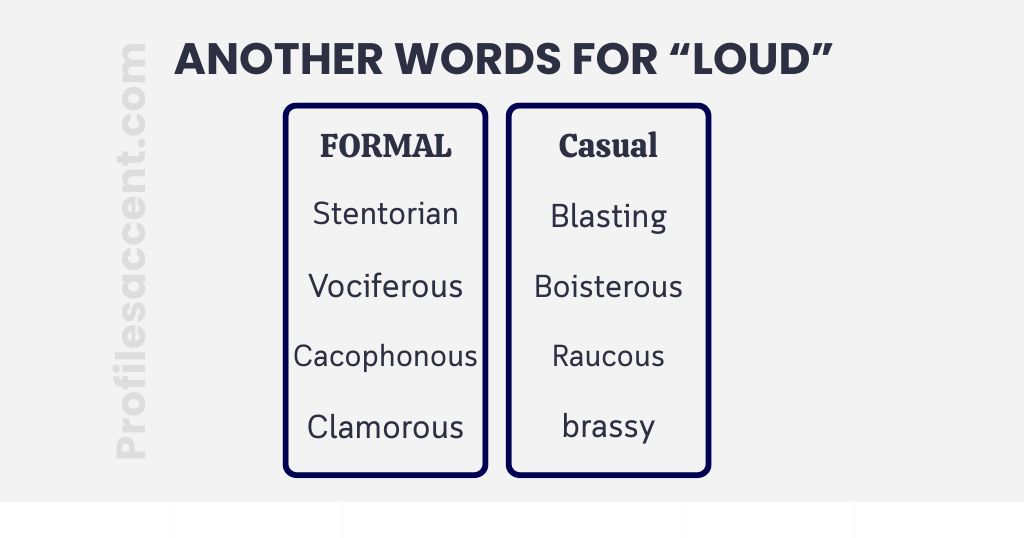
- Use in formal writing or essays: Stentorian, vociferous, cacophonous, clamorous, reverberant
These words signal precision and vocabulary depth without sounding forced.
- Use in casual writing, dialogue, or social content: Blasting, boisterous, raucous, in-your-face, brassy
These feel natural in conversation and creative prose. They won’t sound out of place next to everyday speech.
- Words to avoid in professional or academic contexts: Blasting and in-your-face are fine in creative writing or blog posts. Drop them from reports, cover letters, or academic essays entirely.
Another Words for Loud: Common Mistakes Writers Make
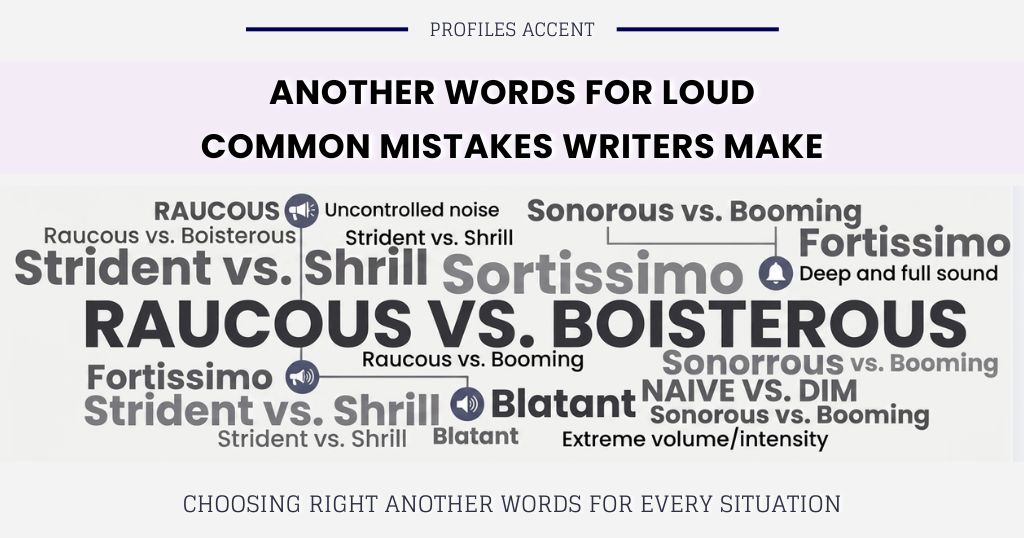
Raucous vs. Boisterous: Both describe noisy groups of people. But boisterous carries energy and cheer. Raucous leans toward disorder, roughness, or something that’s crossing a line. A boisterous party is fun. A raucous crowd might be about to cause trouble.
Strident vs. Shrill: Both describe high-pitched sounds that grate on the ear. Shrill is more about pitch. Strident is more about how that pitch feels emotionally. A strident tone is cutting and often implies an argumentative quality.
Sonorous vs. Booming: Both describe full, deep sound. Sonorous has a warmth and richness to it. Imagine a cello or a poet’s reading voice. Booming is bigger, louder, and less intimate. A stadium announcer has a booming voice. A storyteller has a sonorous one.
Fortissimo in everyday writing: This is a musical direction, not a general adjective. Saying “the thunderstorm was fortissimo” works as a creative choice. Using it as a standard synonym in a news article looks strange.
Using “blatant” for noise: Blatant is more about shamelessness and obviousness than actual volume. “Blatant noise” works when you’re describing someone who should know better and is being disruptive on purpose. It carries a moral edge. It’s not just loud, it’s inconsiderate loud.
Related Words Worth Keeping Nearby
- Crepitating: A rapid, crackling sound. Not loud in the traditional sense, but intense in its own way. Think fire or static on a line.
- Stentorious: A rare variation of stentorian. Occasionally seen in older literary writing.
- Forte: In music, loud but not extreme. One step below fortissimo. Useful in any music-related context.
- Vehement: Not strictly about sound, but often paired with volume when someone speaks with intense emotion and force. “A vehement response” implies both passion and volume.
A Small but Important Usage Note
Some words in this list carry social or behavioral meanings beyond just noise. Obstreperous and vociferous can come across as dismissive when applied to people who are simply passionate or advocating loudly for a cause. Context matters. Using vociferous for someone demanding justice is neutral to positive. Using obstreperous for the same person sounds condescending. Know what tone you’re setting before you choose.
The Right Loud Synonym Is One Good Question Away
When you’re stuck on “loud,” ask yourself three questions. Is this about sound, personality, or appearance? Is the loudness positive, neutral, or negative? And how intense does it actually need to feel?
Match those answers to this guide and you’ll almost always land on the precise word. The difference between resonant and deafening isn’t just volume. It’s the entire emotional experience of the moment you’re describing.
Pick the word that tells readers how it felt, not just how it sounded.
Discover More Articles:

I’m Rowan, a language addict who loves exploring how words work in everyday communication. I’ve spent years studying English vocabulary and helping others express themselves more clearly. My goal is simple: make learning new words easy and practical. I focus on real-life examples that show when and how to use different terms. Through clear explanations and honest guidance, I help readers choose the right words for any situation with confidence.