You rewrote the sentence three times. It still feels flat. The problem? “Learn” is sitting right in the middle of it, doing almost nothing.
It’s not a bad word. It’s just overworked. On resumes, in essays, in everyday writing, “learn” shows up so often it stops meaning anything specific. And when a word loses its edge, the whole sentence loses power.
Choosing a sharper word doesn’t just sound better. It tells the reader something different. “She mastered the process” hits harder than “she learned the process.” “He uncovered the pattern” feels alive. “He learned the pattern” feels like a school report.
This guide gives you 40+ real alternatives, explains when each one works, and helps you stop reaching for the same tired word every time you sit down to write.
What “Learn” Is Really Saying (And Why It Often Falls Short)
At its simplest, to learn means to take in new information and hold onto it. But that single meaning stretches in many directions. Sometimes learning is slow and deliberate. Sometimes it’s a sudden flash of understanding. Sometimes it’s painful. Sometimes it’s joyful.
The word carries a neutral emotional weight by default, which is exactly why it can feel so empty without context.
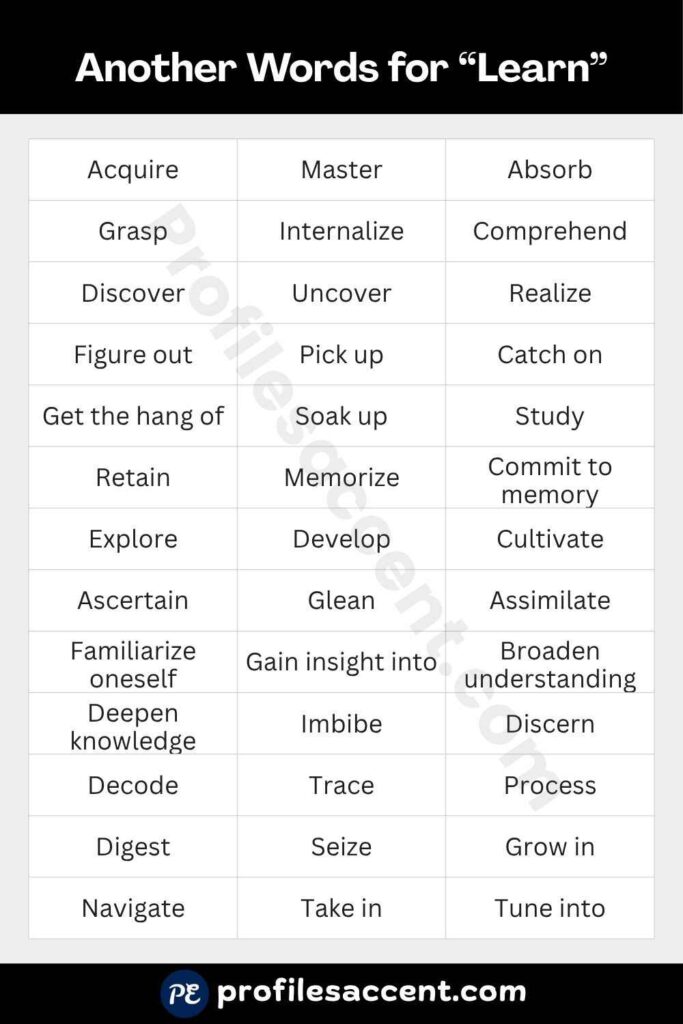
Another Word for Learn: 40+ Synonyms at a Glance
| Word/Phrase | Tone | Best Used When | Short Example |
| Acquire | Formal | Gaining skills or knowledge with effort | Acquired fluency in French |
| Master | Strong/Formal | Full, independent expertise | Mastered financial modeling |
| Absorb | Neutral | Taking in information deeply | Absorbed every detail of the brief |
| Grasp | Neutral/Informal | Understanding a concept | Finally grasped the theory |
| Internalize | Formal | Making ideas part of your thinking | Internalized the new workflow |
| Comprehend | Formal | Deep intellectual understanding | Struggled to comprehend the framework |
| Discover | Positive | Finding something for the first time | Discovered a faster route |
| Uncover | Investigative | Revealing something hidden | Uncovered the real cause |
| Realize | Emotional | Sudden awareness | Realized her mistake too late |
| Figure out | Casual | Solving through thinking | Figured out how the tool works |
| Pick up | Casual | Learning informally | Picked up cooking from her grandmother |
| Catch on | Casual | Gradually starting to understand | Caught on quicker than expected |
| Get the hang of | Informal | Learning a skill through practice | Got the hang of the new system |
| Soak up | Casual/Positive | Eager, passive absorption | Soaked up everything the mentor said |
| Study | Neutral/Academic | Deliberate formal learning | Studied the effects of sleep deprivation |
| Retain | Neutral | Keeping knowledge in memory | Struggled to retain technical terms |
| Memorize | Neutral | Committing facts to memory | Memorized the presentation script |
| Commit to memory | Formal | Intentional memorization | Committed the process to memory |
| Explore | Positive/Light | Early-stage discovery | Explored new design techniques |
| Develop | Formal | Building capability over time | Developed strong negotiation skills |
| Cultivate | Formal/Warm | Slowly growing knowledge or skill | Cultivated expertise in data analysis |
| Ascertain | Very Formal | Finding out through investigation | Ascertained the root cause |
| Glean | Formal/Literary | Gathering bits from multiple sources | Gleaned insights from dozens of interviews |
| Assimilate | Formal | Deeply absorbing complex concepts | Assimilated new research into existing models |
| Familiarize oneself | Neutral | Building basic familiarity | Familiarized herself with the codebase |
| Gain insight into | Neutral | Developing deeper understanding | Gained insight into user behavior |
| Broaden understanding | Formal/Positive | Expanding what you know | Broadened her understanding of global markets |
| Deepen knowledge | Formal | Going further into a subject | Deepened his knowledge of ancient history |
| Imbibe | Literary | Eagerly absorbing ideas | Imbibed the philosophy of the movement |
| Discern | Formal | Recognizing something through careful observation | Discerned the pattern in the data |
| Decode | Casual/Modern | Understanding something complex | Decoded the hidden meaning |
| Trace | Neutral | Following the origin of something | Traced the history of the technique |
| Process | Neutral | Working through new information | Took time to process the feedback |
| Digest | Casual/Neutral | Fully understanding after reflection | Needed a day to digest the information |
| Seize | Strong/Active | Taking knowledge with purpose | Seized every learning opportunity |
| Grow in | Warm/Personal | Personal development over time | Grew in confidence and knowledge |
| Navigate | Modern | Learning through complexity | Navigated a steep learning curve |
| Take in | Casual | Receiving and understanding | Took in everything the coach said |
| Tune into | Casual/Creative | Becoming aware of something subtle | Tuned into the cultural differences |
| Enrich understanding | Formal | Adding depth to what you know | Enriched her understanding of the subject |
Not All Synonyms for Learn Work the Same Way
Not all of these words do the same thing. Grouping them by meaning helps you see where each one truly belongs.
Understanding vs. Memorizing
These are two completely different brain activities, but people often use words for them interchangeably.
Comprehend, grasp, assimilate, discern all point to real understanding. You see why something is true.
Memorize, retain, commit to memory point to storage. You know it, but you may not fully understand it.
Using “memorize” when you mean “understand” is a quiet mismatch that weakens your writing.
Active vs. Passive Learning
Some words carry energy. Acquire, master, cultivate, develop suggest that the learner did something. They worked. They pushed.
Others are softer. Absorb, soak up, pick up, take in suggest learning happened almost naturally, without force.
If you’re writing a resume or a cover letter, passive words can quietly hurt you. Active words make you sound like someone who takes ownership.
Discovery vs. Instruction
Discover, uncover, trace, ascertain all suggest that you went looking for something. The knowledge wasn’t handed to you.
Study, familiarize, attend, follow suggest learning through a structured source.
This distinction matters in storytelling, research writing, and professional bios.
How Hard Does the Word Hit? A Tone Scale for “Learn” Alternatives
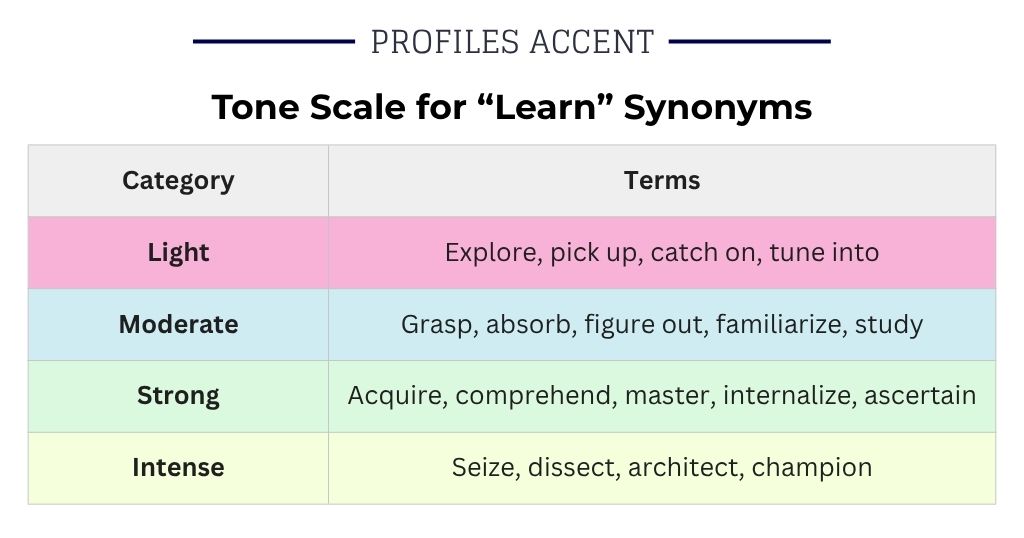
Some situations call for a mild word. Others need something with real weight. Here’s how these alternatives line up from light to strong:
- Light → Explore, pick up, catch on, tune into
- Moderate → Grasp, absorb, figure out, familiarize, study
- Strong → Acquire, comprehend, master, internalize, ascertain
- Intense → Seize, dissect, architect, champion
If you’re writing about a casual experience, “picked up” fits perfectly. If you’re writing about years of professional development, “mastered” or “cultivated” lands with much more authority.
Watch What Happens When You Swap “Learn” Out
Here are real before-and-after rewrites so you can see how word choice changes tone.
Original: I learned a lot from that project.
- Formal: “The project significantly deepened my understanding of project-based risk management.”
- Casual: “That project taught me more than any training session ever could.”
- Academic: “The experience provided meaningful insight into cross-functional team dynamics.”
- Creative: “That project cracked something open in how I think about failure.”
Each version says something slightly different. The formal version is professional. The creative version is personal. “I learned a lot” says nothing memorable.
Original: She learned from her mistakes.
- Formal: “She demonstrated a clear capacity to reflect on setbacks and recalibrate her strategy.”
- Casual: “She figured out what went wrong and changed direction.”
- Academic: “Her performance reflected a process of iterative self-correction.”
- Creative: “Every mistake quietly reshaped her.”
Original: The students learned the new system quickly.
- Formal: “Students rapidly acquired proficiency in the updated platform.”
- Casual: “The students caught on to the new system faster than expected.”
- Academic: “Participants demonstrated swift assimilation of the revised operational framework.”
- Creative: “Within a week, the system had stopped feeling foreign to them.”
The Right Synonym for Learn Depends on Where You’re Writing
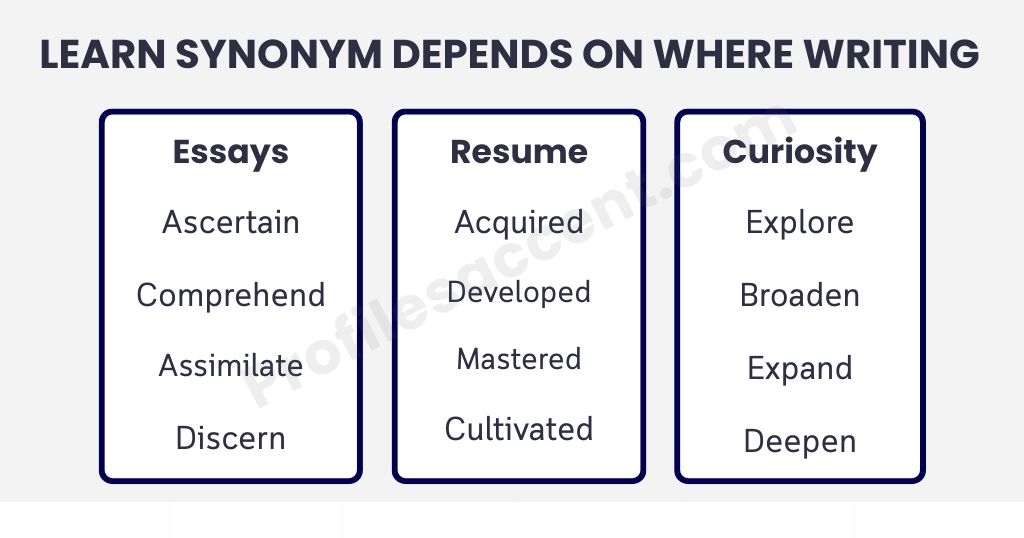
- Another word for learn in an essay
Skip “learn” in formal essays. It signals low register. Use ascertain, comprehend, assimilate, discern, or acquire instead. These show the reader you’re treating the subject seriously.
- Another word for learn on a resume
“Learned” on a resume is almost always the wrong move. It describes what happened to you, not what you did. Try: acquired, developed, mastered, cultivated, built proficiency in. Pair any of these with a result and you’re in much stronger shape.
- Another word for learning new things
When the focus is on growth and curiosity, consider: explore, broaden, expand, deepen, enrich, venture into. These carry a sense of forward movement that “learn” simply doesn’t.
- Synonyms for learner
Describing a person rather than an action? Try: novice, apprentice, inquisitive mind, quick study, emerging talent, curious thinker. Each one suggests something different about how they approach knowledge.
- Learn synonym for kids
Simpler language works better here. Discover, explore, find out, pick up, figure out, try all feel natural for younger readers without sounding forced.
- Another word for learning from mistakes
This deserves its own moment because the phrasing matters enormously. Strong alternatives include: reflect and adjust, recalibrate, take stock, grow through, extract the lesson. Avoid weak phrases like “take it as a lesson” in serious writing. They feel like a shrug.
Synonyms That Look Like “Learn” But Work Differently
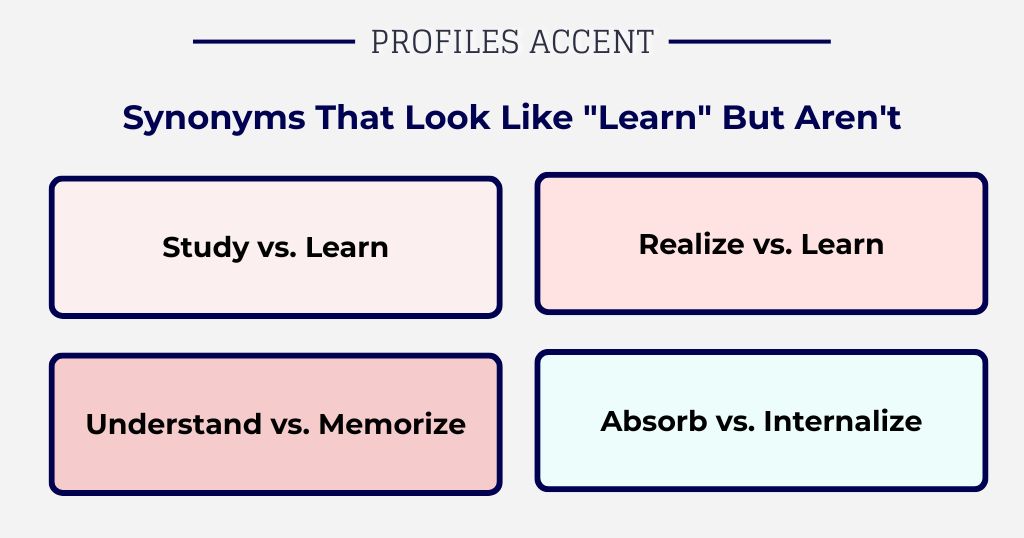
Study vs. Learn
Study is the process. Learning is (sometimes) the result. You can study hard and still not learn. Using them as if they mean the same thing creates logical confusion in academic writing.
Realize vs. Learn
“I realized the answer” means it came to you. “I learned the answer” means someone or something taught it to you. These are not interchangeable.
Understand vs. Memorize
This one trips up students and professionals alike. You can memorize something you don’t understand. You can understand something you’ll never remember. They describe completely different mental experiences.
Absorb vs. Internalize
Absorb is passive. You take something in. Internalize is deeper. You’ve made it part of how you think and act. In professional writing, “internalized” signals transformation. “Absorbed” signals exposure.
Words That Live in the Same Neighborhood
- Educate points outward. You educate someone else. You learn yourself.
- Train is narrow and skill-specific. It implies repetition and a clear outcome. “Learn” is broader.
- Develop focuses on progress over time. It’s about growth more than a single moment of understanding.
- Explore stays open-ended. It doesn’t promise you’ll arrive anywhere. It just signals the journey started.
- Adapt is what happens after learning. You took in new information and changed how you operate because of it.
Which Synonym for Learn Should You Actually Use?
Here’s a practical way to decide:
- Writing something formal? Use acquire, comprehend, assimilate, or cultivate.
- Writing a resume? Use action verbs: developed, mastered, built proficiency in, internalized.
- Writing casually? Use pick up, figure out, catch on, get the hang of.
- Describing discovery? Use uncover, trace, ascertain, realize, or explore.
- Describing growth over time? Use cultivate, develop, broaden, or deepen.
The word “learn” isn’t broken. It just rarely tells the full story. When you pick the right replacement, you don’t just improve the sentence. You tell the reader exactly what kind of learning happened, and that specificity is what makes writing feel real.
Discover More Articles:

I’m Rowan, a language addict who loves exploring how words work in everyday communication. I’ve spent years studying English vocabulary and helping others express themselves more clearly. My goal is simple: make learning new words easy and practical. I focus on real-life examples that show when and how to use different terms. Through clear explanations and honest guidance, I help readers choose the right words for any situation with confidence.