You finish writing a sentence and something feels off. The word “behavior” sits there, flat and overused. You know what you mean, but the sentence doesn’t quite land. Maybe you’re writing an essay. Maybe a work report. Maybe a short story where the character needs more life.
The problem isn’t the idea. It’s the word.
Why “Behavior” Alone Is Costing Your Writing
“Behavior” is one of those words that does too much heavy lifting. It works in almost any sentence, which is exactly why it weakens so many of them. Swapping it out isn’t just about vocabulary. It’s about precision, tone, and making your reader feel exactly what you intend.
This guide gives you 30+ real alternatives, with honest guidance on when each one works, and when it doesn’t.
What Behavior Really Means Before You Replace It
At its simplest, behavior means what someone or something does. It’s observable. It’s external. You can see it, measure it, or describe it.
That’s important to hold onto, because several words people treat as synonyms actually describe something internal. Attitude, for example, is what someone thinks or feels. Behavior is what they do. Mixing them up is one of the most common writing mistakes, and a costly one in academic writing.
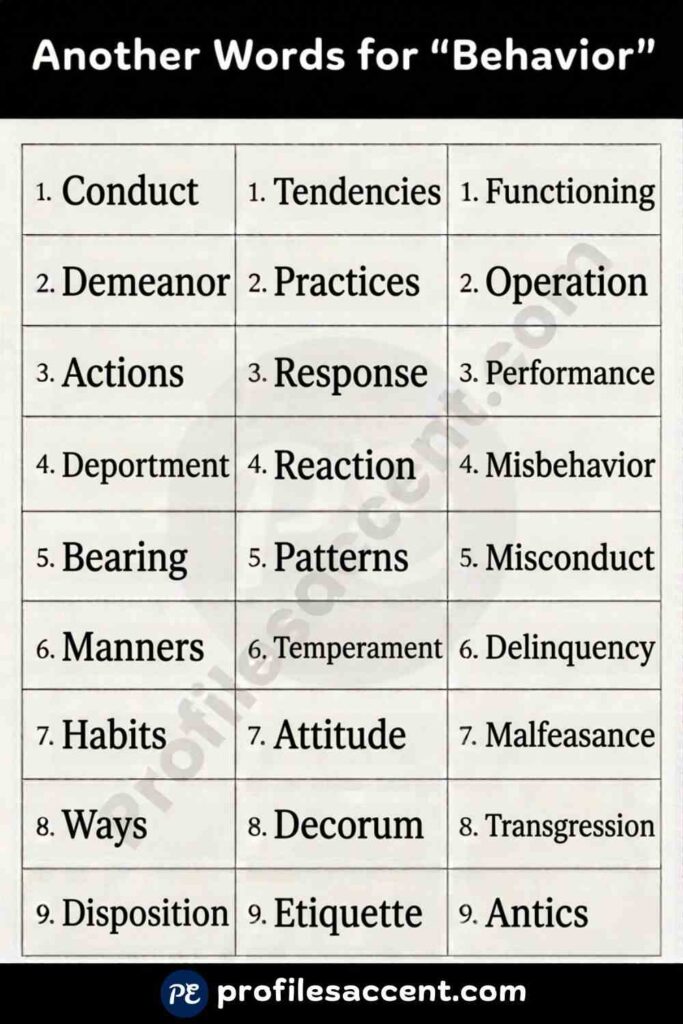
Another Word for Behavior: 30+ Quick Table for Behavior Synonyms
| Word | Tone | Best Used When | Short Example |
| Conduct | Formal | Judging ethics or rules | His conduct was professional |
| Demeanor | Neutral-warm | Describing how someone comes across | Her calm demeanor helped |
| Actions | Neutral | Listing specific things someone did | His actions surprised everyone |
| Deportment | Very formal | Social or professional settings | Proper deportment was expected |
| Bearing | Formal | Describing physical or social posture | She carried herself with bearing |
| Manners | Everyday | Describing social habits | His manners were impeccable |
| Habits | Casual | Patterns repeated over time | Old habits are hard to break |
| Ways | Casual | Describing general tendencies | She has a gentle way about her |
| Disposition | Formal | Describing a person’s general nature | A cheerful disposition |
| Tendencies | Neutral | Describing repeated inclinations | He showed aggressive tendencies |
| Practices | Neutral | Describing repeated professional acts | Their business practices were fair |
| Response | Technical | Psychology or biology contexts | The organism’s stress response |
| Reaction | Neutral | Immediate behavioral output | Her reaction was unexpected |
| Patterns | Academic | Identifying repeated sequences | Behavioral patterns emerged |
| Temperament | Psychological | Describing inherent personality style | A calm temperament under pressure |
| Attitude | Use carefully | Only if you mean both action and stance | His attitude showed in his actions |
| Decorum | Formal | Describing appropriate social behavior | Office decorum must be maintained |
| Etiquette | Social | Rules of polite behavior | Basic etiquette was ignored |
| Functioning | Technical | Systems, biology, machines | The system’s normal functioning |
| Operation | Technical | How something works mechanically | The engine’s standard operation |
| Performance | Context-specific | How well something executes | His performance under stress |
| Misbehavior | Negative | Specifically wrong or disruptive acts | The child’s misbehavior escalated |
| Misconduct | Negative-formal | Ethical or professional violations | Investigated for misconduct |
| Delinquency | Negative-legal | Youth or legal contexts | Juvenile delinquency rose sharply |
| Malfeasance | Legal | Intentional wrongdoing in official roles | The officer faced malfeasance charges |
| Transgression | Moral | Crossing a moral or ethical line | A serious transgression of trust |
| Antics | Informal | Playful or ridiculous actions | His antics kept everyone laughing |
| Inclinations | Soft | Suggesting tendencies without certainty | Natural inclinations toward caution |
| Propensity | Formal | A strong natural tendency | A propensity for risk-taking |
| Trait | Psychological | A stable personality characteristic | Honesty is his defining trait |
| Mien | Literary | Face or expression as reflection of inner state | A thoughtful mien throughout the trial |
| Custom | Cultural | Accepted social or cultural practices | A long-standing cultural custom |
| Comportment | Formal | Self-management according to social expectations | Her comportment impressed the board |
How Behavior Synonyms Group by Meaning
Not all of these words mean the same thing. They cluster around different ideas. Understanding those clusters keeps you from making a word choice that technically fits but still feels wrong.
Words That Describe What Someone Did vs. Who They Are
Words like actions, conduct, and deeds describe things you can point to. Something that happened. Something someone did.
Words like disposition, temperament, and inclination describe tendencies. What a person is likely to do based on their nature. These aren’t interchangeable with behavior in research or academic writing, because tendencies predict behavior, they don’t describe it.
Social Behavior Words vs. Technical Behavior Words
Demeanor, deportment, manners, and etiquette all belong to social contexts. They carry an implied audience. Someone is watching. There’s a standard being met or broken.
Functioning, operation, and performance belong to systems and biology. There’s no moral weight. A machine doesn’t have manners. Using “demeanor” in a biology report would read as strange as using “functioning” to describe a dinner guest.
When the Word Already Carries a Verdict
Most behavior words are neutral. But some carry built-in judgment.
Misconduct, delinquency, malfeasance, and transgression are all negative by nature. You wouldn’t say someone’s “misconduct was kind.” The word already tells the reader something went wrong.
On the lighter side, antics suggests something silly or amusing rather than harmful. It softens what might otherwise sound critical.
Behavior Synonym Intensity: From Mild to Serious
If you’re writing about negative behavior, word choice controls exactly how serious the situation feels.
- Mild: Misbehavior, antics, waywardness
- Moderate: Misconduct, impropriety, transgression
- Strong: Malfeasance, delinquency, wrongdoing
- Most severe: Criminal conduct, predatory behavior, willful malfeasance
Moving up this scale changes the emotional temperature of your sentence. “The employee’s misbehavior was noted” sounds manageable. “The employee’s misconduct led to an investigation” sounds serious. Same event. Completely different impact.
Watch the Shift: Same Sentence, Different Synonym, Different Meaning
Here’s where the theory becomes practical. Let’s take weak sentences and sharpen them.
Original: The child showed bad behavior at school.
- Formal: The student demonstrated disruptive conduct during class sessions.
- Casual: The kid was acting out all day.
- Academic: The subject exhibited patterns of defiant response in structured settings.
- Creative: Something had shifted in him; small rebellions replaced the quiet boy teachers once knew.
Original: We studied the behavior of the animals.
- Formal: We analyzed the observable actions of the animal subjects.
- Biology-specific: We documented the organismic responses of the species under variable conditions.
- Casual: We watched what the animals did and tracked the patterns.
- Creative: The animals moved through the space as if following some invisible script.
Original: Her behavior at work was professional.
- Formal: Her conduct in the workplace consistently met the highest professional standards.
- Casual: She handled herself really well at work.
- Academic: Her demonstrated performance aligned with established professional norms.
Each version says the same thing. But each one creates a different picture in the reader’s mind.
Which Behavior Synonym Belongs Where: Formal vs. Everyday Choices
- Best for essays and research: Conduct, demeanor, tendencies, patterns, disposition, response
- Best for professional emails: Conduct, decorum, performance, manner, bearing
- Best for storytelling: Mien, disposition, antics, ways, bearing, temperament
- Words to avoid in formal writing: Ways, antics, habits (in isolation), “acting out” phrasing
Using “habits” in a psychology research paper feels thin. Using “mien” in a casual email sounds stiff and strange. The right word in the wrong setting creates a mismatch that pulls the reader out of the text.
The Attitude vs. Behavior Confusion Nobody Warns You About
There’s a specific trap around the word “attitude.” It keeps appearing on synonym lists for behavior. In everyday speech, it’s fine. But if you’re writing a psychology essay or research paper, these two words are not the same.
- Attitude lives inside the mind. It’s a belief, a feeling, a stored evaluation.
- Behavior happens in the real world. You can observe it.
Someone can have a positive attitude toward healthy eating and still choose a burger for lunch. The attitude didn’t produce the behavior. That gap between what people believe and what they actually do is well-documented in psychology, and it’s exactly why these words can’t substitute for each other in a research context.
Use disposition or bearing if you want a word that bridges both inner tendency and outward expression.
Behavior Synonym Mistakes That Quietly Hurt Your Writing
Using “attitude” as a direct synonym for behavior in research. As explained above, they describe different things. Don’t blur them.
Using formal words in light contexts. “The toddler displayed malfeasance during snack time” is technically wrong and also funny. Malfeasance implies intentional wrongdoing in an official capacity. It doesn’t belong near children or informal situations.
Overusing “conduct.” It’s a strong, formal choice. Using it in every sentence makes writing feel stiff and institutional.
Treating “response” as interchangeable with “behavior” in biology. A response is usually a reaction to a specific stimulus. Behavior is broader. Phototropism is a behavior. Recoiling from heat is a response.
Using “demeanor” for non-human subjects. A molecule doesn’t have demeanor. Neither does a server or a software system. Keep demeanor for people and social settings.
Words That Travel Alongside Behavior in Psychology and Research
These aren’t direct synonyms but they frequently appear in the same conversations.
- Cognition: The internal thought process behind behavior. If behavior is the output, cognition is the engine.
- Motivation: What drives the behavior. Related, but not the same.
- Character: A broader, more permanent concept. Your character shapes your behavior over time.
- Psyche: The inner mind. Useful in literary and psychological contexts when behavior reflects something deeper.
- Instinct: Behavior that’s automatic and unlearned. Distinct from conditioned or chosen behavior.
Now Pick Your Word and Use It With Confidence
Here’s the short version. If you need a neutral, catch-all word, “conduct” is the safest formal alternative and “actions” works well in plain writing.
If you’re in psychology, lean toward “response,” “patterns,” or “tendencies.” If you’re writing about biology, try “functioning” or “organismic response.” For social or workplace writing, “demeanor,” “deportment,” or “bearing” give you real precision.
And if you’re writing fiction? Forget the thesaurus for a moment. Ask yourself what the character is actually doing. Describe the action itself. The right synonym will often appear naturally once the scene is clear.
Word choice is quiet power. Use it with intention.
Discover More Articles:

I’m Rowan, a language addict who loves exploring how words work in everyday communication. I’ve spent years studying English vocabulary and helping others express themselves more clearly. My goal is simple: make learning new words easy and practical. I focus on real-life examples that show when and how to use different terms. Through clear explanations and honest guidance, I help readers choose the right words for any situation with confidence.