You just wrote “characterized by” for the third time in the same paragraph. It does not feel wrong, exactly. But it feels stuck. Flat. Like you picked the closest word and moved on without thinking.
That is a common writing moment. The word “characterized” does a decent job, but it carries a passive weight that slows your sentences down. The right replacement depends not just on meaning but on what you are actually trying to show: a trait, a pattern, a process, or an identity. This guide breaks that down so you can make sharper word choices every time.
What Does “Characterized” Really Do in a Sentence?
At its core, “characterized” means that something is defined or identified by a specific quality. It tells your reader: this thing has this feature, and that feature matters.
The tone is neutral and descriptive. It does not lean positive or negative. What it lacks is energy. Most of the time, a better word exists for exactly what you mean.
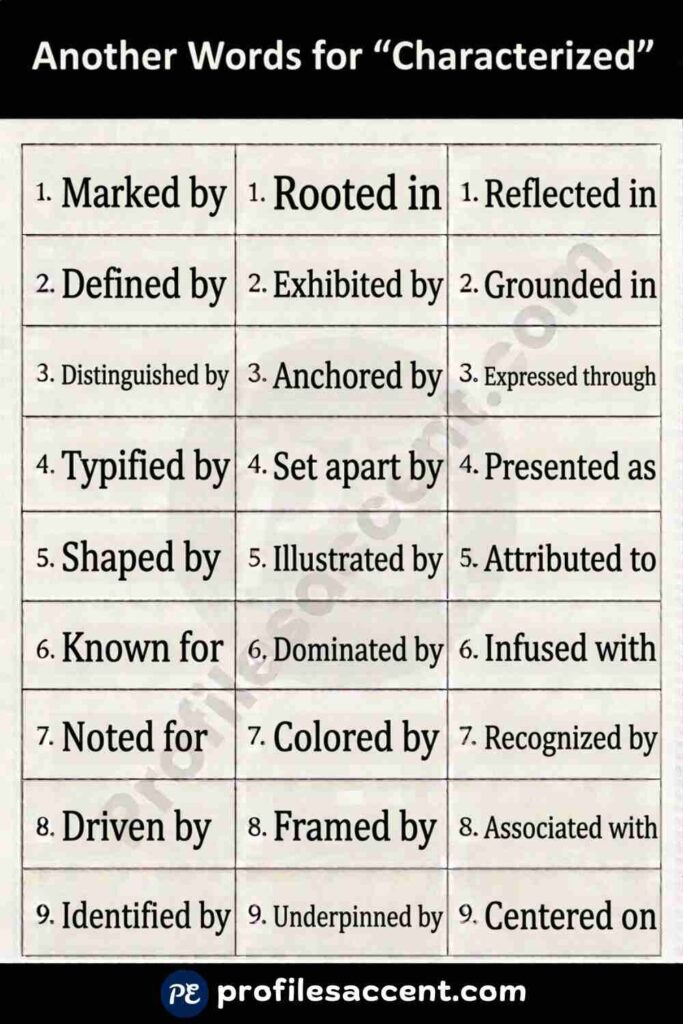
25+ Characterized Synonyms at a Glance: Quick-Reference Table
| Word | Tone | Best Used When | Example |
| Marked by | Neutral/Formal | Highlighting a visible feature | The decade was marked by rapid change. |
| Defined by | Clear/Direct | Stating what shapes something | Her work is defined by precision. |
| Distinguished by | Formal | Setting something apart from others | The species is distinguished by its red crest. |
| Typified by | Academic | Showing a classic example of a group | This genre is typified by short, punchy chapters. |
| Shaped by | Warm/Narrative | Showing influence over time | His worldview was shaped by early hardship. |
| Known for | Conversational | Describing a person or place | She is known for her calm decision-making. |
| Noted for | Formal/Professional | Highlighting a recognized quality | The surgeon is noted for her accuracy. |
| Driven by | Active/Strong | Showing what fuels something | The campaign was driven by grassroots energy. |
| Identified by | Clinical/Research | Labeling a subject by its traits | The bacteria were identified by their cell structure. |
| Rooted in | Reflective | Tracing origin of a quality | His confidence is rooted in years of practice. |
| Exhibited by | Scientific | Showing observed behavior or traits | Aggression is often exhibited by stressed animals. |
| Anchored by | Creative/Structural | Showing a stabilizing quality | The narrative is anchored by a strong opening. |
| Set apart by | Conversational | Highlighting uniqueness | What sets this design apart is its simplicity. |
| Illustrated by | Explanatory | Using an example to show a trait | The trend is illustrated by rising sales figures. |
| Dominated by | Analytical | Showing a feature that outweighs others | The landscape is dominated by open farmland. |
| Colored by | Literary | Showing emotional or subjective influence | Her memories were colored by grief. |
| Framed by | Contextual | Showing the boundaries of something | The debate was framed by economic concerns. |
| Underpinned by | Academic | Highlighting a foundational element | The theory is underpinned by solid evidence. |
| Reflected in | Observational | Showing how a quality becomes visible | Her care is reflected in every small detail. |
| Grounded in | Intellectual | Showing connection to principle or fact | The argument is grounded in careful research. |
| Expressed through | Creative/Abstract | Showing how a quality comes out | His love was expressed through quiet gestures. |
| Presented as | Clinical | How something appears at evaluation | The condition was presented as mild inflammation. |
| Attributed to | Formal | Connecting a trait to a cause or person | The success was attributed to strong leadership. |
| Infused with | Sensory/Literary | Showing something is full of a quality | The prose is infused with dry humor. |
| Recognized by | Taxonomic | Identifying something by its markers | The flower is recognized by its unusual shape. |
| Associated with | Broad/Research | Linking something to a pattern | High stress is associated with poor sleep. |
| Centered on | Structural | Showing what something revolves around | The argument is centered on fairness. |
| Reinforced by | Analytical | Showing a trait that is strengthened | The habit is reinforced by daily routine. |
| Composed of | Technical | Describing structural makeup | The alloy is composed of copper and tin. |
| Indicated by | Scientific | Pointing to evidence of something | Inflammation is indicated by swelling and heat. |
| Captured by | Evocative/Literary | Showing something held in an expression | The mood is captured by the opening scene. |
The Meaning Groups Behind These Synonyms for Characterized
Not all of these synonyms are swappable. They fall into distinct groups, and picking from the wrong group changes what your sentence actually says.
Trait-Based Words
Words like marked by, distinguished by, and noted for describe a visible, defining feature. Use these when the quality is observable and stable. They work well in formal essays and professional writing.
Process-Based Words
In research and science, “characterized” often describes an act of investigation. In those cases, you need words like identified by, indicated by, recognized by, or composed of. These are not just descriptions. They signal a method was used.
Influence-Based Words
Shaped by, rooted in, colored by, and driven by show that something external created or influenced a quality. These feel more dynamic. They suit narrative writing and personal analysis.
Structural Words
Underpinned by, anchored by, framed by, and centered on describe how something is built or organized. They work best in analytical writing when you are explaining the framework of an argument or a system.
How Strong Is Your Word? A Tone Scale for Characterized Synonyms
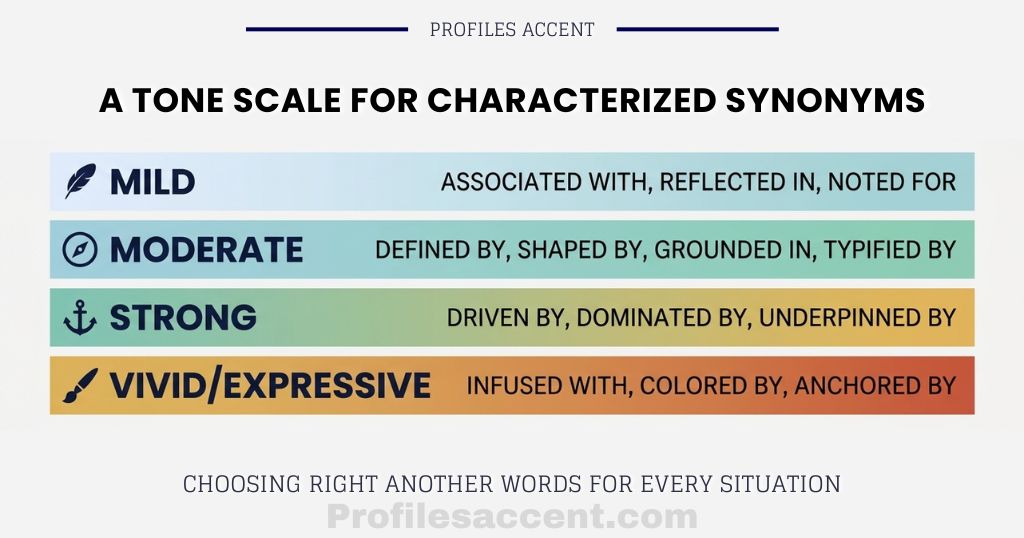
Some replacements are gentle. Others carry more weight. Here is a rough scale from mild to strong:
- Mild → associated with, reflected in, noted for
- Moderate → defined by, shaped by, grounded in, typified by
- Strong → driven by, dominated by, underpinned by
- Vivid/Expressive → infused with, colored by, anchored by
When you want your sentence to feel calm and objective, stay toward the mild end. When you want force or emphasis, move toward the stronger side.
Same Sentence, Better Word: Rewrites Using Characterized Synonyms
Let’s take a few real “characterized by” sentences and rework them across different tones.
Original: The era was characterized by political tension.
- Formal: The era was defined by escalating political instability.
- Academic: Political tension typified the social and legislative climate of that period.
- Creative: The era wore its political tension like a second skin.
- Conversational: That whole period was just heavy with political conflict.
Original: The patient is characterized by chronic fatigue.
- Clinical: The patient presents with persistent fatigue.
- Research: Chronic fatigue was identified as a primary symptom in this case.
- Plain English: The patient’s main symptom is long-term exhaustion.
Original: Her leadership style is characterized by patience.
- Professional: Her leadership is noted for its consistent patience under pressure.
- Narrative: Patience is what defines how she leads.
- Conversational: She leads with a calm patience that others notice right away.
Each version says something slightly different. The right one depends on your audience and your goal.
Formal or Casual? Choosing the Right Another Word for Characterized
- Best for essays and academic papers: typified by, distinguished by, underpinned by, exemplified through, identified by
These signal precision. They signal that you are thinking carefully, not writing loosely.
- Best for professional emails or reports: noted for, defined by, associated with, attributed to
Clean and credible without being stiff.
- Best for storytelling or personal writing: shaped by, colored by, anchored by, rooted in, expressed through
These words bring feeling. They suggest history and texture.
- Words to avoid in formal contexts: set apart by, known for, infused with
These lean conversational. Using them in a research paper or formal report can make your writing feel less authoritative than it should.
A Few Words on Using “Characterized” to Describe People
If you are describing a person, especially their behavior, personality, or identity, word choice matters beyond style.
Clinical words like presenting with or identified by can feel cold and dehumanizing when applied to a person outside a medical setting. A person is not a specimen.
Saying someone is shaped by their environment or known for their resilience respects their full humanity. It describes without reducing.
In writing about mental health, disability, or cultural identity, always ask: does this word describe, or does it define? There is a real difference. Describing is informative. Defining can feel like a label.
Where Writers Go Wrong With Synonyms for Characterized
Swapping without reading the sentence again. Replacing “characterized by” with “distinguished by” and stopping there often leaves the sentence awkward. Sometimes you need to restructure the whole thing, not just swap one word.
Using “typified by” too broadly. This word specifically means the thing is a typical example of a category. If you use it to describe something unusual or unique, it sends the wrong signal entirely.
Confusing “attributed to” with “marked by.” These are not the same. Attributed to connects a quality to a cause or person. Marked by just describes the quality. Using them interchangeably muddies your meaning.
Over-relying on “defined by.” It is clean and flexible, yes. But if every other sentence uses it, your prose starts to feel circular. Rotate.
Words That Orbit “Characterized”: Related Terms Worth Knowing
- Typology refers to a system of classifying things by type. Useful when you are writing about groups, not individuals.
- Distinguishing feature is a noun phrase, not a verb, but it often replaces a full “characterized by” clause more cleanly.
- Hallmark is a strong single noun. “Patience is a hallmark of good leadership” hits harder than “good leadership is characterized by patience.”
- Signature works similarly. “Her signature style” implies both consistency and identity. It is personal and confident.
- Trait keeps things simple. Sometimes the cleanest solution is to drop the passive structure entirely and write: “Her strongest trait is curiosity.”
Choosing the Right Word: A Practical Takeaway
Here is a simple way to decide which replacement fits:
If you are naming a visible feature, use marked by or distinguished by. If you are explaining origins or influence, try rooted in or shaped by. If you are writing research or clinical content, reach for identified by, indicated by, or presented with. If your sentence feels too passive, drop the phrase entirely and rewrite with an active verb.
The word “characterized” is not bad. It is just often the lazy first choice. Now you have the alternatives, the context, and the judgment to pick something better.
Discover More Articles:

I’m Rowan, a language addict who loves exploring how words work in everyday communication. I’ve spent years studying English vocabulary and helping others express themselves more clearly. My goal is simple: make learning new words easy and practical. I focus on real-life examples that show when and how to use different terms. Through clear explanations and honest guidance, I help readers choose the right words for any situation with confidence.