Picture this: you’re writing a cover letter and you type “I am a compassionate person.” You submit it. But so did 47 other applicants, with the exact same word. Or maybe you’re editing an essay and “compassion” appears four times in three paragraphs. You know it needs to change, but every synonym you find feels flat or wrong.
That’s the real problem with finding another word for compassion. It’s not just about swapping one word for another. The replacement has to carry the same emotional weight without shifting the tone in a direction you didn’t intend. The wrong choice can make a warm sentence sound clinical, or a professional statement sound sentimental.
This guide solves that completely.
What Compassion Really Means Before You Replace It
At its core, compassion means feeling someone’s pain and wanting to do something about it. That “wanting to act” part is what separates it from sympathy, which stays at the level of concern, or pity, which often stays at the level of judgment.
It comes from the Latin root compati, meaning “to suffer with.” That’s the soul of the word. You’re not watching from a distance. You’re alongside someone.
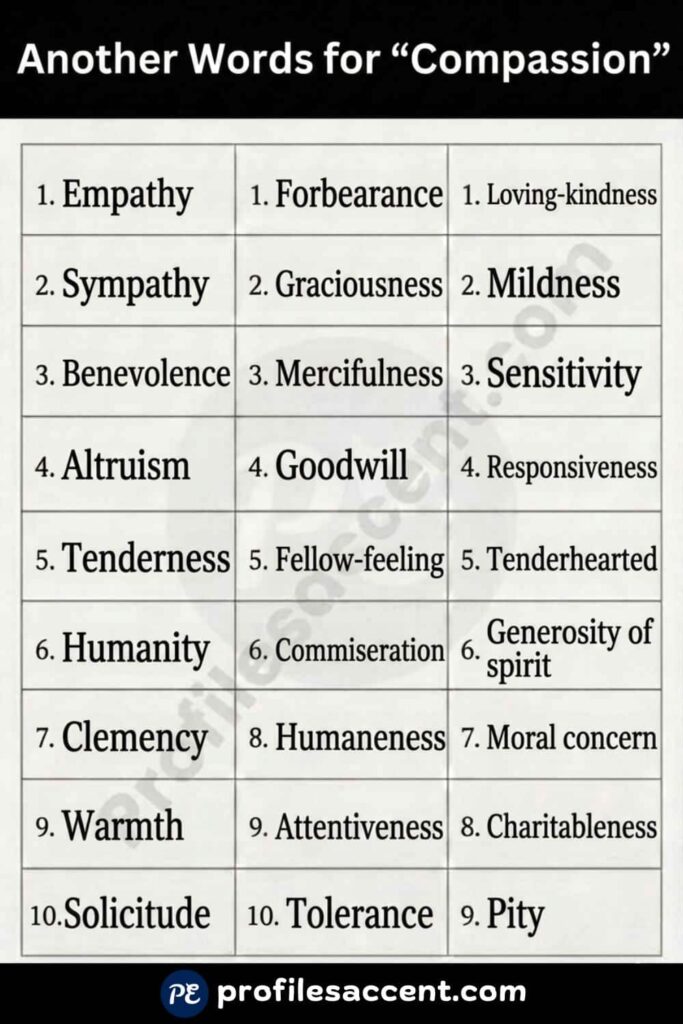
Another Word for Compassion: 35+ Quick Synonyms Table by Context
Find your word fast. Each one is placed in the context where it lands best.
| Word | Tone | Best Used When | Quick Example |
| Empathy | Warm, personal | Writing about emotional understanding | “His empathy helped patients feel heard.” |
| Sympathy | Gentle, formal | Expressing concern from a distance | “She offered her sympathy to the grieving family.” |
| Benevolence | Professional, dignified | Leadership or policy writing | “The director led with quiet benevolence.” |
| Altruism | Action-driven | Resumes, NGO work, medical fields | “Her altruism drove every clinical decision.” |
| Tenderness | Soft, intimate | Creative writing or caregiving contexts | “He responded with unexpected tenderness.” |
| Humanity | Broad, ethical | Essays, social commentary | “The policy was written with basic humanity.” |
| Leniency | Measured, formal | Legal or disciplinary writing | “The court showed leniency given the circumstances.” |
| Clemency | Formal, judicial | Historical or legal texts | “The governor granted clemency to the prisoner.” |
| Warmth | Conversational | Everyday descriptions of people | “Her warmth made the room feel safer.” |
| Solicitude | Refined, professional | Medical or client-care writing | “The staff treated her with genuine solicitude.” |
| Kindheartedness | Casual, friendly | Storytelling or personal essays | “His kindheartedness showed in small acts.” |
| Forbearance | Quiet, patient | Describing restraint and understanding | “She handled the situation with forbearance.” |
| Graciousness | Polished, warm | Professional or social contexts | “The response was handled with graciousness.” |
| Mercifulness | Moral, weighted | Religious or ethical writing | “The teacher’s mercifulness changed his path.” |
| Goodwill | Neutral, positive | Professional relationships, diplomacy | “The gesture built real goodwill between them.” |
| Fellow-feeling | Literary, reflective | Essays or older literary styles | “A fellow-feeling ran through the whole crowd.” |
| Commiseration | Shared, spoken | When grief is expressed openly | “They gathered in mutual commiseration.” |
| Humaneness | Formal noun | Academic or ethical arguments | “The policy lacked basic humaneness.” |
| Concern | Mild, general | Any casual context | “She expressed concern for her neighbor.” |
| Attentiveness | Active, caring | Healthcare, teaching, coaching | “His attentiveness caught the early warning signs.” |
| Tolerance | Measured | When acceptance is the key act | “The community responded with quiet tolerance.” |
| Gentleness | Soft, relational | Parenting, caregiving, therapy | “She approached the topic with gentleness.” |
| Loving-kindness | Spiritual | Meditation, mindfulness writing | “He practiced loving-kindness daily.” |
| Mildness | Calm, restrained | Describing soft leadership or tone | “Her mildness disarmed even the most guarded people.” |
| Sensitivity | Aware, careful | Emotional intelligence contexts | “The counselor’s sensitivity made the difference.” |
| Responsiveness | Clinical, active | Healthcare or professional settings | “Empathetic responsiveness is a trained clinical skill.” |
| Tenderhearted | Personal, warm | Fiction, memoirs, personal letters | “She was tenderhearted in ways she never showed.” |
| Generosity of spirit | Phrase-form | When a single word isn’t enough | “He led with a generosity of spirit.” |
| Moral concern | Academic | Philosophy, ethics papers | “Moral concern guided every decision in the study.” |
| Charitableness | Formal, giving | Written character descriptions | “Her charitableness was never for show.” |
| Pity | Cautionary | Use carefully (see warning below) | “He looked at them with something close to pity.” |
Same Meaning, Different Feel: How These Compassion Synonyms Actually Work
Here’s what most synonym lists skip: two words can mean nearly the same thing but land completely differently in a sentence. Let’s break this down by cluster.
Words That Feel Warm But Stay Passive
Sympathy, concern, warmth, and tenderness all describe an emotional state. They don’t push toward action. If you’re writing a scene where a character feels something deeply but does nothing, these words are exactly right. If you want to show someone who acts, they fall short.
Words That Imply Action
Altruism, solicitude, attentiveness, responsiveness. These carry movement. A professional who shows solicitude isn’t just feeling sad for someone. They’re leaning in. They’re checking. They’re doing. On a resume or in a healthcare context, these choices signal something concrete.
Words With Moral Weight
Clemency, mercifulness, forbearance. These belong in situations where power is involved. A judge shows clemency. A parent shows forbearance. They describe someone who could have been harsh, but chose otherwise. That contrast is what gives them force.
Words That Can Backfire
Pity. Use this carefully. When pity enters a sentence, a subtle hierarchy follows it. It positions the writer above the person being described. That might be intentional in fiction. In professional writing, healthcare, or social commentary, it almost always undermines the tone you want.
How Strong Is Your Word? A Tone Scale for Compassion Synonyms
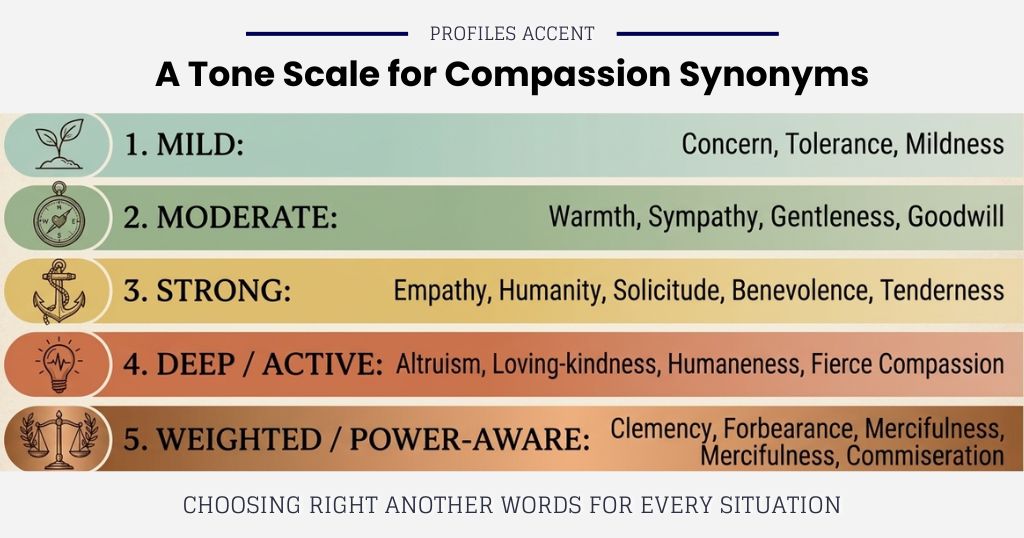
Not all synonyms carry the same emotional weight. Here’s how they line up from lightest to strongest:
- Mild: Concern, tolerance, mildness
- Moderate: Warmth, sympathy, gentleness, goodwill
- Strong: Empathy, humanity, solicitude, benevolence, tenderness
- Deep/Active: Altruism, loving-kindness, humaneness, fierce compassion
- Weighted/Power-Aware: Clemency, forbearance, mercifulness, commiseration
If a sentence needs quiet background emotion, reach toward the mild end. If you’re writing about someone whose compassion defines them or changes a situation, go deeper.
Sentence Rewrites Using Synonyms for Compassion
Original: “She was compassionate toward her students.”
- Formal: “She approached each student with genuine solicitude, adjusting her method to meet their needs.”
- Casual: “She had a real warmth for her students that they never forgot.”
- Academic: “Her demonstrated humaneness in the classroom contributed to measurable improvements in student engagement.”
- Creative: “Something tender lived in the way she looked at the struggling ones, a kindheartedness she never named but always showed.”
Original: “He showed compassion during the crisis.”
- Professional: “His benevolence under pressure helped stabilize the team’s morale.”
- Story-driven: “He didn’t look away. That fellow-feeling he carried, quiet and constant, was the thing that held the room together.”
Original: “The organization is built on compassion.”
- Resume/Formal: “The organization is grounded in altruism and humanitarian concern.”
- Essay: “At its foundation, the institution operates from a principle of humaneness rather than efficiency.”
The Synonym That Sounds Right But Isn’t: A Warning About Pity
There’s a real difference between compassion and pity, and it matters most in writing.
- Compassion says: I see your pain, and I am here with you.
- Pity says: I see your pain, and I’m glad it’s not mine.
That second version may not be what you intend, but it’s what readers often feel. If your sentence includes pity and the subject is a real person, a marginalized group, or someone in a professional context, reconsider. Commiseration or fellow-feeling will carry shared grief without the hierarchy. Empathy will carry depth without distance.
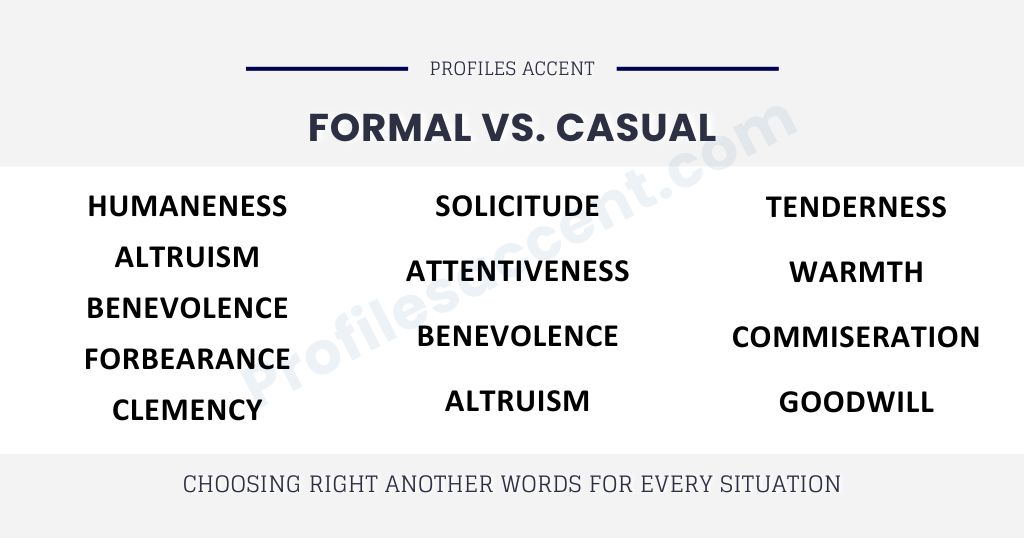
Formal or Casual? Picking the Right Compassionate Word for Your Context
For academic essays and formal writing: humaneness, altruism, benevolence, moral concern, forbearance, clemency
For professional profiles and resumes: solicitude, attentiveness, benevolence, responsiveness, altruism
For creative writing and fiction: tenderness, kindheartedness, fellow-feeling, warmth, commiseration
For everyday speech or casual writing: warmth, concern, goodwill, gentleness
Avoid using loving-kindness in formal academic writing. It carries a specific spiritual meaning from Buddhist practice. In a professional essay, it can feel out of place unless the context genuinely supports it.
The Compassion Synonyms Nobody Talks About (But Should)
Most synonym lists paint compassion as soft. But there’s another version that doesn’t get much attention: the kind that holds firm.
- A social worker who refuses to cover for a client’s harmful choices.
- A teacher who gives a student the honest grade they need rather than the comfortable one.
- A friend who tells a hard truth at exactly the wrong moment, because silence would be worse.
This version has been called “fierce compassion,” and it needs different words.
For this, reach toward: accountability with care, moral courage, radical concern, principled empathy, tough-minded kindness. These aren’t standard thesaurus entries. But in essays about justice, leadership, or social change, they’re far more precise than “compassion” alone.
Mistakes Writers Make When Swapping Out Compassion
Using empathy and compassion as if they’re identical. Empathy is the feeling. Compassion is what follows from it. In clinical or professional writing, this difference is significant.
Choosing sympathy when you mean active support. Sympathy expresses concern. It doesn’t imply doing anything. If your sentence implies action, sympathy will undercut it.
Stacking synonyms for effect. Writing “her warmth and benevolence and kindheartedness” doesn’t intensify the point. It dilutes it. Pick one strong word.
Using archaic words like ruth or fellow-feeling in modern professional contexts. They work beautifully in essays or fiction. In a cover letter or report, they’ll read as odd.
Words That Live Near Compassion Without Meaning the Same Thing
Equanimity: Not quite compassion, but it’s what prevents burnout in people who feel deeply. It’s the ability to stay steady. In writing about healthcare workers or leaders, pairing compassion with equanimity shows emotional intelligence.
Philanthropy: This covers organized, often financial giving. It’s public-facing compassion. Use it when the scale of giving is the point.
Integrity: Sometimes compassion without integrity becomes enabling. When writing about ethical care or leadership, these two words often belong in the same sentence.
Generosity: Generosity can exist without emotional connection. Compassion without generosity can exist too. They overlap but aren’t the same. Knowing the gap makes your writing more precise.
Quick Spelling Note on Compassion
It’s spelled C-O-M-P-A-S-S-I-O-N. Two S’s in the middle, not one. Common errors: compasion, compasssion, compassoin. The adjective is compassionate, with an -ate ending, not -it or -ation.
So Which Synonym for Compassion Should You Actually Use?
The word you pick shapes how the reader sees both the person described and you as the writer. Sympathy creates distance. Altruism signals action. Pity creates hierarchy. Solicitude implies care that’s already happening.
Before you replace “compassion,” ask: does this person feel, or do they act? Are they equal to the person they’re helping, or above them? Is this formal writing, storytelling, or something spoken?
Answer those three questions, and the right word becomes obvious.
Discover More Articles:

I’m Rowan, a language addict who loves exploring how words work in everyday communication. I’ve spent years studying English vocabulary and helping others express themselves more clearly. My goal is simple: make learning new words easy and practical. I focus on real-life examples that show when and how to use different terms. Through clear explanations and honest guidance, I help readers choose the right words for any situation with confidence.