You typed “integrate” three times in one paragraph. Now it sounds repetitive, but nothing else feels right. “Combine” seems too simple. “Merge” feels off. “Unify” might work, but you’re not sure if it fits the sentence.
This happens to a lot of writers. The word “integration” carries a lot of weight, and swapping it blindly can change your meaning without you realizing it.
This guide gives you real alternatives, sorted by where and how they work best. Not just a word dump. Actual guidance.
What Integration Actually Means (And Why Tone Matters)
At its core, integration means bringing separate things together so they function as one. But the emotional weight shifts depending on the setting. In social contexts, it implies fairness and belonging. In business, it suggests efficiency. In technology, it means two systems talking to each other smoothly. The tone is almost always purposeful. Integration is never accidental.
35+ Another Words for Integration: Synonyms at a Glance of Integration
| Word | Tone | Best Used When | Short Example |
| Unification | Formal | Groups or systems becoming one | Team unification improved results |
| Incorporation | Neutral | Adding one part into a larger whole | Incorporation of new data helped |
| Synthesis | Academic | Combining ideas into something new | A synthesis of both theories works |
| Consolidation | Business | Merging scattered things efficiently | Department consolidation cut costs |
| Amalgamation | Formal | Two equal things forming one new entity | School amalgamation took two years |
| Fusion | Creative | Two things blending closely | Cultural fusion shaped the city |
| Blending | Casual | Gentle, natural mixing | Blending styles made it feel fresh |
| Assimilation | Social | Being absorbed into a larger group | Assimilation was slow but steady |
| Inclusion | Social | Making sure no one is left out | Inclusion was the school’s top goal |
| Cohesion | General | Parts staying together naturally | Team cohesion improved over time |
| Coordination | Professional | Parts working together smoothly | Better coordination solved the issue |
| Merging | Business/Tech | Two things becoming one | Merging the files took seconds |
| Embedding | Tech | Placing something inside a system | Embedding the tool was simple |
| Interweaving | Creative | Complex, close connection | Interweaving plots kept readers hooked |
| Mainstreaming | Education | Bringing into the standard system | Mainstreaming helped special students |
| Harmonization | Policy/Music | Making different parts match | Harmonization of rules was needed |
| Collaboration | Professional | Working together toward a goal | Collaboration between teams grew |
| Linkage | Technical | Connecting two separate parts | Linkage between systems improved |
| Joining | Simple | Basic connection of parts | Joining the programs saved time |
| Coupling | Engineering | Technical connection of two systems | Coupling the modules worked well |
| Absorption | Social/Biology | One thing taking in another fully | Absorption into the culture was fast |
| Alignment | Strategy | Getting parts to point the same way | Strategic alignment was the goal |
| Weaving | Creative | Connecting parts like threads | Weaving feedback into the design helped |
| Coalescence | Formal | Gradual coming together | Slow coalescence formed one strong unit |
| Federation | Political/Tech | Units staying separate but connected | A federation of services ran better |
| Bridging | Social/Tech | Connecting two distant things | Bridging the gap took careful work |
| Stitching together | Informal | Fixing or connecting loosely | Stitching the parts together worked |
| Cross-linking | Tech | Creating connections across systems | Cross-linking data improved search |
| Orchestration | IT/Cloud | Managing many parts to work as one | Cloud orchestration reduced errors |
| Reconciliation | Essay/Finance | Bringing opposing parts into agreement | Data reconciliation fixed the report |
| Triangulation | Research | Combining multiple methods or sources | Triangulation made the findings stronger |
| Interoperability | Tech | Two systems sharing data smoothly | Interoperability was the missing piece |
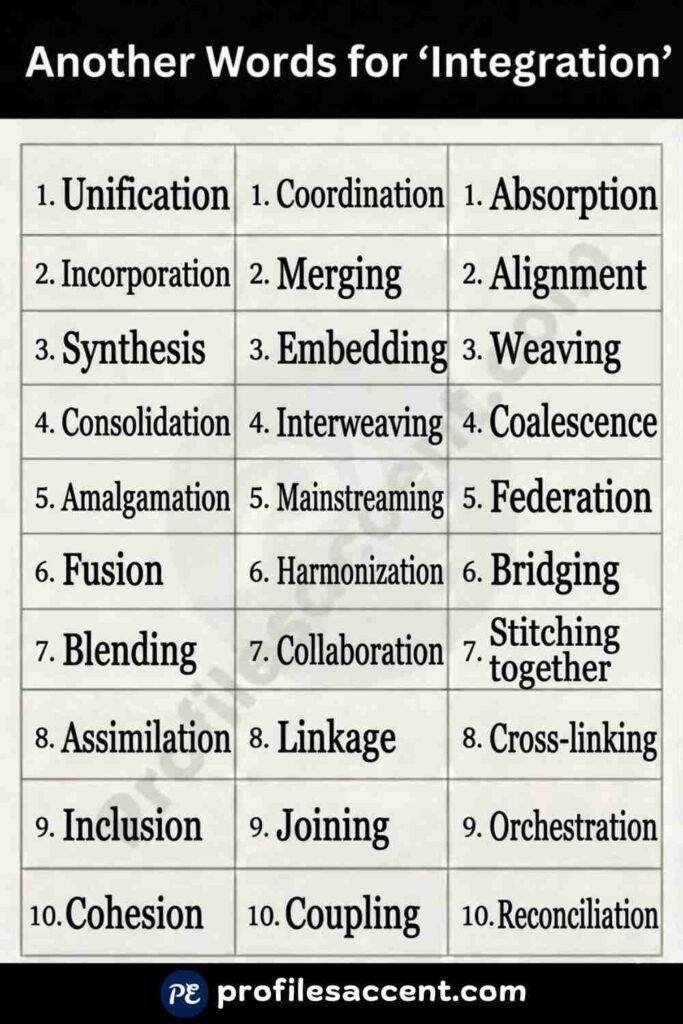
How the Same Idea Changes When You Integrate Different Words
The right word depends on more than the dictionary definition. It depends on who is reading and what story you are telling.
In Social Writing
“Inclusion” keeps the focus on belonging. “Assimilation” changes the tone entirely. It suggests someone had to give up something to fit in. These two words are not interchangeable in sociology, even though many writers treat them that way.
Use “inclusion” when the goal is welcoming.
Use “assimilation” carefully, only when describing cultural absorption.
In Academic Writing
“Synthesis” does the heavy lifting. It implies you took separate ideas and built something new from them. “Incorporation” works when you are adding a source into your own argument without transforming it. “Reconciliation” fits when your essay is resolving two conflicting findings.
In Business Writing
“Consolidation” signals efficiency and control. “Amalgamation” is more formal and usually means two organizations merged into a brand-new one. “Alignment” works for strategy documents without sounding too corporate.
In Technology
“Embedding” means something is placed deep inside a system. “Interoperability” is the most precise term when two different platforms can exchange data. “Orchestration” works best in cloud and IT environments where many services are managed together.
From Gentle to Precise: A Tone Scale for Integration Synonyms
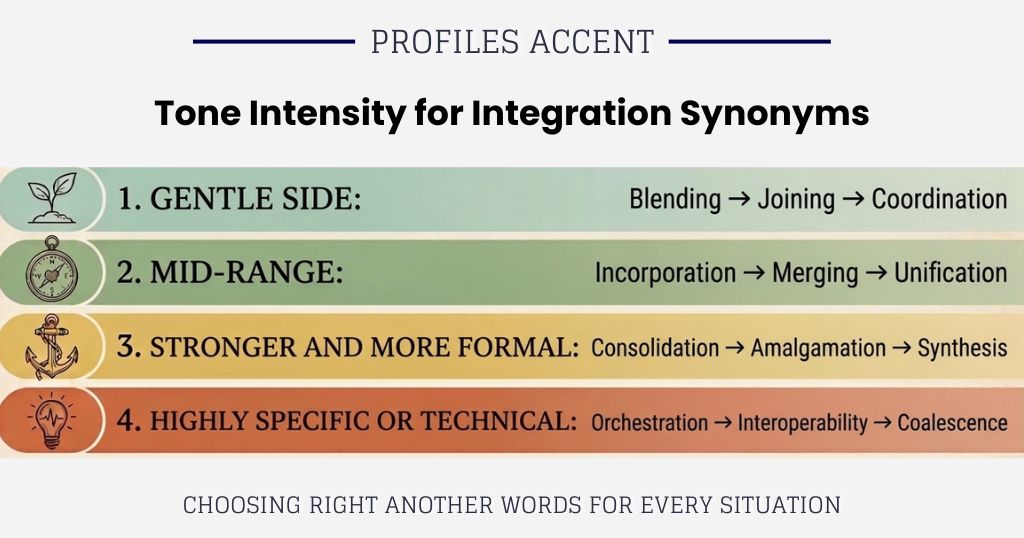
Not all synonyms carry equal weight. Here is how the intensity builds:
- Gentle side: Blending → Joining → Coordination
- Mid-range: Incorporation → Merging → Unification
- Stronger and more formal: Consolidation → Amalgamation → Synthesis
- Highly specific or technical: Orchestration → Interoperability → Coalescence
If you are writing for a general audience, stay in the gentle to mid-range zone. If you are writing for specialists, the stronger and technical words carry more precision.
Watch What Happens When You Swap “Integrate” in Real Sentences
Original (weak): The company worked on the integration of its teams.
- Formal: The organization pursued a structured consolidation of its regional divisions.
- Casual: The company brought its teams together under one roof.
- Academic: This process reflected the systematic unification of operational units across departments.
- Creative: Slowly, the teams stopped feeling like strangers and started working as one.
Original (weak): Schools focused on the integration of students with disabilities.
- Formal: Schools implemented mainstreaming policies for students with special needs.
- Casual: Schools worked hard to include every student, no matter their ability.
- Academic: The study examined inclusion frameworks as alternatives to segregated learning environments.
Original (weak): The software needed better integration.
- Formal: The system required enhanced interoperability across its core modules.
- Casual: The apps needed to work together more smoothly.
- Technical: Developers prioritized cross-system linkage and orchestration to reduce failure points.
Each rewrite shifts the reader’s understanding. The facts stay the same. The impression changes.
When Certain Synonyms for Integration Cross a Line
Some synonyms carry loaded histories. A few things worth knowing:
Assimilation has a painful history in the context of indigenous peoples and immigrant communities. Using it casually in social writing can feel dismissive or historically blind. If you mean “fitting in,” try “inclusion” or “belonging” instead.
Desegregation is specific to racial history in countries like the United States. It refers to ending legally enforced separation. Do not use it as a light synonym for “integration” in general contexts.
Mainstreaming in education refers specifically to placing students with disabilities in standard classrooms. Using it in a business or tech setting can sound odd or out of place.
Common Errors Writers Make While Trying to Integrate New Vocabulary
- Treating “synthesis” and “combination” as the same thing.
Synthesis implies something new is created. Combination just means two things exist together. Big difference in a research paper.
- Using “amalgamation” in casual speech.
It sounds odd in everyday writing. Save it for formal documents or company announcements.
- Confusing “merging” with “federation.”
When two things merge, they lose their separate identities. In a federation, they keep their independence while sharing some functions. This matters a lot in both political writing and software architecture.
- Overusing “alignment.”
Strategy documents are full of it. At a certain point, it stops meaning anything. If two departments are aligning, say what that actually looks like in practice.
- Using “conflate” as a synonym.
“Conflate” means wrongly mixing two things that should stay separate. It is not a neutral word. Using it as a simple synonym for “integrate” will confuse academic readers immediately.
Words That Live Near “Integration” But Mean Something Different
These are not direct synonyms, but they live near the same idea:
Interplay describes how two things influence each other without fully combining. Useful in analysis.
Convergence is when two separate paths move toward the same point. Great for trends and strategy writing.
Cohesion focuses on how well parts stay together once combined. It says more about the result than the process.
Complementarity suggests two things work better because of their differences, not in spite of them. Strong in research and relationship writing.
Cross-pollination is a creative way to describe ideas from one field improving another. Works well in innovation writing.
So Which Word Should You Actually Use?
Here is a fast way to decide.
- Adding a smaller part into a larger structure? Use incorporation.
- Two equal things joining to form something new? Use amalgamation or fusion.
- Bringing ideas together in a research paper? Use synthesis or reconciliation.
- Making sure people belong and are not excluded? Use inclusion.
- Technology systems sharing data? Use interoperability or orchestration.
- Everyday writing for a broad audience? Use joining, blending, or bringing together.
The goal is not to sound smarter. The goal is to say exactly what you mean, in a way the reader understands the first time they read it.
Discover More Articles:

I’m Rowan, a language addict who loves exploring how words work in everyday communication. I’ve spent years studying English vocabulary and helping others express themselves more clearly. My goal is simple: make learning new words easy and practical. I focus on real-life examples that show when and how to use different terms. Through clear explanations and honest guidance, I help readers choose the right words for any situation with confidence.