You typed “access” three times in one paragraph. It happens. The word is so useful that writers lean on it constantly, then suddenly notice it’s everywhere. The real problem is not repetition alone. It is that “access” carries different meanings depending on where you use it, and swapping it carelessly can change your tone completely.
“Entry” sounds legal. “Availability” sounds policy-driven. “Reach” sounds human. Choosing the right one is what separates clear writing from forgettable writing.
So What Does “Access” Really Mean?
At its core, access means the ability to reach, use, or enter something. That something could be a building, a database, a healthcare system, or an opportunity. The word sits in a neutral zone: not too formal, not too casual. That is exactly why writers overuse it. And overuse flattens meaning.
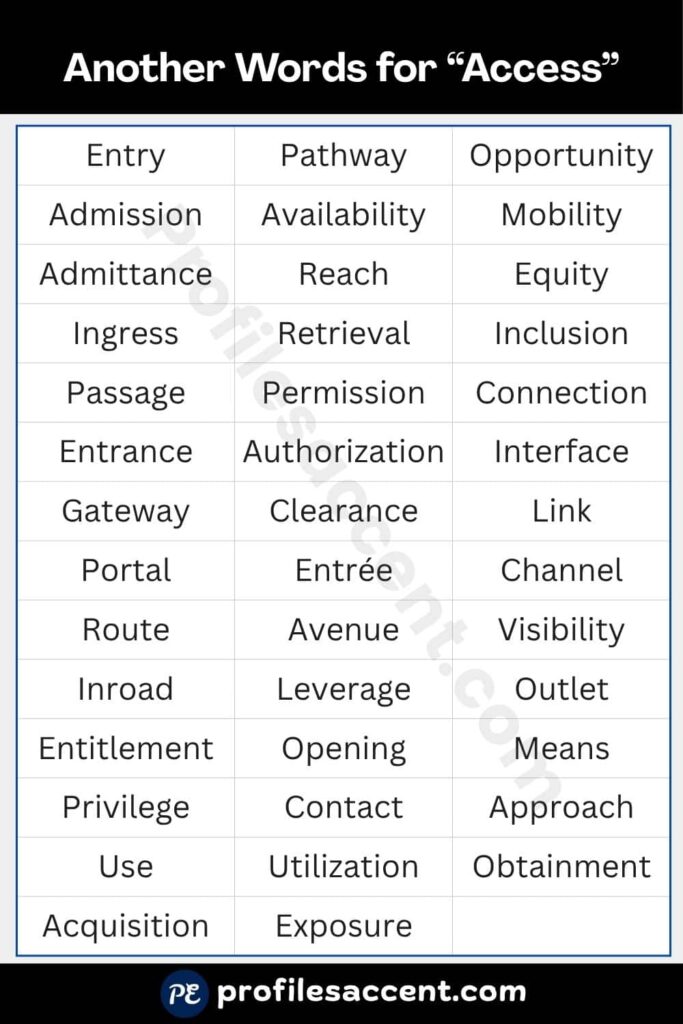
Your Go-To Table of 40+ Synonyms for Access
| Word | Tone | Best Used When | Quick Example |
| Entry | Neutral | Physical or permission-based situations | “Entry to the building requires a badge.” |
| Admission | Semi-formal | Institutions, events, schools | “Admission to the program was competitive.” |
| Admittance | Formal | Legal or security contexts | “Admittance was restricted to staff only.” |
| Ingress | Technical | Architecture, real estate, engineering | “The fire code requires a secondary ingress.” |
| Passage | Neutral | Routes, channels, physical movement | “The passage through the checkpoint was slow.” |
| Entrance | Everyday | Physical doorways or starting points | “The entrance to the clinic was wheelchair-friendly.” |
| Gateway | Figurative | Opportunities, systems, transitions | “This degree is a gateway to public service.” |
| Portal | Digital/Formal | Online systems, platforms | “Log in through the student portal.” |
| Pathway | Figurative | Opportunities, career, education | “They created a clear pathway for low-income applicants.” |
| Availability | Policy-based | Resources, services, healthcare | “Medication availability in rural areas is limited.” |
| Reach | Human/Warm | People, communities, outreach | “The program expanded its reach into underserved areas.” |
| Retrieval | Technical | Data, files, computing | “Retrieval of archived records takes under a second.” |
| Permission | Legal/Formal | Authorization, rights | “You need written permission to view those files.” |
| Authorization | Formal | Security, IT, institutional | “Authorization was denied at the server level.” |
| Clearance | High-security | Government, medical facilities, IT | “Security clearance is required for this floor.” |
| Entrée | Social/Prestige | Networking, elite environments | “The fellowship gave her an entrée into research circles.” |
| Use | Casual | Everyday language | “Use of the equipment is limited to members.” |
| Utilization | Academic | Healthcare policy, resources | “Healthcare utilization dropped during the lockdown.” |
| Obtainment | Formal | Acquiring rights or resources | “Obtainment of a visa proved difficult.” |
| Acquisition | Formal/Business | Data, assets, information | “Data acquisition follows a strict privacy protocol.” |
| Exposure | Contextual | Knowledge, media, culture | “Early exposure to reading builds strong vocabulary.” |
| Opportunity | Human | Social equity, education | “Every child deserves opportunity regardless of zip code.” |
| Mobility | Systemic | Social, economic, physical movement | “Economic mobility depends on access to quality schools.” |
| Equity | Advocacy | Rights, fairness, resources | “Health equity starts with fair distribution of services.” |
| Inclusion | Social | Belonging, participation | “Inclusion means more than open doors.” |
| Connection | Relational | Networks, relationships, digital | “A strong internet connection is essential for remote work.” |
| Interface | Digital | Software, systems, user interaction | “The new interface allows faster record retrieval.” |
| Link | Digital/Casual | Websites, networks, references | “The link to the database was broken.” |
| Channel | Operational | Communication, distribution, media | “New channels were opened for community feedback.” |
| Route | Physical | Travel, infrastructure, logistics | “The route to the hospital needs better signage.” |
| Avenue | Figurative | Options, paths, solutions | “Several avenues exist for appealing the decision.” |
| Visibility | Contextual | Information, status, public records | “Increased visibility of case files helped the legal team.” |
| Inroad | Figurative | Breaking into systems or markets | “The startup made early inroads into the healthcare sector.” |
| Leverage | Strategic | Using existing resources or relationships | “The partnership gave them leverage over supply chains.” |
| Outlet | Contextual | Expression, resources, distribution | “Community centers provide an outlet for youth programs.” |
| Entitlement | Rights-based | Legal or civic contexts | “Entitlement to public records is protected by law.” |
| Opening | Casual/Figurative | Opportunity, space, beginning | “This creates an opening for marginalized voices.” |
| Means | Practical | Methods, tools, resources | “They lacked the means to afford proper treatment.” |
| Privilege | Social/Critical | Power, inequality, advantage | “Access to legal help is often a privilege, not a right.” |
| Contact | Relational | People, networks, services | “Direct contact with the department improved response time.” |
| Approach | Neutral | Methods, physical routes | “A multi-layered approach to care delivery works best.” |
How the Meaning Shifts: Access Is Not Just One Thing
“Access” does not mean one thing. It shifts depending on context. Here is how to think about it.
When it is about permission: Use admission, admittance, clearance, or authorization. These words signal that someone has been evaluated and allowed in. They carry a gatekeeping quality.
When it is about physical space: Entry, entrance, ingress, passage, and route all describe ways of getting somewhere. Ingress is the most technical. Entrance is the most familiar.
When it is about fairness or systems: Reach, availability, equity, inclusion, and mobility work better. These words capture the broader idea of whether people can realistically get what they need, not just whether the door exists.
When it is about data or technology: Retrieval, interface, portal, authorization, and link all fit digital contexts well. They sound natural in technical writing without feeling stiff.
When it is about opportunity: Gateway, pathway, opening, avenue, and entrée all suggest a door that leads somewhere meaningful. Each carries a slightly different flavor. Gateway implies transformation. Entrée implies social capital. Pathway implies a structured journey.
From Mild to Powerful: A Tone Scale for Access Synonyms
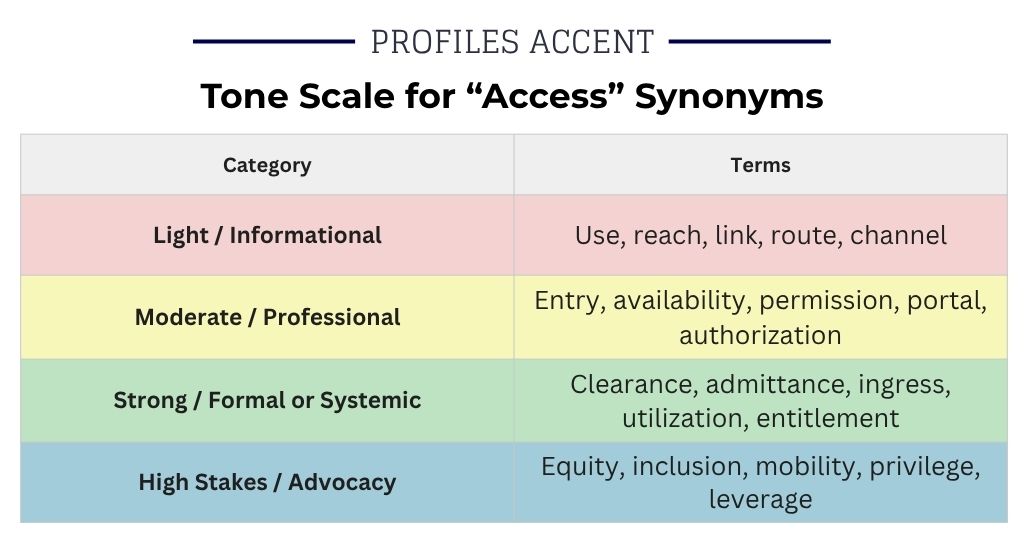
Some synonyms feel neutral. Others carry emotional weight. Here is how they scale:
- Light / Informational: Use, reach, link, route, channel
- Moderate / Professional: Entry, availability, permission, portal, authorization
- Strong / Formal or Systemic: Clearance, admittance, ingress, utilization, entitlement
- High Stakes / Advocacy: Equity, inclusion, mobility, privilege, leverage
When you are writing about healthcare gaps or educational inequality, words like equity and mobility carry more power than access ever could. They signal that you understand what is actually at stake.
Sentence Rewrites: Watch What Happens When You Swap “Access” Out
Sometimes the best way to understand word choice is to watch a sentence shift with it.
Original: “We need to improve access to food in low-income communities.”
- Formal essay: “Expanding equitable food distribution in low-income communities requires systemic investment.”
- Casual article: “More people in low-income neighborhoods need a real shot at affordable food.”
- Policy report: “Improving food availability in underserved areas remains a public health priority.”
- Advocacy piece: “Food equity is not a luxury. It is a right.”
Each version says the same thing. Each one lands differently depending on who is reading it and why.
Original: “Students need access to information online.”
- Academic: “Unrestricted information availability supports independent research among students.”
- Digital policy: “Open internet connectivity enables students to utilize educational resources freely.”
- Plain English: “Students learn better when they can look things up without barriers.”
The synonym you choose is a small decision with a large effect.
When Two Synonyms for Access Look the Same But Are Not
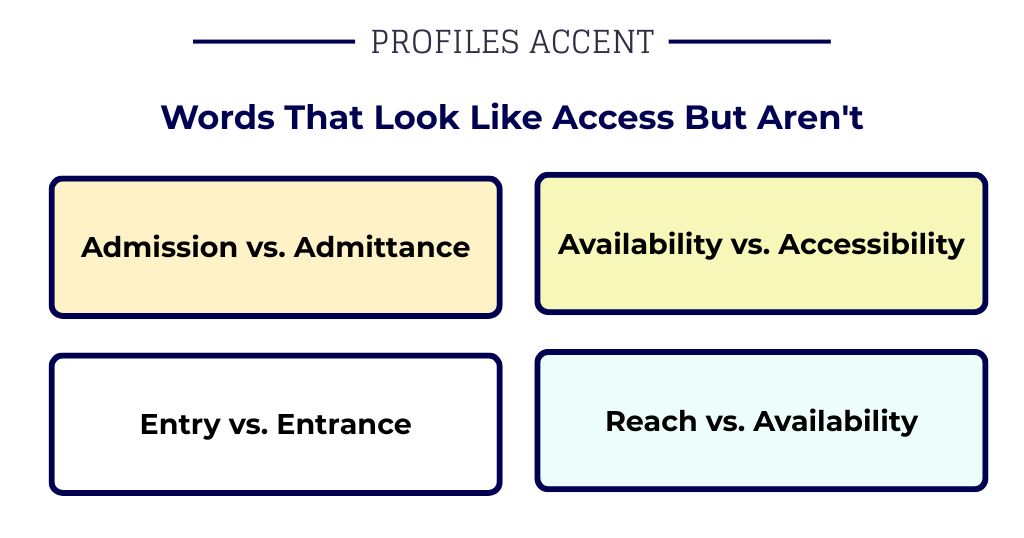
A few pairs trip writers up repeatedly.
Admission vs. Admittance: Both describe permission to enter. Admission is broader and more common. Admittance is more formal and often used in physical or legal settings. You gain admission to a university. You are denied admittance to a restricted lab.
Availability vs. Accessibility: These are not the same. Availability means something exists. Accessibility means people can actually use it. A service can be available but not accessible if people cannot afford it, reach it, or understand it.
Entry vs. Entrance: Entry describes the act or right. Entrance describes the place or beginning. “He was denied entry” works. “He was denied entrance” is slightly more physical in feel.
Reach vs. Availability: Reach is warmer and more human. It implies active effort to include people. Availability is more neutral and administrative.
The Right Other Word for Access, Matched to Your Topic
Another word for access to care / healthcare:
Availability of services, care delivery, healthcare utilization, medical reach, continuity of care
Another word for access to information:
Information availability, data transparency, freedom of information, open records, informational reach
Another word for access to resources:
Resource availability, asset distribution, service reach, equitable allocation
Another word for access to opportunities:
Inclusive pathways, upward mobility, socioeconomic openings, equal footing
Another word for access to food:
Food availability, nutritional equity, food security, dietary reach
When you are writing an essay or policy paper, these phrase-level swaps often work better than single-word synonyms. They match the register of serious writing.
Mistakes Writers Make When Replacing the Word Access
Picking a synonym from a list without checking its tone is the most common error. “Ingress” sounds natural in an engineering report. It sounds stiff in a community newsletter.
Using “utilization” in casual writing is another one. It is a healthcare and policy word. In a blog post about cooking, it reads as robotic.
Replacing access with “privilege” needs care. In a social justice context, it is powerful. In a technical document, it introduces political weight that may not belong there.
And sometimes, keeping the word “access” is simply the right choice. Repetition done well is a technique. Repetition done carelessly is a habit.
Words That Live Near “Access” But Mean Something Different
- Egress: The opposite of ingress. The way out. Used in architecture and legal writing.
- Barrier: The antonym of access in systemic contexts. What stops people from getting in.
- Exclusion: The opposite of access in social or civic writing.
- Throughput: Used in computing and logistics. How much passes through a channel over time.
- Permeability: Used in science and sometimes in policy to describe how open a system is to movement or entry.
Pick Your Synonym for Access and Write With Confidence
The word “access” is reliable. It is clear. But clear does not always mean precise. When you are writing about health systems, choose words that reflect what is really happening. When you are writing about technology, choose words that match the digital environment. When you are writing about people, choose words that sound like a human made a decision, not a policy document.
The right synonym does not just replace a word. It sharpens your point and tells your reader exactly what you mean.
Discover More Articles:

I’m Rowan, a language addict who loves exploring how words work in everyday communication. I’ve spent years studying English vocabulary and helping others express themselves more clearly. My goal is simple: make learning new words easy and practical. I focus on real-life examples that show when and how to use different terms. Through clear explanations and honest guidance, I help readers choose the right words for any situation with confidence.