You just finished writing a sentence like: “The manager downplayed the issue.“ It works. But it feels flat. Or maybe you’ve used “downplay” three times in the same paragraph and your writing is starting to sound repetitive.
Word choice does more than fill space. It signals how seriously you take something, and how seriously you want your reader to take it. The difference between minimized and glossed over is not just stylistic. It’s a shift in tone, intent, and sometimes even morality.
This guide gives you 35+ real alternatives, helps you pick the right one for your context, and shows you what happens when you pick the wrong one.
So What Does Downplay Really Mean?
To downplay something is to make it seem smaller, less serious, or less important than it really is. The intent behind it can vary widely. Sometimes it’s polite. Sometimes it’s deceptive. Sometimes it’s self-protective.
That range of intent is exactly why one synonym never fits every situation.
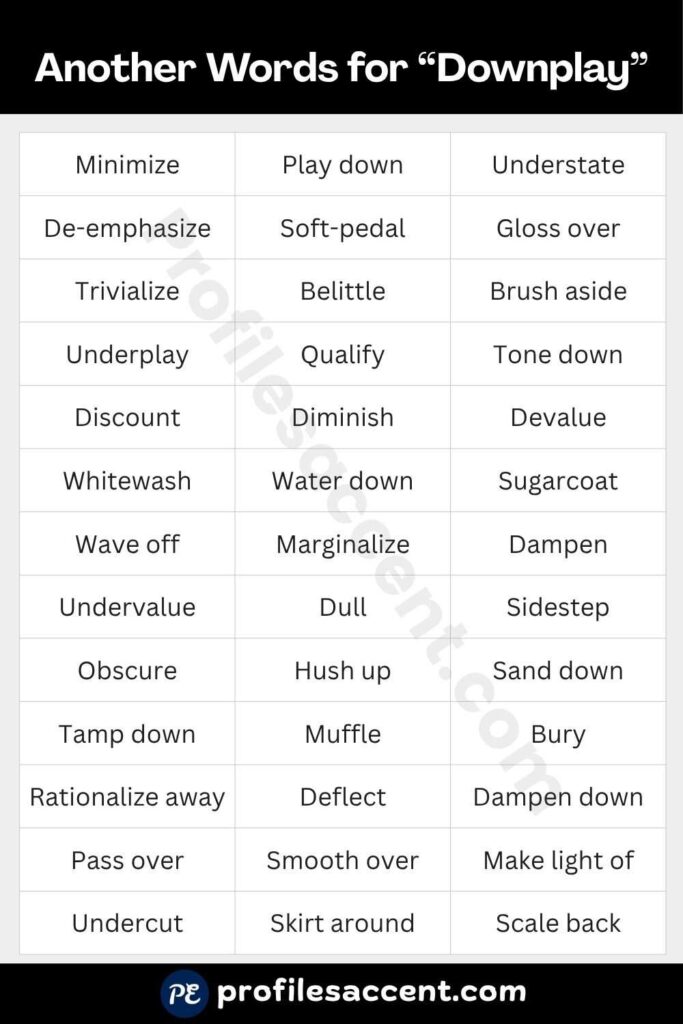
Synonyms for Downplay: 35+ Quick-Access Table
Here are 35+ alternatives, grouped by tone so you can find the right fit fast.
| Word | Tone | Best Used When | Example |
| Minimize | Neutral | Reducing significance generally | She minimized the risk involved. |
| Play down | Informal | Casual speech or writing | He played down his role in the project. |
| Understate | Formal | Tactful, measured writing | The report understated the damage. |
| De-emphasize | Professional | Business or academic writing | They chose to de-emphasize costs. |
| Soft-pedal | Figurative | Avoiding controversy carefully | The team soft-pedaled the bad news. |
| Gloss over | Slightly negative | Brushing past something quickly | She glossed over the ethical issues. |
| Trivialize | Critical | When something is unfairly dismissed | He trivialized her concerns. |
| Belittle | Negative/personal | Personal dismissal of someone | She felt belittled by his response. |
| Brush aside | Dismissive | Casual or rude dismissal | He brushed aside every complaint. |
| Underplay | Mild | Not giving enough weight to something | The article underplayed the impact. |
| Qualify | Academic | Limiting a claim carefully | She qualified her findings cautiously. |
| Tone down | Conversational | Making something less intense | He toned down his original statement. |
| Discount | Neutral/skeptical | Ignoring or dismissing a factor | They discounted the early warnings. |
| Diminish | Slightly formal | Reducing worth or impact | The speech diminished their effort. |
| Devalue | Formal | Reducing perceived worth | Critics devalued her contribution. |
| Whitewash | Strongly negative | Covering up wrongdoing | The report whitewashed the scandal. |
| Water down | Informal | Weakening something on purpose | The policy was watered down badly. |
| Sugarcoat | Informal | Making bad news sound better | Stop sugarcoating what happened. |
| Wave off | Very casual | Dismissing without engagement | He waved off every concern raised. |
| Marginalize | Academic/political | Pushing an idea to the edges | Critics marginalized her early work. |
| Dampen | Mild | Reducing enthusiasm slightly | His tone dampened the excitement. |
| Undervalue | Neutral | Not giving full credit or worth | The company undervalued her skills. |
| Dull | Creative | Reducing sharpness or impact | Fear dulled his sense of urgency. |
| Sidestep | Evasive | Avoiding a point deliberately | The politician sidestepped the question. |
| Obscure | Negative | Making something harder to see | The language obscured the real issue. |
| Hush up | Informal/negative | Suppressing information | They tried to hush up the complaint. |
| Sand down | Figurative | Smoothing out a sharp truth | The press release sanded down the facts. |
| Tamp down | Slightly formal | Suppressing or limiting intensity | She tamped down any growing concern. |
| Muffle | Creative | Reducing volume or clarity | The statement muffled the real impact. |
| Bury | Strong/negative | Hiding something on purpose | They buried the story on page ten. |
| Rationalize away | Psychological | Explaining something out of existence | He rationalized away every warning sign. |
| Deflect | Evasive | Redirecting attention from a point | She deflected questions about the delay. |
| Dampen down | Slightly formal | Reducing emotional or factual weight | The findings were dampened down deliberately. |
| Pass over | Neutral | Skipping something intentionally | The speaker passed over the controversy. |
| Smooth over | Diplomatic | Making conflict look manageable | Leadership tried to smooth over tensions. |
| Make light of | Informal | Treating something as not serious | He kept making light of her frustration. |
| Undercut | Sharp/critical | Reducing the strength of a point | His tone undercut the seriousness. |
| Skirt around | Evasive | Avoiding without confronting | They skirted around the main issue. |
| Scale back | Neutral | Reducing scope or seriousness | She scaled back her original claims. |
| Paint over | Figurative | Covering a flaw with appearance | The review painted over major problems. |
| Suppress | Strong | Actively stopping something from showing | Evidence was suppressed in the case. |
Not All Downplay Synonyms Work the Same Way
Not all these words do the same job. Here is where most synonym lists fail people. They give you a list but not a map.
Mild and polite territory
Understate, qualify, de-emphasize, tone down. These words suggest restraint, not deception. A scientist qualifies findings because the data supports caution. A diplomat understates tension to keep talks going. The action is deliberate but not dishonest.
Middle ground: Evasive but not quite dishonest
Soft-pedal, gloss over, sidestep, smooth over. These are where things get murky. You are not lying, but you are not being fully open either. A public relations team soft-pedals a recall. A manager glosses over a failed quarter. The intent is to manage perception, not communicate clearly.
Strong dismissal territory
Trivialize, belittle, marginalize, brush aside. These words carry weight because they involve someone actively diminishing another person or idea. Trivializing someone’s grief is not just understatement. It is invalidation. This cluster often shows up in emotional or interpersonal contexts.
Cover-up language
Whitewash, suppress, bury, hush up. These are not subtle. They describe deliberate concealment. Use them when the intent is clearly to hide something, not just reduce it.
How Strong Is the Word You Are Picking? (Tone Intensity Scale)
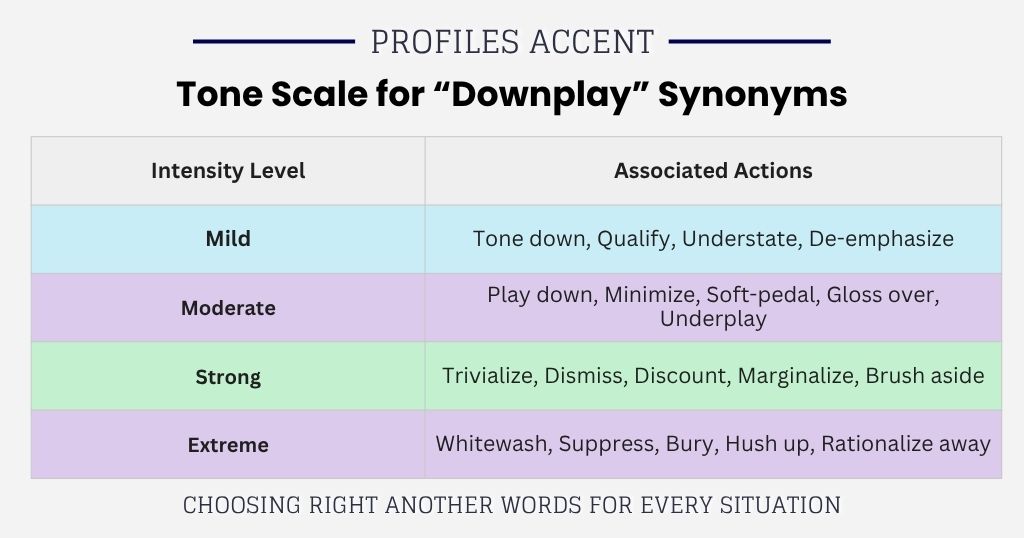
If you want to signal how serious the downplaying is, this scale helps:
- Mild: Tone down → Qualify → Understate → De-emphasize
- Moderate: Play down → Minimize → Soft-pedal → Gloss over → Underplay
- Strong: Trivialize → Dismiss → Discount → Marginalize → Brush aside
- Extreme: Whitewash → Suppress → Bury → Hush up → Rationalize away
Each step up the scale signals more intent, more consequence, and often more moral weight. Choosing the right intensity changes how your reader perceives the situation entirely.
Swapping Out Downplay: Real Sentence Rewrites
Original: The official downplayed the incident.
- Formal: The official chose to de-emphasize the incident in his public statement.
- Academic: The official’s account systematically understated the severity of the incident.
- Casual: The official totally played it down like it was nothing.
- Creative: The official painted over the incident with careful, colorless language.
Original: She downplayed her own success.
- Formal: She consistently undervalued her professional contributions.
- Conversational: She kept making light of everything she had actually achieved.
- Psychological framing: She diminished herself so others would feel more comfortable.
- Sharp: She sanded down her success until it was barely recognizable.
Each version tells a slightly different story about motive, tone, and emotional charge. That is the power of choosing deliberately.
Downplay Synonym Guide for Formal and Informal Writing
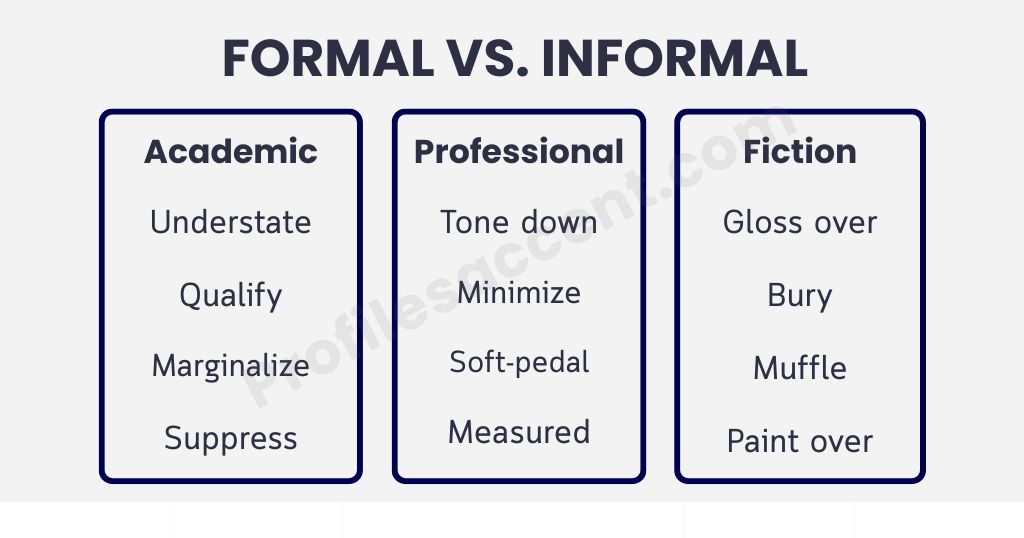
For academic essays: understate, de-emphasize, qualify, marginalize, suppress
These carry analytical precision. They suggest intentional reduction, not casual disregard.
For professional emails: tone down, minimize, soft-pedal, scale back
Practical, measured, and unlikely to offend. These suit workplace communication where clarity and diplomacy both matter.
For fiction and storytelling: gloss over, bury, muffle, paint over, sand down
Figurative language opens up here. A character can “bury the truth under politeness” without sounding clinical.
Words to avoid in formal writing: sugarcoat, wave off, make light of, hush up
These read as too casual or too accusatory for academic or professional contexts.
When Certain Synonyms for Downplay Go Too Far
Some synonyms carry serious weight and deserve careful handling.
Gaslight is not just a dramatic version of downplaying. It describes a specific form of psychological manipulation where someone makes another person doubt their own perception of reality. Using it loosely or casually cheapens its meaning and can confuse readers.
Whitewash has a complicated history tied to racial language in some contexts. Be aware of this when using it outside its clear meaning of covering up facts.
Belittle implies a personal, often emotional attack. It should not be used where simple minimization is what you mean. Choosing belittle over minimize signals that harm was done to a person, not just to a fact.
Emotional contexts like grief, mental health, or trauma require extra care. If someone feels their pain has been trivialized, the word choice alone communicates a violation. Write accordingly.
Mistakes Writers Make When Using Downplay or Its Alternatives
Mixing up underplay and downplay. Underplay often fits performance contexts, like an actor who underplays a role by keeping emotions quiet. Downplay fits factual or situational minimization. They are not always interchangeable.
Using belittle when you mean minimize. Belittle is personal. If you’re writing about data or a policy decision, minimize is the better fit. Belittle implies someone was targeted.
Overusing “minimize.” It is the most common synonym for downplay, which means it has become almost invisible. In important writing, it often lands with less impact than a more specific choice.
Confusing undervalue with downplay. To undervalue is to misjudge worth. To downplay is to reduce how something is presented. A company might undervalue an employee’s skills without ever downplaying them publicly. The actions are different.
Treating all these words as emotionally neutral. They are not. Even a word like tone down suggests there was something sharp that needed softening. Every word in this family carries an implied judgment about what is real and what is being hidden.
Words That Sit Near Downplay But Mean Something Different
- Underrate is about judging quality or ability too low. Not the same as downplaying importance.
- Dismiss often means rejecting something outright rather than quietly reducing it. Downplaying still acknowledges the thing exists. Dismissal ends the conversation.
- Conceal focuses on hiding, not reducing. You can downplay something while still mentioning it. Concealment removes it entirely.
- Hedge means to qualify a statement carefully to avoid commitment. Close to qualify, but hedging often comes from uncertainty rather than a desire to reduce impact.
The Right Downplay Synonym Is One Decision Away
The word you choose when something is being made to seem smaller than it is, whether you are writing about a politician, a conversation, or your own achievements, tells the reader how much weight to assign to what happened.
Pick a word that matches your intent. If it was innocent restraint, understate or qualify will serve you. If it was evasion, soft-pedal or gloss over fit better. If it was something darker, suppress or whitewash are waiting there for you.
Precision is not just about accuracy. It is about honesty with your reader.
Discover More Articles:

I’m Rowan, a language addict who loves exploring how words work in everyday communication. I’ve spent years studying English vocabulary and helping others express themselves more clearly. My goal is simple: make learning new words easy and practical. I focus on real-life examples that show when and how to use different terms. Through clear explanations and honest guidance, I help readers choose the right words for any situation with confidence.