You typed a sentence. Read it back. The word “so” appears three times. You know something feels off, but you are not sure what to replace it with. That is the real problem. It is not about finding a synonym. It is about knowing which synonym fits that exact moment in your writing.
“So” does different jobs depending on where it sits. In one sentence it shows a result. In another it adds force to an emotion. In a third it just fills space between thoughts. Swapping it blindly for “therefore” or “very” often makes things worse, not better.
This guide cuts through that confusion.
What Does “So” Really Mean?
At its core, “so” is a connector and an intensifier. It links causes to effects, emotions to outcomes, and thoughts to conclusions. But its tone is relaxed. It belongs to everyday speech. That casual quality is exactly why it slips into writing so easily and why replacing it requires some thought.
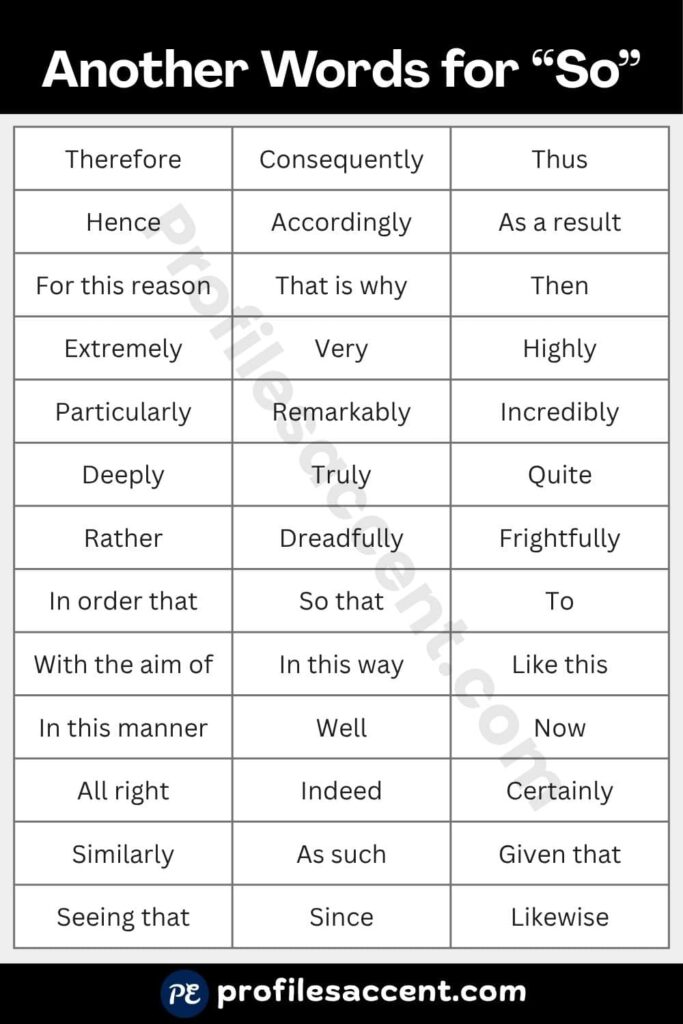
Quick Table: 40+ Synonyms for “So” at a Glance
| Word / Phrase | Tone | Best Used When | Quick Example |
| Therefore | Formal | Showing a logical result | She studied hard; therefore, she passed. |
| Consequently | Formal | Cause leads to outcome | It rained; consequently, the event was cancelled. |
| Thus | Formal | Academic or essay writing | The data was flawed; thus the results were unreliable. |
| Hence | Formal | Followed by a noun phrase | Poor planning, hence the delay. |
| Accordingly | Formal | Professional writing | The terms changed; act accordingly. |
| As a result | Neutral | Any result-based context | He missed the bus. As a result, he was late. |
| For this reason | Neutral | Explaining cause clearly | For this reason, we changed the plan. |
| That is why | Casual | Spoken or informal writing | She hates noise. That is why she left early. |
| Then | Casual | Sequence or light result | She called, and then everything changed. |
| Extremely | Standard | Replacing “so” as intensifier | It was extremely cold that night. |
| Very | Standard | Everyday emphasis | The answer was very clear. |
| Highly | Semi-formal | Professional or academic tone | This approach is highly effective. |
| Particularly | Semi-formal | Specific emphasis | The second point is particularly strong. |
| Remarkably | Expressive | Showing surprise or admiration | She was remarkably calm under pressure. |
| Incredibly | Casual-strong | Emotional writing or speech | It was incredibly frustrating. |
| Deeply | Emotional | Personal or reflective writing | He was deeply moved by the letter. |
| Truly | Expressive | Adding sincerity | She was truly exhausted. |
| Quite | Mild | British tone, soft emphasis | It was quite unexpected. |
| Rather | Mild-formal | Understated tone | The results were rather disappointing. |
| Dreadfully | Informal-dramatic | Exaggeration or old-style tone | It was dreadfully boring. |
| Frightfully | Old-fashioned | Humor or character voice | He was frightfully rude about it. |
| In order that | Formal | Expressing purpose | She left early in order that she could prepare. |
| So that | Neutral | Purpose clause | He trained hard so that he could compete. |
| To | Concise | Replacing “so I could” | She saved money to buy a new phone. |
| With the aim of | Formal | Purpose in professional writing | We restructured with the aim of cutting costs. |
| In this way | Neutral | Describing manner or method | Fold the paper in this way. |
| Like this | Casual | Instruction or demonstration | Hold the brush like this. |
| In this manner | Formal | Formal description of method | Proceed in this manner for best results. |
| Well | Casual | Starting a new thought | Well, that changes things. |
| Now | Casual | Topic shift or transition | Now, let us look at the next step. |
| All right | Casual | Moving the conversation along | All right, where do we begin? |
| Indeed | Formal | Confirming a previous point | He was, indeed, correct. |
| Certainly | Confident | Stronger confirmation | That is certainly the case. |
| That is the case | Formal-neutral | Replacing “I think so” formally | I believe that is the case. |
| That is my hope | Reflective | Replacing “I hope so” | That is my hope, honestly. |
| Likewise | Agreement | Showing something applies equally | She enjoyed it. Likewise, her sister did too. |
| Similarly | Agreement | Comparing two matching points | Similarly, the second study reached the same conclusion. |
| As such | Formal | Drawing a conclusion | It was untested; as such, we could not approve it. |
| Given that | Formal | Setting a conditional premise | Given that the data supports it, we proceed. |
| Seeing that | Casual-neutral | Informal reasoning | Seeing that no one objected, we moved on. |
| Since | Causal | Natural and flexible | Since she was tired, she went home. |
One Word, Four Jobs: Synonyms for “So” by Function
Other Words for So When You Mean “Therefore”
This is the most common role. “I forgot my umbrella, so I got soaked.” The second idea happens because of the first.
In this role, formal alternatives include therefore, consequently, thus, and hence. But here is what most skip: these words do not always swap in the same spot. “Hence” works best before a noun, not a full clause. You can write “hence the confusion,” but “hence she was confused” sounds stiff and unusual.
For everyday writing, “as a result” or “for this reason” flow more naturally. They feel complete without sounding stiff.
When So Means “Very”: Finding the Right Intensifier
“It was so good.” Here, “so” functions like “very” or “extremely.” The tricky part is matching the right intensifier to the right emotion.
- “Extremely” works for temperature, difficulty, and speed.
- “Deeply” fits emotions like sadness, love, or regret.
- “Remarkably” signals surprise.
- “Highly” belongs to professional contexts, like skills or recommendations.
Mixing these up creates odd sentences. “He was highly sad” does not sound right. “He was deeply sad” does.
When So Means “Very”: Finding the Right Intensifier
“She rehearsed daily so she could perform confidently.” Here, “so” introduces a goal.
You can replace it with “so that” for clarity, “in order that” for formal writing, or simply “to” when the sentence allows it. That last option is often the cleanest choice. “She rehearsed daily to perform confidently” says the same thing in fewer words.
When So Is Just Filler (And What to Do About It)
“So, basically, what I wanted to say was…” In speech, this is natural. In writing, it adds nothing.
Here, the best replacement is often no word at all. Delete it. The sentence becomes stronger. If you need a transition, “well,” “now,” or “all right” carry similar rhythm but feel slightly more intentional.
How Strong Is Your Word? A Tone Scale for “So” Synonyms
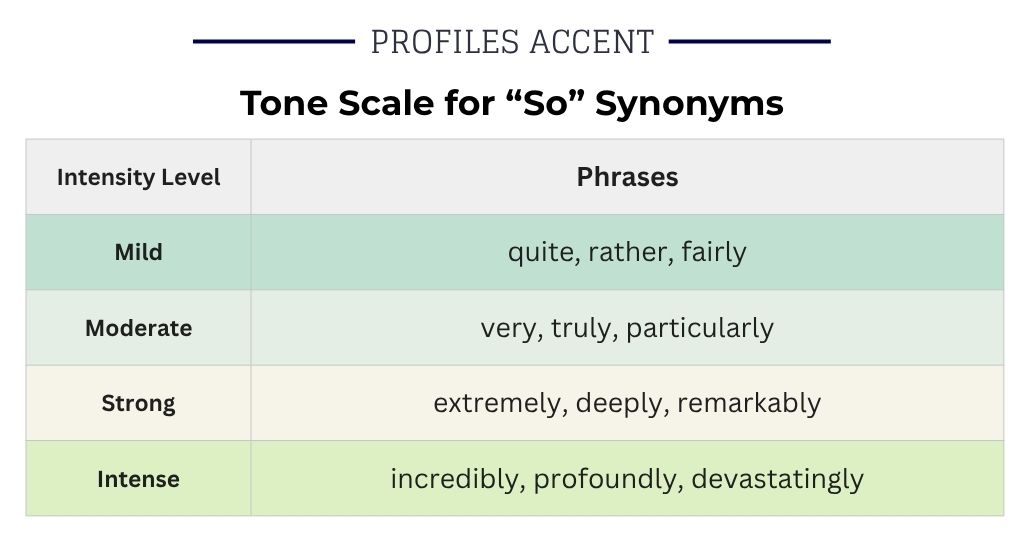
When “so” is working as an intensifier, different words carry different weight:
- Mild: quite, rather, fairly
- Moderate: very, truly, particularly
- Strong: extremely, deeply, remarkably
- Intense: incredibly, profoundly, devastatingly
The gap between “quite cold” and “devastatingly cold” is enormous. Choose based on what the moment actually calls for. Most writers reach for “extremely” when “quite” would do the job without overdramatizing.
See the Shift: Sentence Rewrites Using Different Words for “So”
Original: She was so tired she could not speak.
- Formal: She was too exhausted to speak.
- Academic: Her fatigue was such that speech became difficult.
- Casual: She was completely wiped out, not a word left in her.
- Creative: Tiredness pressed down on her like something heavy and damp.
Original: I studied hard, so I passed.
- Formal: I studied hard; consequently, I passed.
- Email: I put in the prep, and it paid off.
- Academic: Thorough preparation resulted in a passing grade.
- Casual: I studied hard. That is why I passed.
Original: So, I wanted to ask you something.
- Formal: I would like to raise a question.
- Email: I wanted to bring something to your attention.
- Casual: Actually, can I ask you something?
- Script/Dialogue: Look, there is something I need to ask.
Each version keeps the meaning but shifts how it lands on the reader.
Mistakes Writers Make When Replacing So
Replacing casual “so” with “hence” in emails. This is the most common mistake. “I was out of the office, hence my late reply” sounds unnatural in a message between colleagues. “Hence” belongs in academic papers and legal writing. Keep it there.
Using “therefore” to start every paragraph. It creates a marching-drum rhythm that exhausts readers quickly. Vary it with “as a result,” “this is why,” or simply restructure the sentence.
Treating “so that” and “so” as the same. They are not. “So” links results. “So that” introduces purpose. You cannot swap them and keep the meaning. “He trained so he won” and “He trained so that he could win” are grammatically different structures.
Stacking intensifiers. “It was so very extremely cold” is not more powerful. It is just noisy. Pick one word and let it do its job.
Formal vs. Casual: Which So Synonym Belongs Where
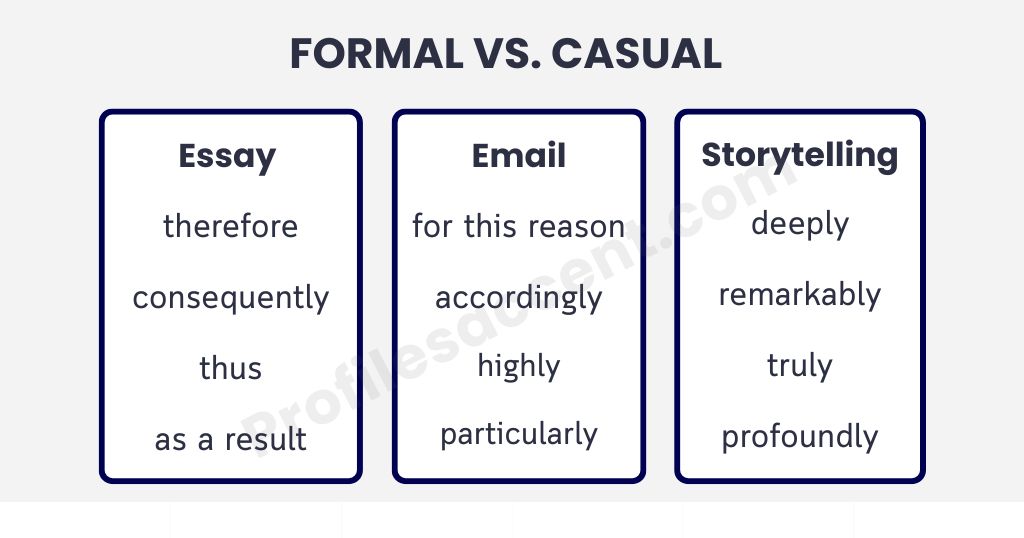
Writing an essay or IELTS task?
- Use: therefore, consequently, thus, as a result, hence, accordingly
- Avoid: so, really, awfully, that is why
Writing a professional email?
- Use: as a result, for this reason, accordingly, highly, particularly
- Avoid: hence (sounds old-fashioned in most emails), ergo (sounds sarcastic)
Writing dialogue or a blog?
- Use: that is why, then, well, so that, seeing that, since
- Avoid: thus, consequently, in order that (these sound stiff in casual voices)
Writing creatively or descriptively?
- Use: deeply, remarkably, truly, profoundly, in this way
- Avoid: highly (it is too corporate), ergo (too Latin, breaks story rhythm)
Words Close to “So” That Are Worth Knowing
Since works like a causal “so” but leads with the reason instead of the result. “Since it was raining, we stayed in” vs. “It was raining, so we stayed in.” Both are correct. The word order shifts the emphasis.
Given that adds a slightly more formal reasoning feel. Great for reports or presentations.
As such draws conclusions from a prior statement. It is not a perfect swap for “so” but it fills a similar role in formal writing.
Provided that introduces conditions. Often confused with purpose clauses, but it sets a requirement rather than a goal.
Seeing that is the informal cousin of “given that.” It sounds natural in conversation and casual writing without feeling sloppy.
Picking the Right “So” Synonym Without Overthinking It
Ask yourself one question before you replace “so”: what is this word doing right now?
- If it is showing a result, check your tone. Formal writing gets “consequently.” A text message gets “that is why.”
- If it is adding emphasis, check the emotion. Physical extremes take “extremely.” Feelings take “deeply” or “truly.”
- If it is explaining a purpose, try replacing the whole phrase with “to” and a verb. Often that single change makes the sentence sharper.
And if “so” is sitting at the start of a sentence with no real job? Cut it. The sentence will breathe better without it. Word choice is not about finding a fancier word. It is about finding the right word for that specific moment, reader, and tone.
Discover More Articles:

I’m Rowan, a language addict who loves exploring how words work in everyday communication. I’ve spent years studying English vocabulary and helping others express themselves more clearly. My goal is simple: make learning new words easy and practical. I focus on real-life examples that show when and how to use different terms. Through clear explanations and honest guidance, I help readers choose the right words for any situation with confidence.