You know that moment when you’re writing and you type the word “idea” for the fourth time in two paragraphs? You notice it. Your reader notices it too. But the problem isn’t just repetition. It’s that “idea” is doing too much work. It’s carrying meanings it was never meant to handle alone.
A bold creative spark is not the same as a business proposal. A vague gut feeling is not the same as a scientific hypothesis. When you use “idea” for all of them, something gets lost in translation. The right synonym doesn’t just replace a word. It sharpens your meaning.
What Idea Actually Covers
At its simplest, an idea is something formed in the mind. It could be a plan, a belief, a sudden realization, or just a loose feeling about something. The word is flexible, which is exactly why it gets overused.
The emotional weight behind it varies too. Some ideas feel urgent and bold. Others feel half-formed and uncertain. Choosing a better word signals to your reader exactly which kind you mean.
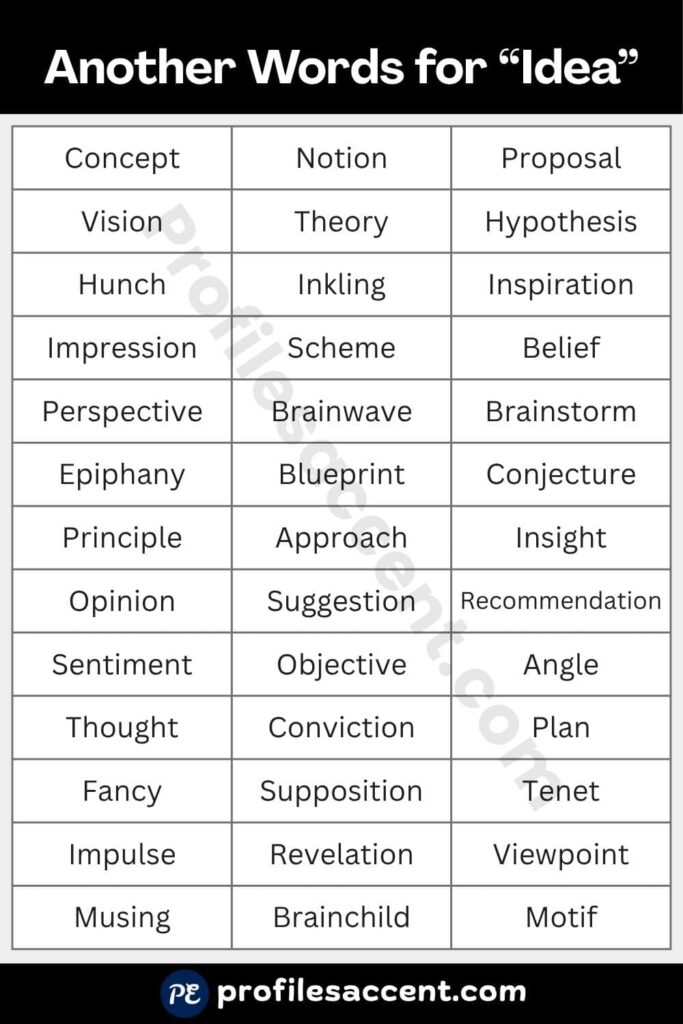
Another Word for Idea: 40+ Quick Synonym Table
| Word | Tone | Best Used When | Example |
| Concept | Formal | Explaining an abstract principle | “The concept needs more research.” |
| Notion | Neutral/Vague | Something loosely held | “I had a notion it wouldn’t work.” |
| Proposal | Professional | Suggesting a plan formally | “Her proposal impressed the board.” |
| Vision | Inspired | Describing a future goal | “His vision changed the company.” |
| Theory | Academic | Explaining something systematically | “The theory holds in most cases.” |
| Hypothesis | Scientific | Making a testable assumption | “The hypothesis was proven wrong.” |
| Hunch | Casual | Going with instinct | “I had a hunch about this.” |
| Inkling | Subtle | A faint, early suspicion | “She had an inkling of the truth.” |
| Inspiration | Creative | A sudden motivating thought | “The trip gave her fresh inspiration.” |
| Impression | Reflective | A feeling or early judgment | “My first impression was positive.” |
| Scheme | Strategic | A structured plan | “The scheme required careful timing.” |
| Belief | Convictional | A firmly held view | “That belief shaped his decisions.” |
| Perspective | Analytical | A point of view | “Her perspective changed my mind.” |
| Brainwave | Informal/UK | A sudden clever thought | “He had a brainwave mid-meeting.” |
| Brainstorm | Informal/US | A quick spontaneous idea | “Let’s brainstorm before the call.” |
| Epiphany | Emotional | A moment of sudden clarity | “It was a real epiphany for her.” |
| Blueprint | Technical | A detailed plan | “The blueprint was ready by Friday.” |
| Conjecture | Academic | An unproven opinion | “That’s pure conjecture at this point.” |
| Principle | Foundational | A core belief or rule | “Fairness is a key principle here.” |
| Approach | Practical | A method or angle of action | “Try a different approach this time.” |
| Insight | Deep | A sharp, meaningful understanding | “That insight changed everything.” |
| Opinion | Personal | A personal viewpoint | “In my opinion, this works better.” |
| Suggestion | Soft | A gentle recommendation | “May I offer a suggestion?” |
| Recommendation | Professional | Formal advice | “The recommendation was well-received.” |
| Sentiment | Emotional | A feeling tied to a view | “Public sentiment shifted quickly.” |
| Objective | Goal-based | A target or aim | “The main objective is growth.” |
| Angle | Informal | A unique slant on something | “That’s an interesting angle.” |
| Thought | General | Any mental consideration | “It’s just a thought, not a plan.” |
| Conviction | Strong | A deep, firm belief | “She spoke with real conviction.” |
| Plan | Action-based | Something ready to execute | “We need a solid plan by Monday.” |
| Fancy | Playful | A light or imaginative thought | “It was just a passing fancy.” |
| Supposition | Tentative | An assumed but unverified thought | “That’s a reasonable supposition.” |
| Tenet | Formal | A core guiding belief | “Equality is a founding tenet.” |
| Impulse | Instinctive | A quick, unplanned urge | “It was an impulse, not a strategy.” |
| Revelation | Dramatic | A surprising discovery | “The findings were a revelation.” |
| Viewpoint | Analytical | How someone sees something | “His viewpoint made complete sense.” |
| Musing | Reflective | A quiet, wandering thought | “These were just musings, nothing firm.” |
| Brainchild | Creative | An original idea someone created | “This app was her brainchild.” |
| Motif | Artistic | A repeating creative theme | “Loss was the central motif.” |
| Spark | Early-stage | The very first hint of an idea | “That question gave me a spark.” |
The Meaning Clusters That Change Everything
Most people treat synonyms as equals. They’re not. The word you choose tells your reader how confident you are, how developed your thinking is, and what kind of action you expect.
When the Idea Is Still Forming
Words like spark, inkling, hunch, and musing live at the early stage. They signal uncertainty. They tell the reader: this is real, but raw. Use them when you want to invite conversation or show honest thinking.
“I have an inkling this approach might work” sounds open, curious, and humble. That tone matters in collaborative spaces.
When the Idea Has Shape
Concept, theory, and hypothesis carry more weight. They suggest the idea has been thought through. In academic or research writing, these words do serious lifting. Don’t use them casually unless you mean what they imply.
When the Idea Is Ready for Action
Proposal, plan, scheme, and blueprint live in the world of doing. These words suggest something executable. If you’re writing a business email or a project pitch, these are your strongest options.
When the Idea Is Personal
Opinion, belief, sentiment, and conviction sit in the world of values and viewpoints. They’re not about plans. They’re about what someone holds to be true. Using these signals personal ownership of a thought.
How Strong Is Your Synonym? A Tone Scale for “Idea”
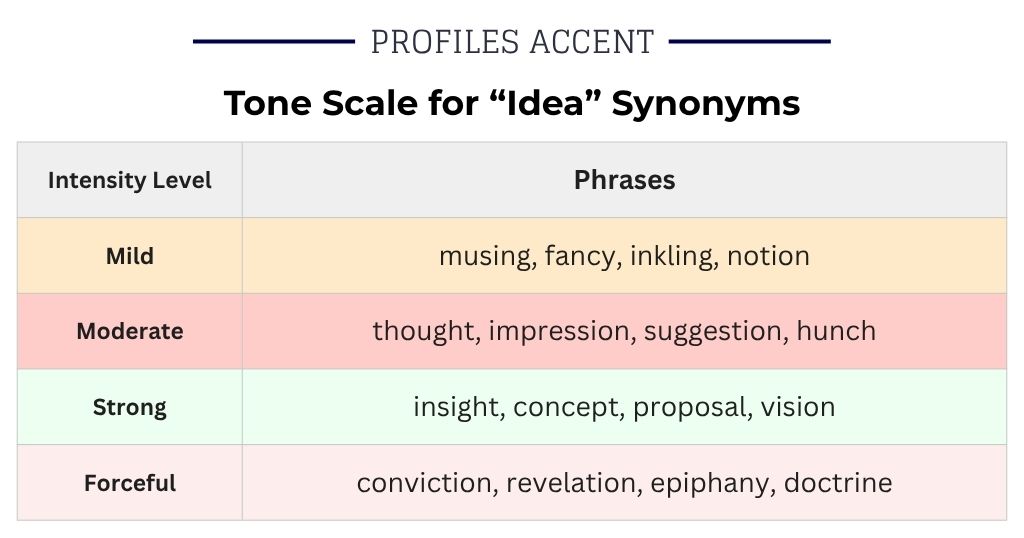
Not every idea carries equal emotional force. Here’s how these words sit on a scale from mild to strong:
- Mild: musing, fancy, inkling, notion
- Moderate: thought, impression, suggestion, hunch
- Strong: insight, concept, proposal, vision
- Forceful: conviction, revelation, epiphany, doctrine
The further right you go, the more authority and certainty the word carries. A “musing” invites debate. A “conviction” closes it.
Synonyms for Idea in Action: Sentence Rewrites That Show the Difference
Seeing these words in action is more useful than any definition.
Original: “I have an idea for the project.”
- Formal: “I’d like to submit a proposal for the project.”
- Casual: “I’ve got an angle on this project that might work.”
- Academic: “I’ve developed a hypothesis worth testing.”
- Creative: “A vision came to me for this project last night.”
Each version signals something different. The formal one implies a document is coming. The casual one sounds collaborative. The academic one sets up evidence. The creative one sparks curiosity.
Original: “She shared her idea with the team.”
- Professional: “She presented her recommendation to the team.”
- Casual: “She threw out a suggestion during the meeting.”
- Inspiring: “She shared a vision that got everyone talking.”
Original: “It was a good idea.”
- More specific: “It was a sharp insight.” / “It was a well-timed proposal.” / “It was a genuine revelation.”
Each swap makes the sentence do more work without adding words.
Formal vs. Informal Synonyms for Idea at a Glance
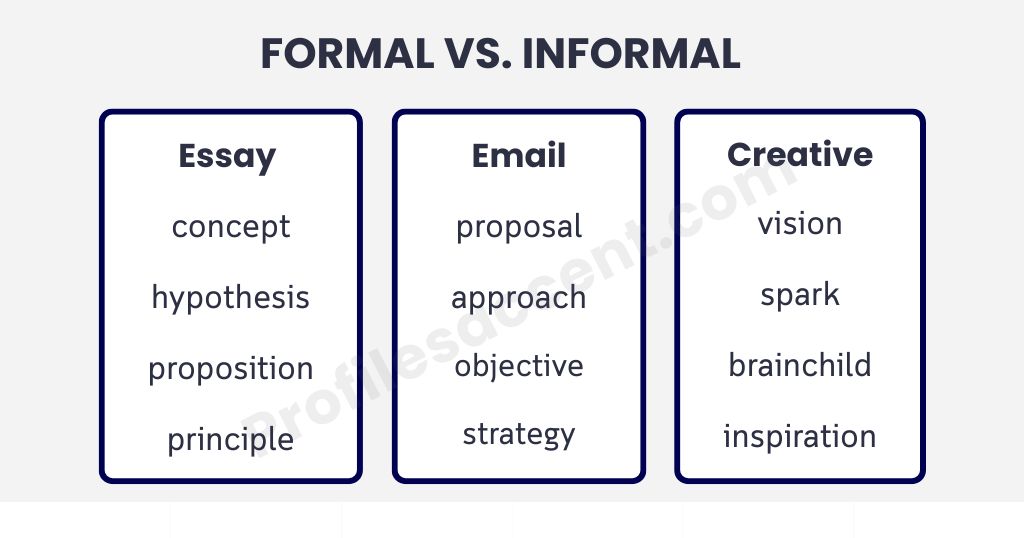
If you’re writing an essay or research paper, reach for: concept, hypothesis, proposition, principle, tenet, theory.
For professional emails and business writing: proposal, recommendation, objective, approach, strategy.
For storytelling and creative writing: vision, spark, brainchild, inspiration, epiphany, motif.
For casual conversation or informal blogs: hunch, angle, brainwave, thought, take, notion.
Words to avoid in formal contexts: brainwave, fancy, gut feeling, impulse.
These carry a lightness that doesn’t belong in serious writing.
Mistakes Writers Make When Swapping “Idea” for Another Word
Using “concept” when you mean “idea.” Concept implies something more developed. If the thought is still loose, notion or thought is more accurate.
Mixing up “hypothesis” and “theory.” A hypothesis is an untested guess. A theory has been tested and holds up. In everyday writing people flip these. In academic writing, that’s a real error.
Using “vision” too freely. Vision is a strong word. It suggests foresight and leadership. Using it for a minor suggestion dilutes it. Save it for genuinely big-picture thinking.
Treating “opinion” and “belief” as identical. An opinion can be casual and changeable. A belief usually runs deeper and ties to identity or values. The difference matters in persuasive writing.
Overusing “insight.” It’s become a buzzword. Reserve it for moments where something genuinely shifts the understanding, not just any observation.
Words That Live Near Idea but Mean Something Different
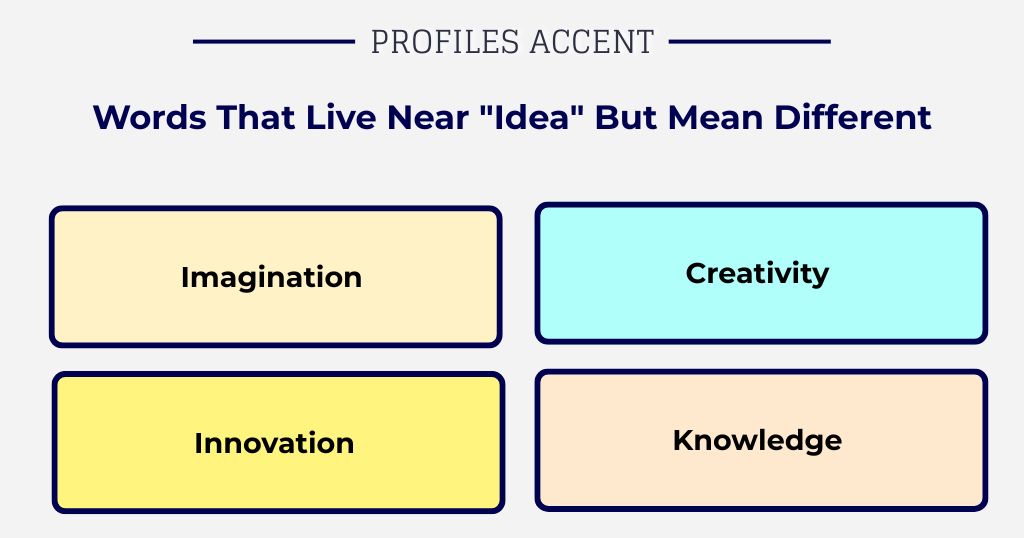
- Imagination is the mental ability to form ideas. The idea itself is the product. Don’t swap them.
- Creativity is a trait. It describes someone’s capacity, not the specific thought they had.
- Innovation implies that the idea was applied and changed something. An idea can stay in your head. Innovation can’t.
- Knowledge is what you already know. Ideas emerge from knowledge but aren’t the same thing.
- Intent is the purpose behind an idea. You can have a clear idea with no clear intent, or strong intent with only a vague idea.
Idea Antonyms Worth Knowing
Sometimes naming what something is not helps you pick the right synonym:
- Reality sits opposite to an idea that hasn’t been tested yet.
- Fact contrasts with opinion or belief.
- Certainty sits against conjecture or supposition.
- Indifference runs against conviction.
Knowing the antonym helps you feel where your word lands on the spectrum.
How to Pick the Right Synonym for “Idea” Every Time
Here’s a clean way to decide which word to use. Ask yourself three questions:
How developed is the thought? If it’s early and uncertain, go vague: spark, inkling, hunch. If it’s developed, go precise: proposal, concept, theory.
What’s the tone of the piece? Academic writing needs hypothesis or proposition. Casual writing wants thought or angle.
What do you want the reader to feel? If you want them to act, use proposal or plan. If you want them to reflect, use insight or perspective. If you want them to dream, use vision.
One right synonym, chosen for the right reason, does more than any amount of clever phrasing. The word sets the room before the sentence even ends.
Discover More Articles:

I’m Rowan, a language addict who loves exploring how words work in everyday communication. I’ve spent years studying English vocabulary and helping others express themselves more clearly. My goal is simple: make learning new words easy and practical. I focus on real-life examples that show when and how to use different terms. Through clear explanations and honest guidance, I help readers choose the right words for any situation with confidence.