You’re writing an email, a resume, or maybe an essay. You type “such as” once. Then twice. By the third time, it starts to feel lazy. You know there are better options, but picking the wrong one can quietly shift your tone from professional to careless, or from clear to confusing.
That’s the real problem. It’s not just about finding a replacement word. It’s about knowing when a replacement actually improves your writing, and when it creates a new mistake.
This guide gives you 45+ alternatives, explains the hidden differences between them, and helps you pick the right one based on your actual context.
What Such As Actually Means (And Why It Gets Overused)
At its core, “such as” introduces examples from a larger group. It signals: this list is not complete, just representative. The tone is neutral. It works in formal writing, casual writing, and most places in between.
The emotional weight is almost zero. It doesn’t emphasize. It doesn’t imply rarity or importance. It simply points.
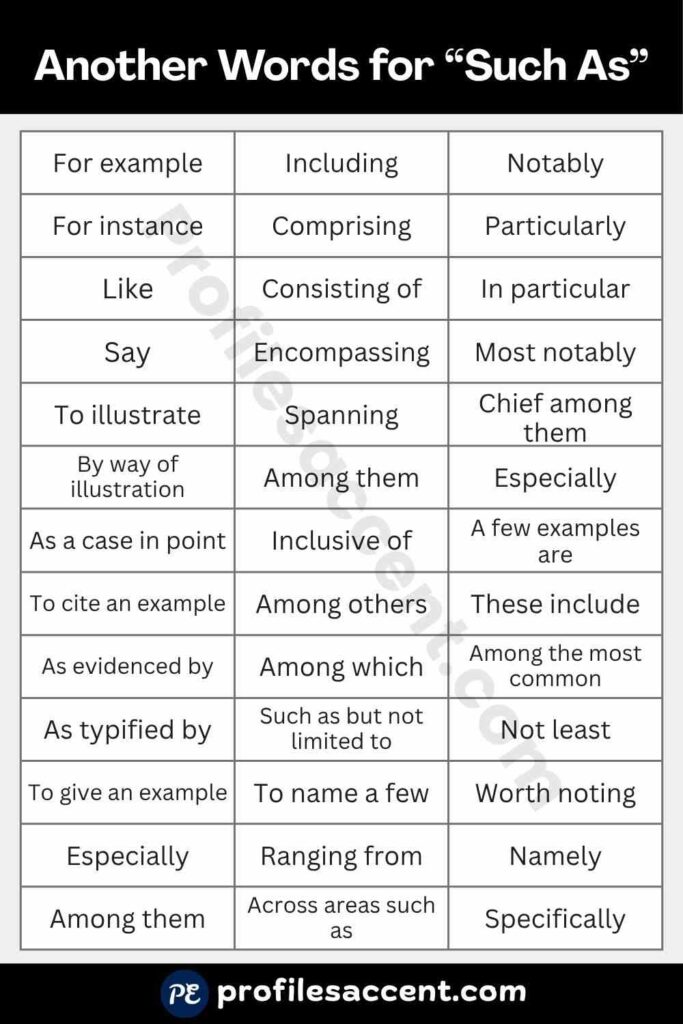
Your 45+ Quick Table: Synonyms for Such As at a Glance
| Word / Phrase | Tone | Best For | Quick Example |
| Including | Neutral | Partial lists, emails, reports | Tools including a drill and saw |
| Namely | Formal | Naming specific items precisely | Three skills, namely patience and focus |
| Specifically | Formal | Precision, reports, resumes | Specifically, the sales team |
| For example | Neutral | Teaching, essays, blogs | For example, a morning walk |
| For instance | Neutral | Essays, formal speech | For instance, solar energy |
| In particular | Formal | Highlighting one item | In particular, the budget issue |
| Particularly | Neutral-formal | Adding slight emphasis | Particularly during peak hours |
| Notably | Semi-formal | Spotlighting strong examples | Notably, revenue rose by 30% |
| Comprising | Formal | Complete, exhaustive lists | A team comprising four leads |
| Consisting of | Formal | Full set descriptions | A plan consisting of three steps |
| Encompassing | Formal | Showing wide scope | A role encompassing three departments |
| Spanning | Professional | Showing range | Experience spanning five industries |
| Among them | Neutral | After a broader statement | Among them, the strongest was logic |
| Like | Casual | Conversation, informal writing | Hobbies like reading and hiking |
| Say | Casual | Friendly suggestion tone | A short trip, say, to the coast |
| Especially | Neutral | Adding slight weight | Especially during the winter months |
| To illustrate | Formal | Academic, presentations | To illustrate, consider this case |
| By way of illustration | Formal | Academic or legal writing | By way of illustration, the 2019 data |
| As an example | Neutral | Teaching, explanations | As an example, consider water usage |
| As a case in point | Formal | Argument support | As a case in point, the 2020 report |
| To cite an example | Formal | Academic writing | To cite an example, early research shows |
| As evidenced by | Formal | Data-driven arguments | As evidenced by the quarterly results |
| As typified by | Formal | Describing a pattern | As typified by most urban schools |
| Including but not limited to | Legal | Contracts, compliance writing | Services including but not limited to… |
| Inclusive of | Formal | Legal, financial writing | Inclusive of all applicable taxes |
| Among others | Neutral | Suggesting a longer list exists | Python, Java, among others |
| Among which | Formal | Relative clause writing | Three options, among which the first… |
| Such as but not limited to | Legal | Protective language in contracts | Items such as but not limited to… |
| To name a few | Casual-neutral | Closing an open-ended list | Coffee, tea, juice, to name a few |
| To give an example | Neutral | Explanations, how-to content | To give an example, the login flow |
| Most notably | Formal | Strongest example emphasis | Most notably, the Q3 turnaround |
| Chief among them | Formal | Ranking examples by importance | Chief among them was the timing error |
| Prime examples include | Formal | Presentations, reports | Prime examples include the 2022 rollout |
| A few examples are | Neutral | General writing | A few examples are listed below |
| These include | Neutral | After a category statement | These include digital and print media |
| Among the most common | Neutral | Describing patterns | Among the most common causes is stress |
| Not least | Formal | Adding an important item last | Benefits exist, not least the cost saving |
| Worth noting | Neutral | Drawing attention to one point | Worth noting is the drop in March |
| Ranging from | Neutral | Showing a spectrum | Topics ranging from science to art |
| Across areas such as | Neutral | Broad category writing | Skills across areas such as data and design |
The One Rule Most Writers Miss: Complete vs. Partial Lists
Most guides skip this. It matters more than tone.
When your list is everything, use words like comprising, consisting of, or encompassing. These signal closure. The reader understands nothing was left out.
When your list is just a sample, use including, notably, for instance, or such as. These signal openness. More items exist beyond what you named.
Getting this wrong causes real confusion. Writing “The package comprising a pen, notebook, and case… along with other items” contradicts itself. “Comprising” closed the list. “Along with other items” reopened it.
One quick test: Can you say “and more” at the end? If yes, use a partial-list word. If no, use a complete-list word.
Why “Like” Is Not Always a Safe Synonym for “Such As”
This one catches people off guard.
- “Such as” and “like” feel interchangeable in everyday speech. In formal writing, they carry different meanings.
- “Countries such as France and Germany” tells the reader: France and Germany are examples of countries in your group.
- “Countries like France and Germany” technically means: countries that resemble France and Germany, which may or may not include France and Germany themselves.
In an essay or report, using “like” where you mean “such as” introduces a quiet ambiguity. Most readers won’t catch it consciously, but careful readers will. In academic writing especially, avoid “like” as a synonym for “such as.”
From Soft to Strong: A Tone Scale for Such As Alternatives
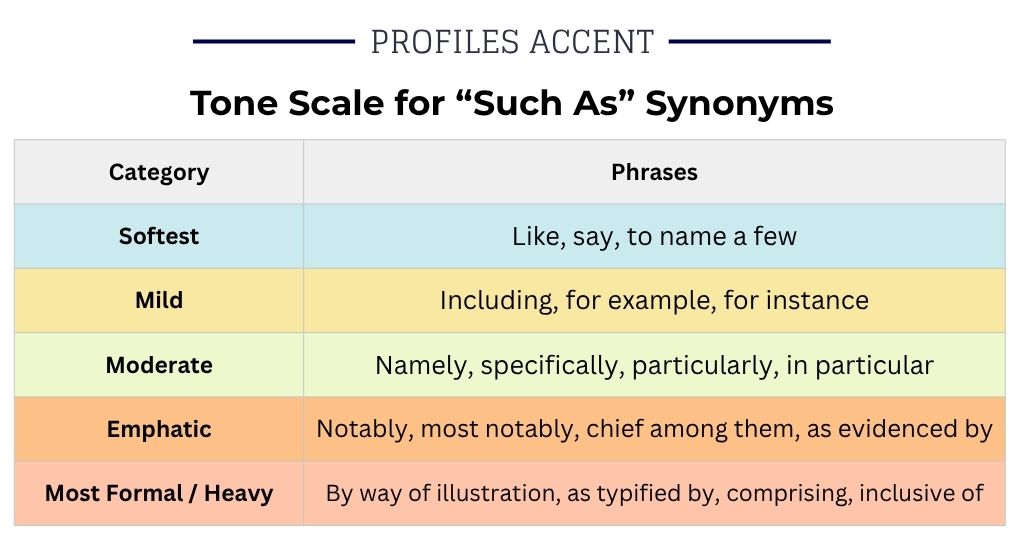
Not all synonyms carry equal weight. Here’s how they rank from softest to most emphatic:
- Softest: like, say, to name a few
- Mild: including, for example, for instance
- Moderate: namely, specifically, particularly, in particular
- Emphatic: notably, most notably, chief among them, as evidenced by
- Most Formal / Heavy: by way of illustration, as typified by, comprising, inclusive of
If your sentence needs emphasis, move up the scale. If it needs to stay light, stay near the bottom. Mismatching emphasis to context is one of the most common tone errors in professional writing.
Watch the Words Transform: Rewrites Using Other Words for Such As
Original: “She has worked in many fields such as marketing, finance, and tech.”
- Formal report: “She brings experience spanning marketing, finance, and technology.”
- Resume bullet: “Directed cross-functional work across marketing, finance, and technology.”
- Academic: “Her professional background encompasses marketing, finance, and technology.”
- Casual email: “She’s worked in a few areas, like marketing, finance, and tech.”
Each rewrite changes the impression the reader gets. “Spanning” suggests range. “Encompasses” signals completeness. “Like” keeps things conversational.
Original: “The project includes tasks such as research, writing, and editing.”
- Legal context: “The project includes tasks including but not limited to research, writing, and editing.”
- Presentation: “The project comprises three core tasks: research, writing, and editing.”
- Casual: “The project covers a few things, like research, writing, and editing.”
Notice how “comprises” in the presentation version removes the “open list” feel. It sounds more deliberate and complete.
Where Context Changes Everything: Synonyms for “Such As” by Situation
On a resume
Skip “such as” almost entirely. It reads passively. Use “spanning,” “encompassing,” “comprising,” or “notably” to frame your experience with purpose. “Managed five systems, notably SAP and Salesforce” sounds stronger than “managed systems such as SAP and Salesforce.”
In legal or compliance writing
Use “including but not limited to” when you want the list to feel protective but open. This phrasing explicitly signals that more items could apply. Using a hard list without this phrase can create unintended limitations in contracts.
In IELTS or academic essays
Vary your phrasing across the piece. Using “such as” three times in one essay costs you on the lexical resource score. Rotate between “for instance,” “to illustrate,” “namely,” and “in particular.” Each carries slightly different academic weight.
In creative or narrative writing
“Say” and “like” work beautifully. They keep pace moving and avoid stiffness. “A short trip, say to the mountains” reads far more naturally than “a short trip, for instance to the mountains.”
e.g. vs. i.e.: The Abbreviations Writers Confuse with “Such As”
Both are abbreviations that sometimes replace “such as,” but they are not the same.
- e.g. means “for example.” It introduces a sample, just like “such as.” Use it mid-sentence with a comma after: “…outdoor activities, e.g., hiking and swimming.”
- i.e. means “that is” or “in other words.” It restates or clarifies. It never introduces examples. “The project is delayed, i.e., it won’t launch in Q1” is correct. “The project uses tools, i.e., Slack and Notion” is wrong. That second one needs “e.g.”
Swapping these two is one of the most common errors in business writing.
Mistakes People Make When Swapping Out Such As
Using “namely” when your list is vague. “Namely” implies you are about to name something precisely and completely. If your list is open-ended, use “including” or “for instance” instead.
Using “comprising” when your list is partial. This signals a complete set. Partial lists need “including” or “such as.”
Starting a sentence with “such as” or “e.g.” Neither works at the start of a sentence. Use “For example” or “For instance” to open a sentence instead.
Using “like” in formal academic writing. It reads casual and can technically mean something different from what you intend.
Overloading “particularly.” It’s a useful word, but using it in three consecutive sentences drains its emphasis quickly.
Words Close to “Such As” That Mean Something Slightly Different
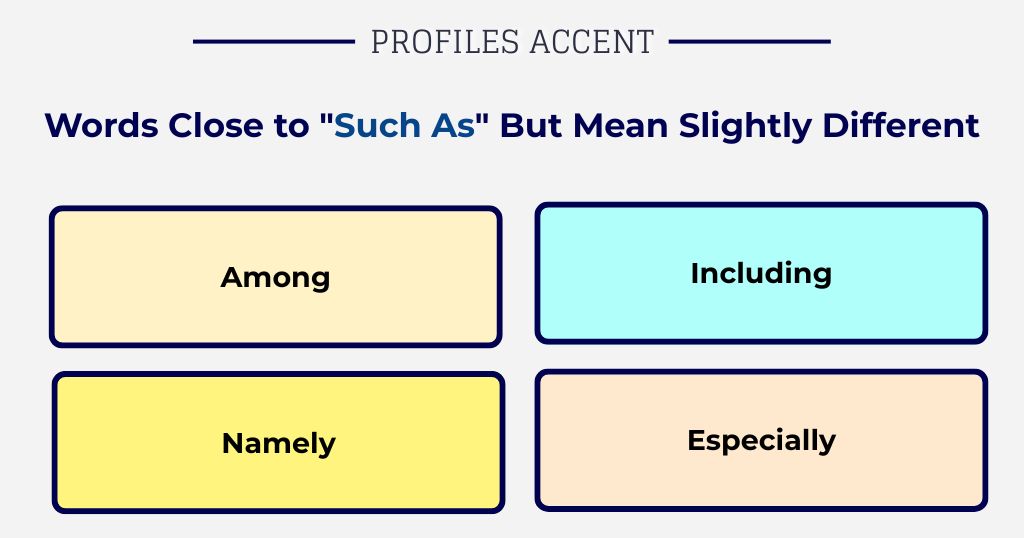
Among: Refers to position within a group, not introducing examples. “Among the candidates” is different from “candidates such as…”
Including: Close to “such as” but stronger at implying the rest of the list exists. Good default choice when in doubt.
Namely: More precise than “such as.” Use it only when you are naming every item in the category.
Especially: Adds emphasis to one item. It doesn’t introduce a list. “Especially on weekends” singles out one point rather than offering multiple examples.
Notably: Points to the strongest example in a set. It judges. “Such as” doesn’t judge. Use “notably” when the example you’re citing is the most impressive one.
The Shortcut: How to Pick Another Word for Such As Without Overthinking
Ask yourself three things before writing:
- Is my list everything, or just some things? Complete = comprising. Partial = including, for example, such as.
- Is this formal writing? Formal = namely, specifically, to illustrate. Casual = like, say, to name a few.
- Am I trying to emphasize one strong example? Use “notably” or “most notably.” If all examples are equal, use “including” or “for instance.”
That’s the whole decision. Most of the time, one of those three questions points you directly to the right word. Trust your answer and move forward.
Discover More Articles:

I’m Rowan, a language addict who loves exploring how words work in everyday communication. I’ve spent years studying English vocabulary and helping others express themselves more clearly. My goal is simple: make learning new words easy and practical. I focus on real-life examples that show when and how to use different terms. Through clear explanations and honest guidance, I help readers choose the right words for any situation with confidence.