You finish a sentence and pause. “I have a lot of work.” It feels flat. Weak. Like you grabbed the first word your brain offered and moved on. The problem isn’t that “a lot” is wrong. It’s that it says almost nothing. It fills space without adding weight.
Writers at every level fall into this habit. And the fix isn’t just swapping one word for another. It’s about picking the word that actually matches what you mean.
This guide gives you over 35+ real alternatives, organized by how and where they actually work.
What Does “A Lot” Really Say?
At its core, “a lot” signals large quantity or high degree. It works with both countable things (people, ideas, tasks) and uncountable ones (time, energy, knowledge). Its tone is neutral and casual by default.
That’s exactly why it gets overused. It fits everywhere but stands out nowhere.
Quick-Access Synonym Table “A Lot” at a Glance
| Word/Phrase | Tone | Best Used When | Example |
| Substantial | Formal | Describing size or impact | Substantial progress was made |
| Considerable | Formal | Showing notable quantity | Considerable effort went into this |
| Extensive | Formal | Covering wide range | Extensive research supports this |
| Copious | Formal/Academic | Describing detailed output | Copious notes filled her desk |
| Numerous | Neutral/Academic | Countable items only | Numerous studies confirm this |
| Abundant | Neutral | Plentiful supply | Abundant resources are available |
| Profuse | Formal | Overflowing in quantity | Profuse apologies were offered |
| Ample | Formal | More than enough | Ample time was given to finish |
| Voluminous | Academic | Large in volume or size | Voluminous data was collected |
| Immense | Strong/Formal | Great scale or size | Immense pressure was on the team |
| Vast | Strong | Very wide or large | Vast knowledge of the subject |
| Immeasurable | Emotional | Cannot be counted or felt | Immeasurable love for her family |
| Boundless | Emotional | No limits, unlimited | Boundless energy in the classroom |
| Profound | Emotional | Deep and meaningful | Profound impact on her life |
| Deeply | Adverb | Degree of feeling | I deeply appreciate your help |
| Significantly | Adverb | Formal degree or change | It improved significantly |
| Considerably | Adverb | Notable difference | Sales grew considerably |
| Tremendously | Adverb | High degree, strong feel | She helped tremendously |
| Enormously | Adverb | Very large in degree | This meant enormously to him |
| Greatly | Adverb | General high degree | It helped me greatly |
| Frequently | Adverb | High frequency/often | She travels frequently |
| Repeatedly | Adverb | Happening again and again | He tried repeatedly |
| Consistently | Adverb | Reliable repetition | She consistently delivers results |
| Many | Neutral | Countable, general use | Many people attended |
| Much | Neutral | Uncountable, general use | Much time was wasted |
| Plenty | Casual/Neutral | Enough and more | There’s plenty of food |
| Heaps | Casual | Informal, large pile feel | Heaps of fun at the event |
| Loads | Casual | Everyday informal use | Loads of things to discuss |
| Tons | Casual | Very informal quantity | We got tons of feedback |
| Masses | Casual | Large groups or amounts | Masses of people showed up |
| Oodles | Playful | Light, fun writing | Oodles of creativity in her work |
| Gobs | Playful | Casual and colorful | Gobs of paint on the canvas |
| Scads | Playful/Dated | Informal, slightly old | Scads of options to choose from |
| A wealth of | Formal | Information or knowledge | A wealth of experience |
| A multitude of | Formal/Literary | Countable, many types | A multitude of challenges |
| A surplus of | Formal | More than needed | A surplus of supplies |
| A torrent of | Strong/Vivid | Fast-moving volume | A torrent of complaints |
| A barrage of | Vivid | Overwhelming incoming | A barrage of questions |
| A flurry of | Vivid/Active | Fast, active quantity | A flurry of activity in the office |
| A sea of | Creative | Visual, large crowd/amount | A sea of faces in the crowd |
| A cascade of | Creative | Flow, layered quantity | A cascade of emotions followed |
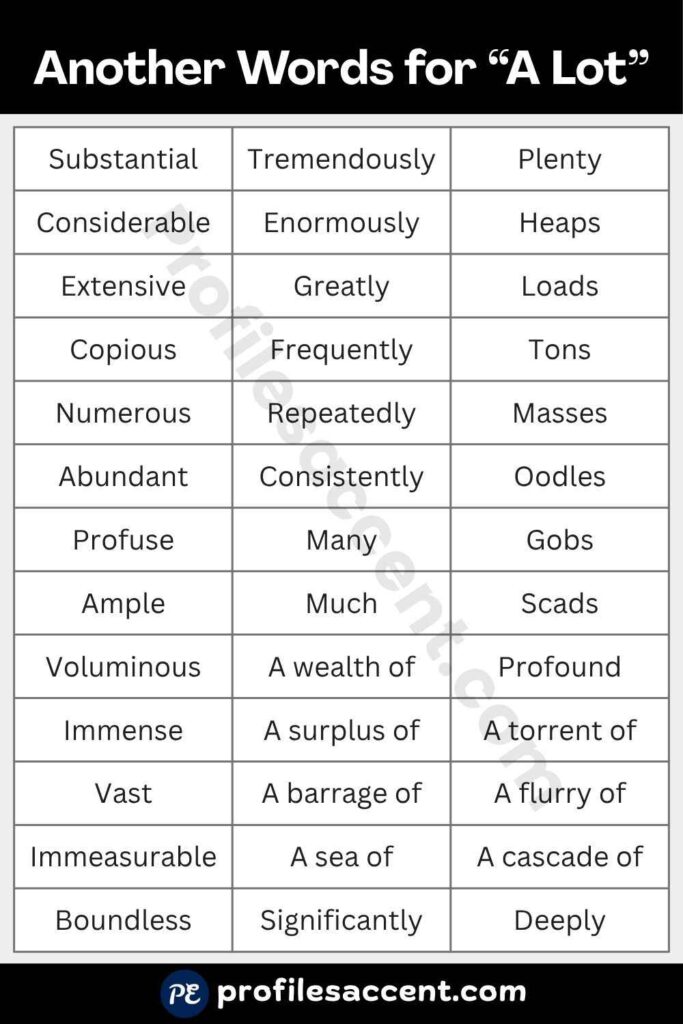
Not All “A Lot” Synonyms Mean the Same Thing
“A lot” doesn’t always mean the same thing. Context shapes what word actually fits.
When You Need Another Word for a Lot of Something (Quantity)
If you’re talking about numbers or amounts, the word needs to reflect scale. “Many” and “numerous” work for things you can count. “Much” and “substantial” work for things you can’t. Using “numerous” for water or “much” for people sounds off.
For formal contexts, “considerable” and “extensive” signal quantity with added weight. They don’t just say “a lot.” They suggest that the amount actually matters.
When You Need a Word for A Lot in Terms of Degree
“I enjoyed it a lot” is about how much, not how many. Here, adverbs carry the load. “Tremendously,” “greatly,” “enormously” all communicate intensity. Pick based on the emotional register you want.
- “Tremendously” sounds enthusiastic.
- “Considerably” sounds measured.
- “Greatly” sits comfortably in between.
Another Word for A Lot Meaning “Often”
“She calls a lot” means often. The word isn’t about quantity of people or volume of anything. It’s about how often something happens. Use “frequently,” “consistently,” or “repeatedly” instead. These are far more specific and much easier for readers to process.
How Strong Is Your Synonym? (Tone Intensity Scale)
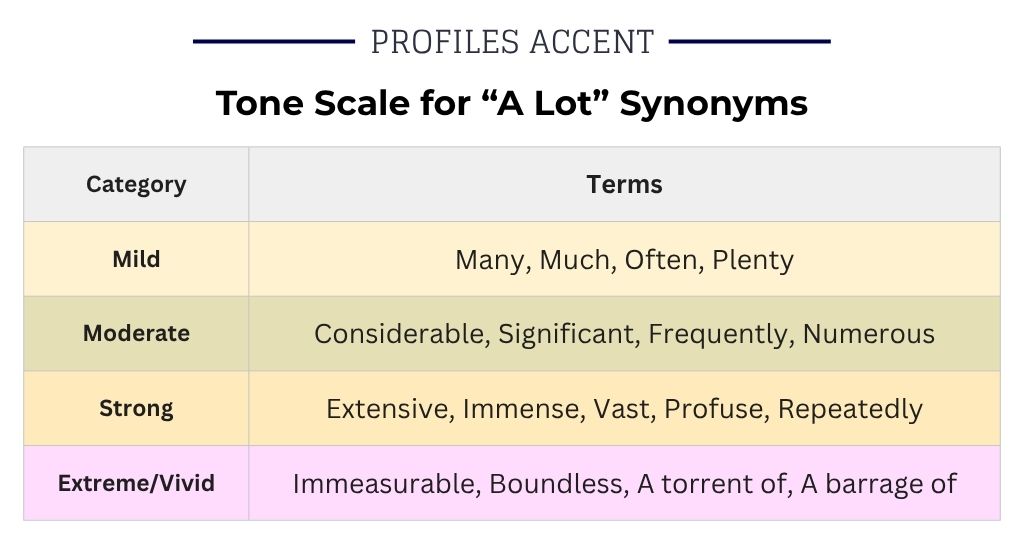
Not every synonym hits with equal force. Here’s how they stack up from gentle to overwhelming:
- Mild: Many, Much, Often, Plenty
- Moderate: Considerable, Significant, Frequently, Numerous
- Strong: Extensive, Immense, Vast, Profuse, Repeatedly
- Extreme/Vivid: Immeasurable, Boundless, A torrent of, A barrage of
If your writing needs weight, stay in the strong range. If you want to stay neutral and professional, moderate words keep you in safe territory. Vivid phrases like “a torrent of” should be used sparingly. Once or twice they’re memorable. Overuse kills the effect.
See the Difference: Rewrites Using Better Words for “A Lot”
Here’s where the real shift happens. The goal isn’t just replacing one word. It’s rewriting the whole sentence to match the tone you actually want.
Original: “I have a lot of work this week.”
- Formal: “My workload this week is substantial.”
- Casual: “I’m buried in tasks this week.”
- Creative: “This week handed me a mountain of things to finish.”
Each version says something slightly different. The formal one feels controlled. The casual one feels real and relatable. The creative one adds a visual weight to the stress.
Original: “She knows a lot about history.”
- Academic: “She holds extensive knowledge of historical events.”
- Conversational: “She knows history inside and out.”
- Vivid: “History seems to live in her memory.”
Notice how “inside and out” does more than “a lot” ever could. It suggests depth, not just quantity.
Original: “He helped a lot during the project.”
- Professional: “He provided considerable support throughout the project.”
- Warm/Personal: “He showed up for every step of the project.”
- Direct: “His help made a measurable difference.”
Another Word for A Lot in Specific Situations
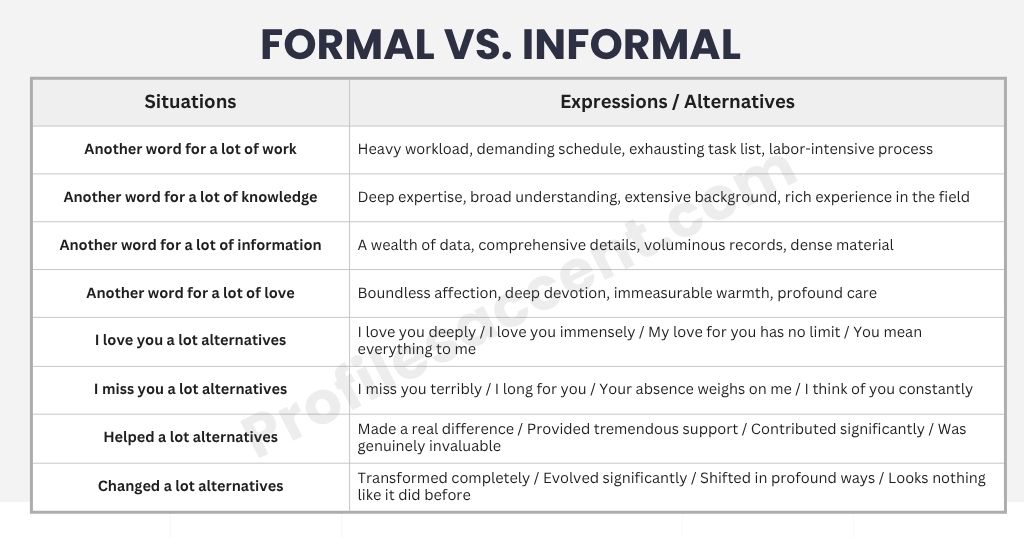
Some searches point to very specific situations. Here’s what actually works in each:
Another word for a lot of work:
- Heavy workload, demanding schedule, exhausting task list, labor-intensive process
Another word for a lot of knowledge:
- Deep expertise, broad understanding, extensive background, rich experience in the field
Another word for a lot of information:
- A wealth of data, comprehensive details, voluminous records, dense material
Another word for a lot of love:
- Boundless affection, deep devotion, immeasurable warmth, profound care
I love you a lot alternatives:
- I love you deeply / I love you immensely / My love for you has no limit / You mean everything to me
I miss you a lot alternatives:
- I miss you terribly / I long for you / Your absence weighs on me / I think of you constantly
Helped a lot alternatives:
- Made a real difference / Provided tremendous support / Contributed significantly / Was genuinely invaluable
Changed a lot alternatives:
- Transformed completely / Evolved significantly / Shifted in profound ways / Looks nothing like it did before
Common Mistakes When Replacing “A Lot”
A few specific mistakes come up again and again.
Using “various” or “several” as substitutes. These don’t mean the same thing as “a lot.” They suggest different types or a small handful, not large quantity. “I have various things to do” does not replace “I have a lot of things to do.”
Misusing “plethora.” This word originally pointed to excess or overload, often negative in tone. Using it to mean simply “many” misses the mark. “A plethora of options” works. “A plethora of sunshine” sounds off.
Forcing formal words into casual writing. Writing “copious amounts of homework” in a text message will read as stiff and odd. Match the register of the word to the register of the situation.
Ignoring countable vs. uncountable rules. “Numerous time” is wrong. “Numerous times” is correct. “Much ideas” is wrong. “Many ideas” is correct. This one small detail separates confident writing from careless writing.
Skipping the number option. Sometimes the best replacement for “a lot of” isn’t a synonym at all. It’s a real number. “A lot of employees were affected” becomes far stronger as “Over 300 employees were affected.” This is especially true in business and academic writing.
Words Close to “A Lot” but Not Quite the Same
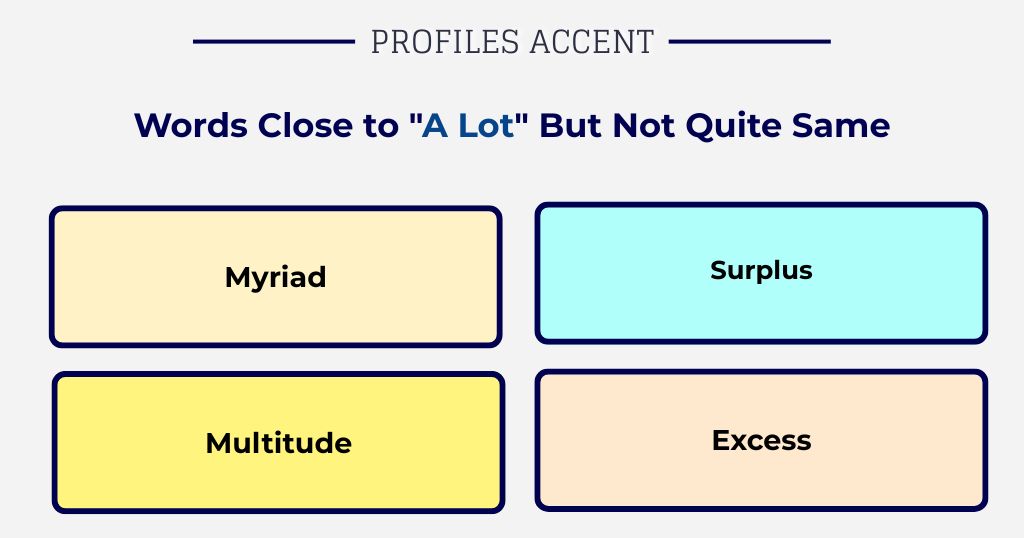
Myriad: Means countless. Works best as an adjective now (“myriad challenges”). Originally a noun meaning ten thousand. Use it for variety and range, not just raw quantity.
Surplus: Points to excess beyond what’s needed. It carries a practical tone, often used in supply, budget, or resource conversations.
Multitude: Suggests crowd-like volume. Works well for people and ideas. Slightly formal and literary.
Excess: Leans negative. It implies too much, often to the point of being a problem. Don’t use it as a neutral substitute for “a lot.”
Aggregate: Used in data and statistics. Means a total combined amount. Specific to numbers and figures.
Choosing Your “A Lot” Synonym with Confidence
The best synonym for “a lot” depends on three things: what you’re counting, who you’re writing for, and the feeling you want to leave behind.
For essays and reports, go formal and specific. “Substantial,” “considerable,” and “extensive” will almost always serve you better than “a lot.” If you can use a real number, do that first.
For everyday writing, “many,” “loads,” or “plenty” feel natural without sounding stiff. For emotional moments, reach for “deeply,” “profoundly,” or “boundlessly.” These words carry feeling in a way that “a lot” simply cannot.
The next time you type “a lot,” pause for two seconds. Ask what you actually mean.
- Quantity?
- Frequency?
- Intensity?
- Emotion?
The right category will point you straight to the right word.
Discover More Articles:

I’m Rowan, a language addict who loves exploring how words work in everyday communication. I’ve spent years studying English vocabulary and helping others express themselves more clearly. My goal is simple: make learning new words easy and practical. I focus on real-life examples that show when and how to use different terms. Through clear explanations and honest guidance, I help readers choose the right words for any situation with confidence.