There is a moment every writer knows. You type “proactive” and it looks fine. Then you read it again. It feels thin. Overused. Like a word that has been sitting in corporate emails and resume bullet points for so long that it no longer carries weight.
The problem is not the meaning. The meaning is solid. The problem is that “proactive” has become invisible from repetition. Readers skim past it. Hiring managers ignore it. And in academic or creative writing, it can feel oddly out of place.
This article helps you find words that actually land, depending on where and how you are writing.
What Does Proactive Actually Mean?
At its core, proactive describes someone who acts before a problem appears, rather than waiting to respond after it happens. It carries a sense of ownership, intention, and forward movement.
Emotionally, it is a positive word. It signals responsibility and awareness. But its tone is neutral to formal, which is why it fits professional writing but can feel stiff in casual conversation.
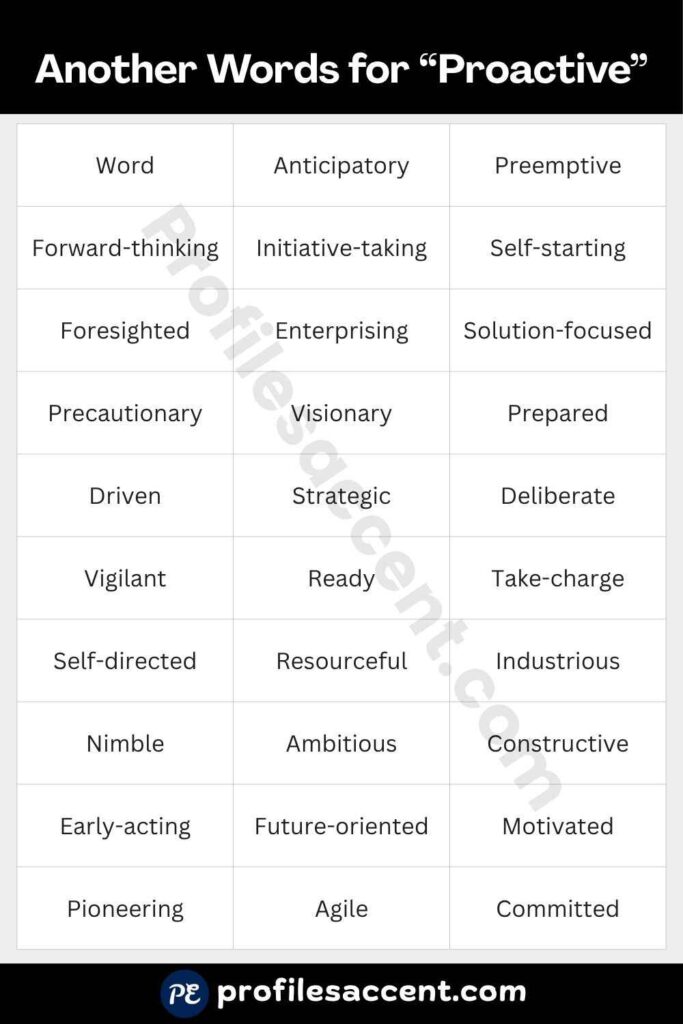
Quick Table of 45+ Synonyms for Proactive
| Word | Tone | Best Used When | Quick Example |
| Anticipatory | Formal | Academic or research writing | An anticipatory response saved time |
| Preemptive | Strategic | Business, risk planning | A preemptive review caught the error |
| Forward-thinking | Positive, professional | Leadership, strategy | A forward-thinking plan for growth |
| Initiative-taking | Action-focused | Workplace behavior | An initiative-taking team member |
| Self-starting | Confident | Resumes, team descriptions | A self-starting approach to projects |
| Foresighted | Thoughtful, slightly formal | Essays, analysis | A foresighted decision in uncertain times |
| Enterprising | Bold, action-driven | Business, entrepreneurship | An enterprising approach to sales |
| Solution-focused | Constructive | Problem-solving contexts | A solution-focused mindset helped us adapt |
| Precautionary | Careful | Safety, medical, academic | Precautionary steps reduced risk |
| Visionary | Imaginative | Leadership, creative contexts | A visionary leader planned years ahead |
| Prepared | Simple, clear | Everyday writing, reports | The team was prepared before the deadline |
| Driven | Energetic | Character descriptions | A driven employee who never waited |
| Strategic | Calculated | Business writing, planning | A strategic hire before the busy season |
| Deliberate | Intentional | Any formal context | Deliberate choices led to strong results |
| Vigilant | Alert | Safety, monitoring contexts | Vigilant staff caught the issue early |
| Ready | Simple, conversational | Casual or everyday tone | She was ready before anyone asked |
| Take-charge | Bold, informal | Team contexts, casual writing | A take-charge attitude helped the group |
| Self-directed | Independent | Professional or educational | A self-directed learner who set goals |
| Resourceful | Creative problem-solver | Storytelling, profiles | Resourceful staff found another path |
| Prevention-minded | Specific, practical | Health, policy writing | A prevention-minded approach works best |
| Nimble | Quick, adaptable | Startup or modern business | A nimble response to the changing market |
| Ambitious | Goal-driven | Career, motivation contexts | An ambitious thinker who acts early |
| Constructive | Positive, action-focused | Feedback, team writing | A constructive attitude toward challenges |
| Early-acting | Direct, clear | Policy or process writing | Early-acting measures reduced damages |
| Future-oriented | Long-view | Strategy, planning docs | Future-oriented planning is essential |
| Motivated | Energetic | HR, team descriptions | A motivated person who did not wait |
| Pioneering | First-mover | Innovation, history, profiles | Pioneering efforts changed the process |
| Agile | Quick and responsive | Tech, modern business | An agile team that planned in advance |
| Committed | Steady, reliable | Character, values | Committed leaders prepare before crises |
| Industrious | Hardworking | Classic formal writing | Industrious staff completed work early |
Four Ways Writers Use “Proactive” (And the Best Word for Each)
Not all synonyms point to the same idea. “Proactive” actually carries four distinct meaning layers, and the right alternative depends on which one you need.
1. Acting before a problem arrives
This is the most common meaning. Words like preemptive, anticipatory, and precautionary all fit here. They work well when you are describing a decision or action taken to stop something from going wrong.
Precautionary leans toward caution and safety. Preemptive leans toward control and strategy. Small but real difference.
2. Personal drive and initiative
Sometimes “proactive” is really about character. A person who does not wait to be told. In this case, self-starting, driven, or initiative-taking are far more precise. They describe the person’s behavior, not just a philosophy.
3. Long-term planning and vision
Forward-thinking, visionary, and strategic carry a wider time horizon. They suggest not just acting before a problem but planning well ahead for future opportunity. These work better in leadership or strategy discussions.
4. Readiness and preparation
Prepared, equipped, and ready are simpler but sometimes exactly right. They avoid formality and suit everyday communication without sounding clinical.
How Strong Is Your Word? A Tone Scale for Proactive Synonyms
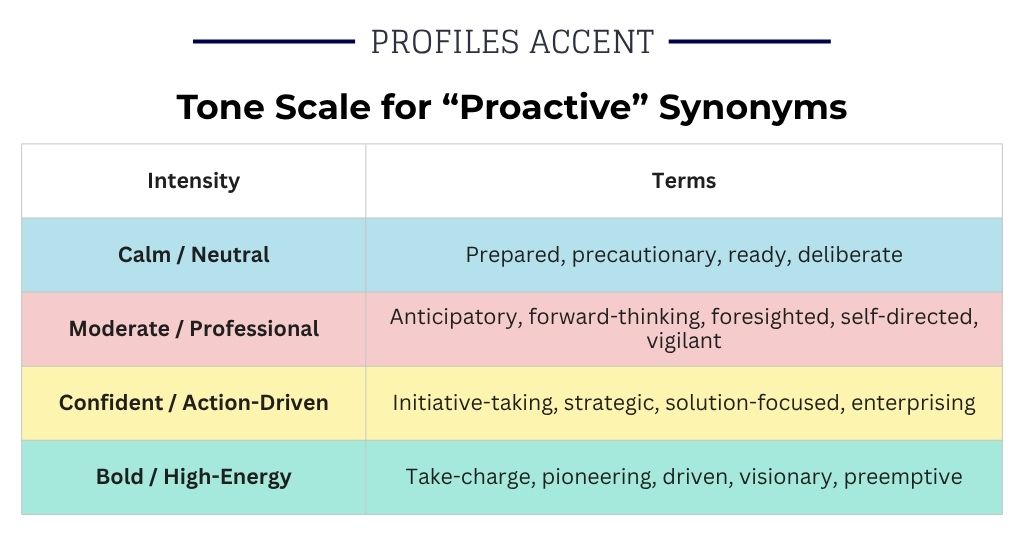
Here is how these alternatives sit on a spectrum from calm and neutral to strong and assertive.
- Calm / Neutral: Prepared, precautionary, ready, deliberate
- Moderate / Professional: Anticipatory, forward-thinking, foresighted, self-directed, vigilant
- Confident / Action-Driven: Initiative-taking, strategic, solution-focused, enterprising
- Bold / High-Energy: Take-charge, pioneering, driven, visionary, preemptive
The words near the top suit research papers and formal reports. The words near the bottom fit leadership profiles, startup culture descriptions, and persuasive writing. Placing the wrong word in the wrong context is where many writers make mistakes.
See the Difference: Sentence Rewrites Using Proactive Alternatives
Sometimes the best way to understand tone is to see it. Here are four rewrites of the same idea across different contexts.
Original sentence: She is a proactive team member who handles issues early.
- Formal tone: She consistently takes anticipatory steps to address issues before they develop.
- Casual tone: She never waits around. She spots a problem and handles it.
- Resume bullet point: Identified recurring workflow gaps and introduced fixes that cut error rates by 30%.
- Creative or storytelling tone: Before anyone else saw the storm coming, she had already started closing windows.
Notice how the resume version drops adjectives entirely and proves the trait through action and result. That matters more than any synonym swap.
Original sentence: We need a more proactive approach to client communication.
- Formal: We recommend an anticipatory communication model that addresses client concerns in advance.
- Casual: Let us reach out to clients before they have to call us.
- Strategy document: A preemptive outreach strategy would reduce reactive support volume and improve satisfaction scores.
Each version says something slightly different. The casual one is the most human. The strategy version is more specific about outcome. Pick based on your reader.
Proactive Synonyms by Writing Context: Formal, Professional, and Casual
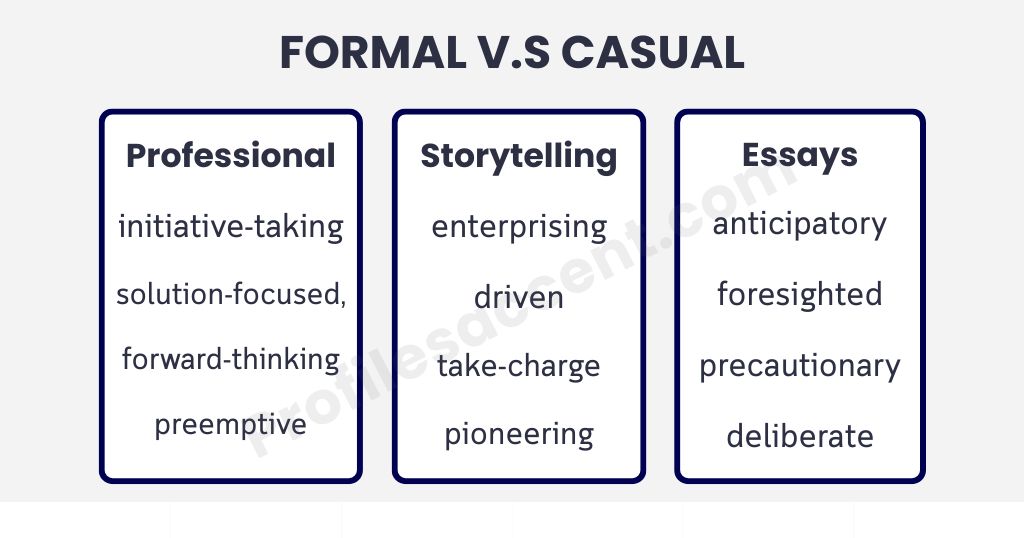
For an essay or academic paper, reach for: anticipatory, foresighted, precautionary, deliberate, strategic
For a professional email or workplace memo: forward-thinking, initiative-taking, solution-focused, preemptive
For storytelling or a personal profile: enterprising, driven, take-charge, pioneering, self-starting
For everyday conversation or social writing: ready, motivated, on top of things, ahead of the curve
Avoid using visionary or prescient in casual writing. They can sound like you are trying too hard. And avoid take-charge in formal academic writing because it reads as informal and vague.
Similar Words, Different Meanings: Common Mix-Ups to Avoid

This is where a lot of writing goes wrong.
Preemptive vs. Preventive
Preemptive implies you acted first to gain an advantage or stop someone else from acting. Preventive is softer and simply means you acted to stop something bad from happening. In a business deal, preemptive is stronger. In a health context, preventive is more appropriate.
Proactive vs. Reactive
These are true opposites. But reactive is not always negative. In some situations, responding quickly and well to something unexpected is a strength. Do not treat reactive as a criticism unless the context calls for it.
Ambitious vs. Proactive
Ambition is about desire and goals. Being proactive is about behavior and action. Someone can be ambitious without ever acting early. These are not the same trait.
Vigilant vs. Proactive
Vigilant means staying alert. Proactive means doing something in advance. Vigilance watches. Proactivity moves. If you mix them up, you change the meaning of the sentence.
When “Proactive” Is Actually the Right Word to Keep
Here is something most synonym guides skip: sometimes the original word is the right call.
If a job description uses “proactive” directly, mirror that language in your cover letter. Applicant tracking systems often scan for exact matches, so swapping it for something clever might actually work against you.
In flowing prose, like a cover letter paragraph, action verbs can feel stilted. “I am someone who anticipates obstacles” sounds more natural than stacking three verbs in a description.
Also, if you are writing about communication style or work philosophy, “My approach is proactive” works well as a stance. It describes an orientation, not a deliverable. That is a valid use.
The Origin Most Synonym Lists Ignore
“Proactive” did not start in a boardroom. It was coined by psychiatrist Viktor Frankl, who used it to describe the human capacity to choose one’s response to any situation, even in suffering. His concept was about deep personal responsibility, not project management.
Over decades, business culture adopted the word and flattened it into a buzzword. That shift stripped it of depth. Knowing this helps you see why it still holds real meaning in contexts that involve agency, ownership, and personal responsibility, but why it falls flat in a list of job skills next to “team player.”
Related Words That Writers Often Confuse with Proactive
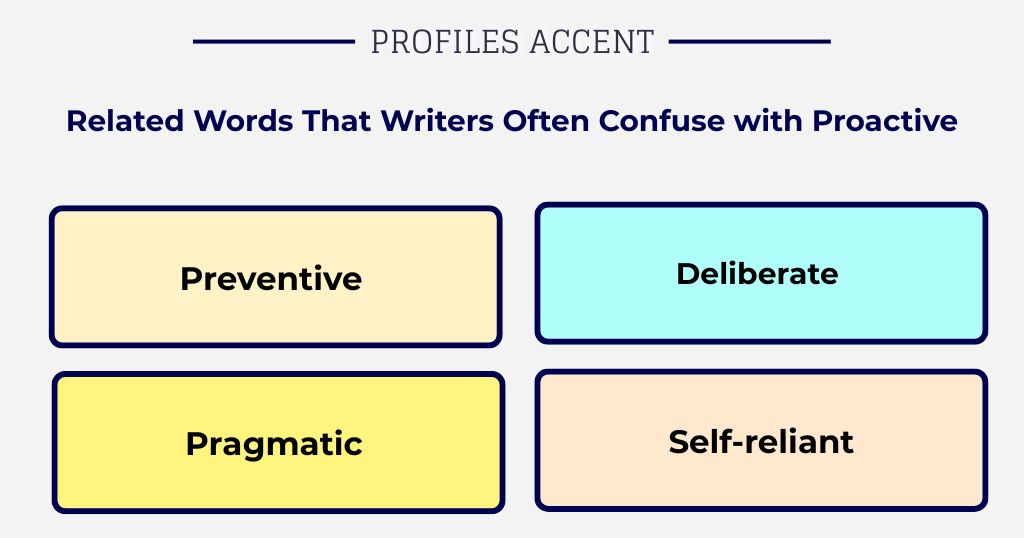
- Deliberate sits close to proactive but emphasizes intention over timing. Deliberate actions are chosen carefully. Proactive actions are taken early.
- Preventive shares the anticipatory quality but focuses specifically on stopping harm. It is narrower.
- Pragmatic is about practical problem-solving. It does not imply acting early but rather acting sensibly.
- Self-reliant suggests independence but not necessarily forward action. A self-reliant person handles things themselves; a proactive person starts before asked.
- Prepared is the closest everyday word but without the strong forward-motion quality of proactive.
Pick the Right Synonym for Proactive: A Final Practical Guide
Here is the practical bottom line.
- If you are writing about a person’s character: self-starting, driven, initiative-taking.
- If you are writing about a plan or strategy: anticipatory, preemptive, forward-thinking.
- If you are describing caution and prevention: precautionary, prevention-minded, deliberate.
- If you are writing a resume bullet: skip adjectives entirely. Use a verb like initiated, identified, or spearheaded, and follow it with a result.
- If you are writing casually: stay ahead of things, get ahead of it, or reach out early all communicate the same idea without sounding stiff.
The goal is not to find a fancier synonym. The goal is to choose a word that earns the reader’s trust by being specific, accurate, and natural in its context.
Discover More Articles:

I’m Rowan, a language addict who loves exploring how words work in everyday communication. I’ve spent years studying English vocabulary and helping others express themselves more clearly. My goal is simple: make learning new words easy and practical. I focus on real-life examples that show when and how to use different terms. Through clear explanations and honest guidance, I help readers choose the right words for any situation with confidence.