You typed “dumb” and something felt off. Maybe it was too harsh. Maybe it sounded lazy. Or maybe you’re writing something professional and that one word is dragging everything down.
The truth is, “dumb” carries a lot of baggage. It can sound careless in an email, offensive in a formal paper, and just plain weak in creative writing. The right replacement doesn’t just fix the sentence. It sharpens your whole message.
This guide gives you real alternatives, grouped by situation, tone, and intent. Not a word dump. Actual guidance you can use today.
What “Dumb” Is Really Saying
Before picking a synonym, know which meaning you’re replacing. “Dumb” has three separate uses, and mixing them up leads to wrong word choices.
- Lacking intelligence or sense (the most common modern use): “That was a dumb move.”
- Unable to speak (the original meaning): historically used to describe someone who could not talk.
- Struck silent by shock: “The news left him dumb with disbelief.”
Each path leads to completely different synonym territory. Most writers only think of the first. But if you’re writing about speechlessness or shock, you need different words entirely.
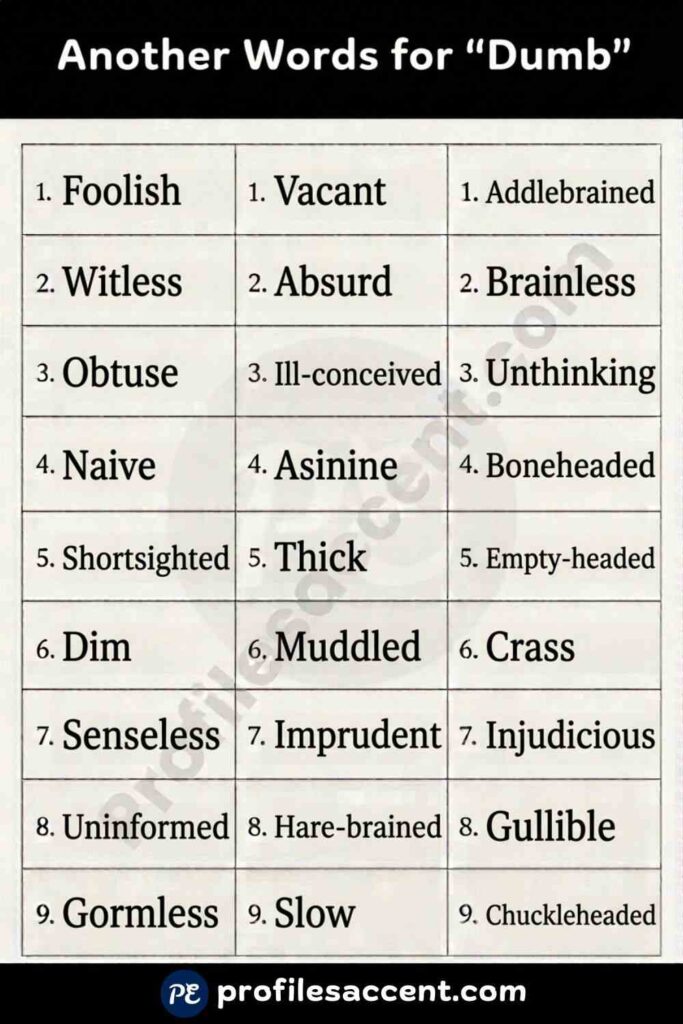
Another Word for Dumb: Quick 30+ Synonym Table
| Word | Tone | Best Used When | Example |
| Foolish | Mild, neutral | Describing a bad choice | That was a foolish risk. |
| Witless | Slightly sharp | Fiction or storytelling | He gave a witless reply. |
| Obtuse | Formal | Academic or professional writing | The reasoning was obtuse. |
| Naive | Gentle | When ignorance, not stupidity, is the point | A naive assumption at best. |
| Shortsighted | Neutral | Poor planning or decisions | A shortsighted strategy. |
| Dim | Casual | Light criticism, informal writing | He seemed a bit dim about it. |
| Senseless | Strong | Emphasizing total lack of logic | A senseless course of action. |
| Uninformed | Professional | Polite, workplace-safe replacement | An uninformed perspective. |
| Gormless | British slang | Humorous or casual writing | He stood there looking gormless. |
| Vacant | Descriptive | Character writing, fiction | A vacant expression on her face. |
| Absurd | Expressive | Emphasizing ridiculousness | That plan was simply absurd. |
| Ill-conceived | Formal | Plans, decisions, proposals | An ill-conceived approach. |
| Asinine | Sharp/comic | Strong but slightly humorous | An asinine comment, honestly. |
| Thick | Casual British | Informal, friendly criticism | He’s a bit thick sometimes. |
| Muddled | Gentle | Confused thinking, not stupidity | Her argument was muddled. |
| Imprudent | Formal | Decisions lacking caution | An imprudent financial move. |
| Hare-brained | Playful | Bad ideas with humor | Another hare-brained scheme. |
| Slow | Neutral | Mild, non-insulting | He was slow to catch on. |
| Addlebrained | Colorful | Creative or humorous writing | An addlebrained suggestion. |
| Brainless | Casual/strong | Informal, expressive | A brainless response. |
| Unthinking | Neutral | Actions done without reflection | An unthinking reaction. |
| Boneheaded | Informal | Stubborn stupidity | A boneheaded mistake. |
| Empty-headed | Descriptive | Shallow thinking, fiction | An empty-headed argument. |
| Crass | Tone-specific | Insensitive and dense behavior | A crass and crass decision. |
| Injudicious | Formal | Legal or official writing | An injudicious statement. |
| Gullible | Specific | Easily deceived, not generally slow | He was gullible, not dumb. |
| Chuckleheaded | Rare/humorous | Comic writing, dialogue | You chuckleheaded fool. |
| Doltish | Literary | Character description in fiction | A doltish but lovable character. |
| Lunkheaded | Slang | Strong informal criticism | A lunkheaded decision again. |
| Speechless | Literal | Inability or shock of speech | She was speechless for a moment. |
| Tongue-tied | Literal/emotional | Nervousness or shock | He went tongue-tied at the question. |
| Inarticulate | Neutral/literal | Communication difficulty | An inarticulate response. |
Two Very Different Meanings, Two Very Different Word Lists
This is the gap most synonym lists completely ignore.
The word “dumb” originally had nothing to do with intelligence. It described someone who could not speak. Over centuries, slang twisted it into an insult about mental ability. That shift created a real problem.
If you write “she was struck dumb,” you mean she was silenced by shock. That’s different from “she said something dumb,” which questions her judgment.
For speechlessness or silence, use: Mute, voiceless, speechless, tongue-tied, inarticulate, tight-lipped, close-mouthed.
For lack of intelligence or sense, use: Foolish, obtuse, witless, dim, senseless, brainless, naive.
Never swap these groups. Calling someone “inarticulate” when you mean “foolish” sends a completely different message, and it might actually be more accurate than you intended.
How Hard Does Each Dumb Synonym Hit? Tone Intensity Scale
Not all synonyms hit the same way. Here’s how they land, from barely a nudge to a full knockout.
- Very Mild: Naive, uninformed, muddled, unfocused
- Mild: Dim, slow, simple, gullible, vacant
- Moderate: Foolish, witless, thick, unthinking, shortsighted
- Strong: Senseless, brainless, obtuse, boneheaded, asinine
- Very Strong: Idiotic, moronic, crass, lunkheaded, imbecilic
Writers often jump straight to the strong end without realizing it. If you’re writing a professional critique, “shortsighted” lands much better than “brainless.” Save the heavy ones for fiction, satire, or situations where impact is the whole point.
Synonyms for “Dumb” in Specific Situations
When the decision was the problem
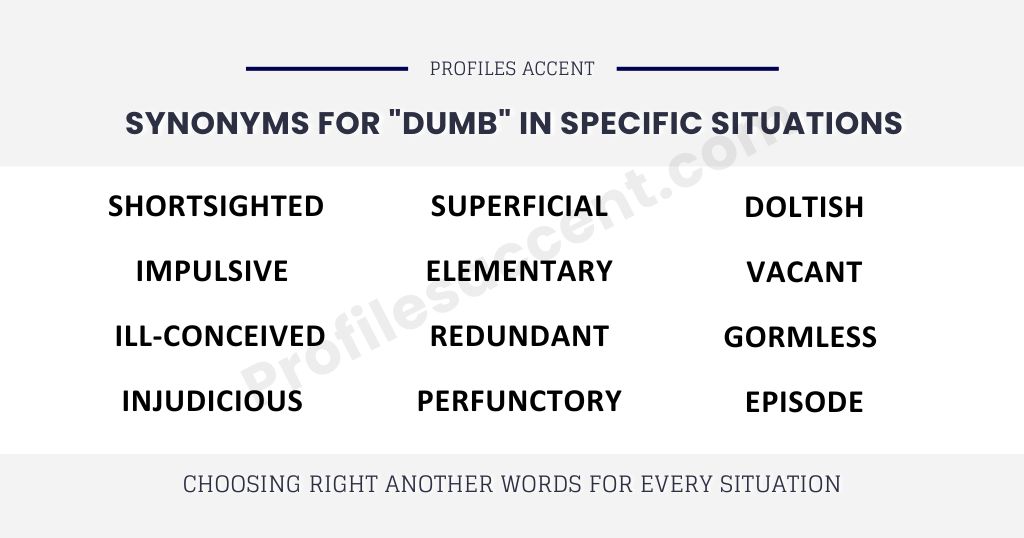
The word “dumb” describes the decision but doesn’t say why it failed. These words are sharper because they name the actual flaw:
- Shortsighted tells the reader no one thought ahead.
- Impulsive says it was rushed.
- Ill-conceived says the foundation was broken from the start.
- Injudicious is perfect for formal writing when someone in authority made a poor call.
When the question felt too obvious
Most people have heard “there’s no such thing as a dumb question.” Still, writers sometimes need a word for a question that reveals a lack of attention or context.
Try: superficial, elementary, redundant, or perfunctory. These don’t attack the person. They describe the quality of the question.
When you’re describing a person
This is where word choice gets most sensitive. Adjectives applied to people land harder than those applied to actions. If you’re writing fiction, words like doltish, vacant, or gormless have texture without being cruel. In real life, opt for describing the behavior, not the person. “That was a shortsighted choice” beats “you’re so dim” every single time.
Sentence Rewrites: See the Difference a Better Word Makes
- Weak sentence: “That was a really dumb thing to say.”
- Formal: “That comment was both ill-advised and counterproductive.”
- Casual: “Honestly, that came out pretty boneheaded.”
- Academic: “The statement reflected a lack of critical evaluation.”
- Creative: “Words tumbled out of him, witless and warm, landing exactly wrong.”
Notice how each version changes not just the word but the whole feeling of the sentence. The formal version protects relationships. The academic version shifts blame onto the thought process, not the person. The creative version adds personality without being cruel.
Need a Synonym for Dumb Starting With a Specific Letter?
Sometimes you need a word that starts with a specific letter. Here are uncommon but strong choices:
- Starts with A: Asinine, addlebrained, absentminded, absurd
- Starts with C: Chuckleheaded, crass, clueless, counterproductive
- Starts with E: Empty-headed, erroneous, eccentric (used loosely)
- Starts with G: Gormless, gullible, goofy
These aren’t all interchangeable. Gormless is British and mildly humorous. Asinine has a sharper comic edge. Chuckleheaded belongs in dialogue, not a business report.
Synonyms That Look Alike But Don’t Work the Same Way
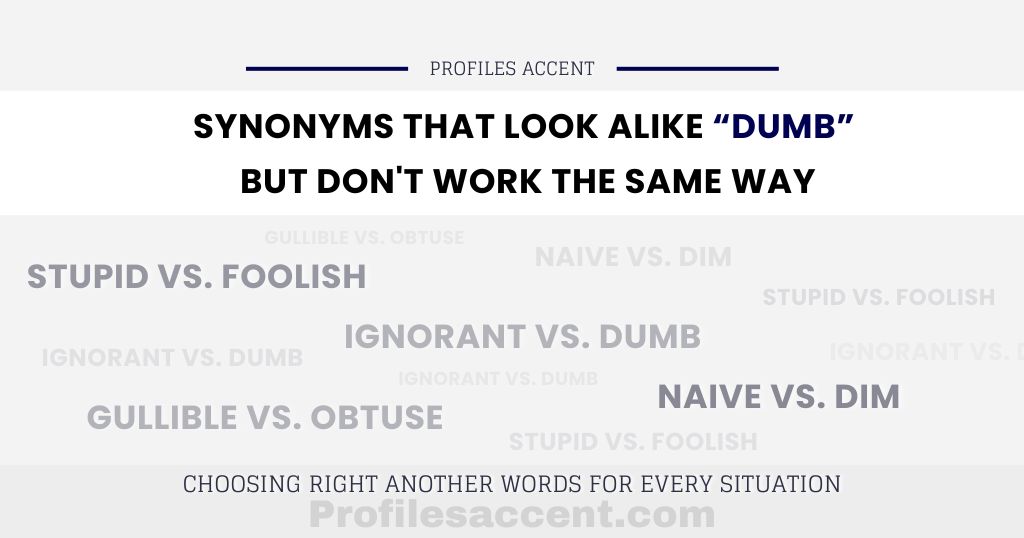
Stupid vs. Foolish: Stupid suggests a fixed lack of ability. Foolish describes a choice or moment. “That was foolish” is far less personal than “that was stupid.”
Ignorant vs. Dumb: Ignorant means lacking information. It’s not about intelligence at all. Using “ignorant” when you mean “slow-thinking” is a genuine mistake.
Naive vs. Dim: Naive implies inexperience, not low intelligence. Someone naive just hasn’t encountered something yet. Someone dim struggles to process it even when they do.
Gullible vs. Obtuse: Gullible means too trusting. Obtuse means slow to understand. They’re not synonyms, even though both can describe someone making a poor judgment.
Getting these wrong doesn’t just hurt your writing. It can accidentally insult someone in a way you didn’t intend, or let someone off the hook when you meant to be critical.
One Thing Worth Knowing Before You Use This Word
Using “dumb” to mean stupid has a real history problem. The original meaning referred to people who could not speak, including many in Deaf communities. When “dumb” shifted into an insult about intelligence, it tied the inability to speak to a lack of worth or thought. That connection is harmful.
In professional, medical, or disability-related writing, never use “dumb” to mean anything other than silence, and even then, more precise words are better. “Nonverbal,” “nonspeaking,” or “mute” serve the literal meaning without the slur history.
In everyday writing, this just means being intentional. There are dozens of better words available. You don’t need to default to one that carries that weight.
The Flip Side: Antonyms for Dumb
Understanding what sits at the other end helps you calibrate tone.
Opposite of slow thinking: Astute, sharp, perceptive, discerning
Opposite of a poor decision: Prudent, judicious, calculated, sagacious
Opposite of speechlessness: Eloquent, articulate, voluble
Words Close to Dumb Synonyms But Not Quite
- Dense: Suggests ideas can’t get through. More about resistance than low ability.
- Thick: British casual, closer to “slow on the uptake” than fully unintelligent.
- Scatterbrained: About disorganized thinking, not low intelligence.
- Erratic: About unpredictable behavior, not stupidity at all.
- Vacant: About absence of engagement. A person can seem vacant and still be very intelligent.
So Which Word Should You Actually Use?
Pick based on what the sentence actually needs. If you’re criticizing a choice, use shortsighted, ill-conceived, or impulsive. If you’re describing a person gently, try naive or unfocused. If you’re writing fiction and want character texture, gormless, doltish, or vacant add color without being flat insults.
The word “dumb” usually isn’t wrong. It’s just lazy. Any of these alternatives will do the job with more precision, and precision is what separates writing that lands from writing that just sits there.
Discover More Articles:

I’m Rowan, a language addict who loves exploring how words work in everyday communication. I’ve spent years studying English vocabulary and helping others express themselves more clearly. My goal is simple: make learning new words easy and practical. I focus on real-life examples that show when and how to use different terms. Through clear explanations and honest guidance, I help readers choose the right words for any situation with confidence.