You finish writing a sentence and stare at the word “boring.” It feels flat. Weak. Like you grabbed the first word that showed up. The problem is not your idea. It is the word you chose to describe it.
“Boring” works fine in conversation. But in writing, it does almost nothing. It tells the reader very little about why something lacks interest. Is it slow? Repetitive? Lifeless? Predictable? Each of those is a different experience, and each deserves a different word.
This guide helps you find the right one.
What Boring Really Means (And Why It Matters)
At its simplest, boring means something fails to hold attention. But that failure can happen in many ways. A task can bore you because it drags on too long. A person can bore you because they never say anything surprising. A movie can bore you because every scene is predictable.
The word carries a neutral, slightly negative tone. It is not harsh, but it is not kind either. Most importantly, it is vague, and vagueness is the enemy of good writing.
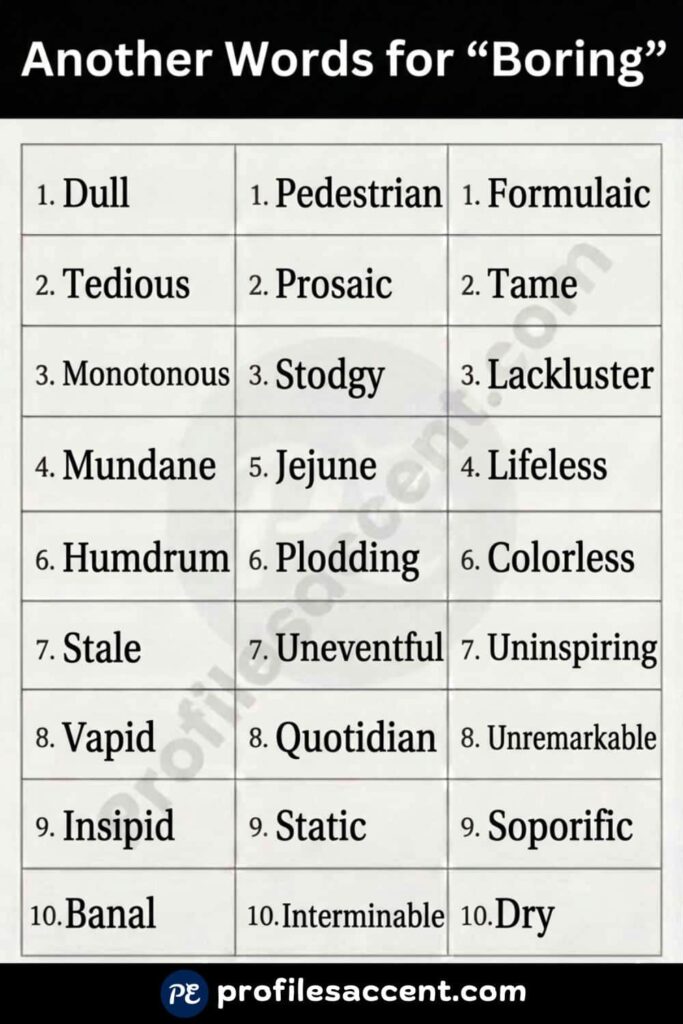
Synonyms for Boring at a Glance: 30+ Quick-Reference Table
| Word | Tone | Best For | Example |
| Dull | Mild, general | Any context | A dull afternoon with nothing to do |
| Tedious | Negative | Long, slow tasks | Tedious paperwork that took all day |
| Monotonous | Neutral | Repetitive sounds or tasks | A monotonous speech with one flat tone |
| Mundane | Soft | Everyday routine | Mundane errands feel endless |
| Dreary | Slightly sad | Weather, mood, settings | A dreary Tuesday with gray skies |
| Humdrum | Casual | Daily life, routine | The humdrum rhythm of the work week |
| Stale | Informal | Ideas, jokes, content | That joke went stale years ago |
| Vapid | Critical | Conversations, media | Vapid TV shows with no real plot |
| Insipid | Formal, critical | Dialogue, personality | An insipid response with zero energy |
| Banal | Literary | Clichés, unoriginal ideas | A banal storyline no one remembers |
| Pedestrian | Formal | Writing, ideas, creativity | A pedestrian plot that never surprised |
| Prosaic | Formal | Writing, speech | Prosaic dialogue that lacked any spark |
| Stodgy | Slightly humorous | Personality, style | A stodgy professor who never smiled |
| Jejune | Literary, rare | Ideas, writing | A jejune argument with no real depth |
| Enervating | Strong | Draining experiences | An enervating lecture that exhausted everyone |
| Plodding | Vivid | Pacing, progress | A plodding story that moved too slowly |
| Uneventful | Neutral | Days, trips, events | An uneventful drive through flat land |
| Quotidian | Academic | Daily routine | The quotidian reality of office life |
| Static | Neutral | Situations without change | A static relationship with no growth |
| Interminable | Expressive | Long meetings, films | An interminable meeting that never ended |
| Formulaic | Critical | Stories, content | A formulaic thriller with zero surprises |
| Tame | Soft | Events, writing | A tame ending after so much buildup |
| Lackluster | Mild, negative | Performance, personality | A lackluster presentation that lost the room |
| Lifeless | Vivid | Atmosphere, performance | A lifeless party nobody enjoyed |
| Flat | Simple | Writing, characters | Flat characters readers forget quickly |
| Colorless | Descriptive | Personality, writing style | A colorless speech that said nothing new |
| Uninspiring | Gentle | Work, ideas, leadership | Uninspiring advice from someone playing it safe |
| Unremarkable | Neutral | Events, places | An unremarkable destination with nothing unique |
| Soporific | Strong, formal | Talks, writing | A soporific lecture that made everyone drowsy |
| Dry | Contextual | Delivery, tone | A dry presentation with no energy |
| Wearisome | Emotional | Long experiences | A wearisome process that drained the team |
| Arid | Figurative | Conversations, ideas | An arid debate that produced nothing useful |
| Absonant | Rare, formal | Disconnected content | An absonant speech that felt out of place |
Words That Look Similar But Work Differently
Most synonym lists just drop words in a pile. That does not actually help you choose. Here is what separates the ones people confuse most.
Tedious vs. Monotonous
These are not the same. Tedious means something takes too long and requires effort. Monotonous means it never changes. You can have a monotonous task that finishes quickly. You can have a tedious task that has some variety. If the length is the problem, use tedious. If the sameness is the problem, use monotonous.
Dull vs. Insipid
Dull is broad. It works for almost anything lacking sharpness or interest. Insipid is more pointed. It implies a total absence of flavor or spirit, like someone removed all the personality on purpose. Calling a conversation insipid feels more cutting than calling it dull.
Mundane vs. Humdrum
Mundane is neutral. It simply means ordinary, everyday, without excitement. Humdrum carries a slightly tired feeling, like you have done the same thing too many times and the energy is gone. Mundane describes the thing. Humdrum describes how it feels over time.
Banal vs. Formulaic
Banal applies to ideas or expressions that are boring because they are so overused they have lost all meaning. Formulaic refers to structure and pattern, usually in storytelling or content, where every piece follows the same predictable shape. A speech can be banal. A movie plot is usually formulaic.
How Strong Do You Want to Sound? A Tone Scale for Boring Synonyms
Not every boring thing deserves a dramatic word. Match your intensity to the situation.
- Mild: Unremarkable, uneventful, mundane, humdrum
These words point out a lack of excitement without being harsh. Good for neutral descriptions.
- Moderate: Dull, tedious, stale, dry, tame, flat
These carry more weight. The reader understands something failed to engage, but the tone stays measured.
- Strong: Monotonous, plodding, wearisome, vapid, insipid, lifeless
At this level, the word signals frustration or real criticism. Use these when the dullness had an actual effect on the experience.
- Extreme: Soporific, enervating, interminable, mind-numbing
These are reserved for situations where boredom becomes almost unbearable. A soporific lecture does not just bore you. It puts you to sleep.
Same Sentence, Better Word: Rewrites in Action
See how swapping one word shifts the entire feeling.
Original: The meeting was boring.
- Formal: The meeting was entirely unremarkable and produced no useful outcomes.
- Casual: That meeting was a complete snoozefest.
- Vivid/Creative: The meeting crawled forward like a clock with a dying battery.
- Academic: The session was notably lacking in stimulating content or productive exchange.
Original: She was a boring person to talk to.
- Gentle: She was a rather unremarkable conversationalist.
- Critical: Every conversation with her felt flat and predictable.
- Formal: She struck others as prosaic, offering little beyond routine observations.
Original: It was a boring day.
- Casual: The whole day was just blah, nothing happened.
- Literary: The day passed without event, colorless and quiet.
- Expressive: It was the kind of uneventful Tuesday that makes the week feel longer.
Each rewrite is not just a synonym swap. The word you choose reshapes what the reader understands and how they feel about it.
Bored vs. Boring: The Mistake Most Writers Don’t Notice
Here is something most synonym lists completely skip. “Boring” describes the thing. “Bored” describes how you feel. These are not interchangeable, and mixing them up is a common writing mistake.
If you want to describe how someone felt, you need words that reflect an internal state: listless, restless, disengaged, apathetic, indifferent, vacant, detached.
If you want to describe the thing causing that feeling, you use the words in this article. Knowing which one you need is half the battle.
Another Word for Boring Starting With M
Writers often look for synonyms beginning with a specific letter. For “M,” the strongest options are:
- Monotonous is the most precise.
- Mundane fits everyday dullness well.
- Mind-numbing works for casual or expressive writing when something is intensely dull.
- Mediocre edges slightly into “average” territory but works when something is boring because it never rises above the baseline.
Slang and Casual Synonyms for Boring That Actually Sound Natural
Sometimes formal synonyms feel out of place. In casual writing, social content, or dialogue, these land better:
- Mid signals something is painfully average and unimpressive without being terrible.
- Blah captures a low-energy, uninterested reaction.
- Snooze-fest is vivid and fun.
- Vanilla works for anything that plays it too safe.
- Dead fits a place or event with no energy or atmosphere.
Use these carefully in writing. They work inside dialogue or informal commentary. In most professional or academic contexts, they would feel out of place.
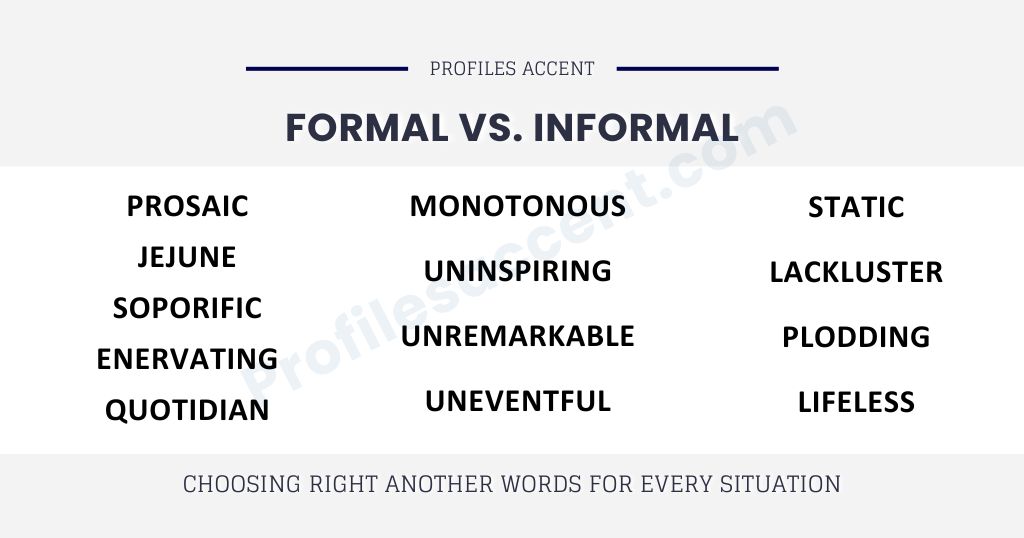
Formal vs. Informal: Another Word for Boring or Dull by Context
For essays and academic writing: prosaic, jejune, soporific, enervating, quotidian, monotonous
For professional emails and reports: uninspiring, unremarkable, uneventful, static, lackluster
For storytelling and creative work: plodding, lifeless, flat, colorless, formulaic, dreary
Avoid in formal contexts: snooze-fest, blah, mid, vanilla, dead. These are conversational. They do not belong in professional or academic writing.
Using These Words Wrong: Mistakes Worth Avoiding
Using “tedious” for anything repetitive. Tedious means slow and long. A quick repetitive action is monotonous, not tedious.
Using “vapid” for anything dull. Vapid specifically means lacking spirit or substance, often in speech or personality. Do not use it for a slow commute or a grey day.
Overusing “dull.” It is a fine general word, but using it three times in one paragraph makes your writing look lazy. Rotate.
Treating “dry” as always negative. Dry delivery in comedy is a skill. Context changes everything with this word.
Stacking extreme words. Calling something both “interminable” and “mind-numbing” and “soporific” in the same paragraph weakens all three. Choose one strong word and let it do the work.
Words That Orbit Boring Without Meaning the Same Thing
Stagnant: Things that are boring because they stopped moving or developing. Often used for careers, relationships, or ideas.
Listless: Describes a person or performance drained of energy, not because they are boring by nature but because the life has gone out of them.
Predictable: A softer, more specific word for something boring because there are no surprises. Often used in storytelling and sports.
Repetitive: Describes the mechanical act of repeating something. Neutral in tone, but can imply boredom depending on context.
Colorless: Works well for personalities or writing styles that lack any distinctive quality.
The Right Synonym for Boring Is a Choice, Not a Guess
You do not need a bigger vocabulary. You need a more precise one. The next time you type “boring,” pause for a second. Ask yourself what kind of dull it is. Is it slow? Repetitive? Lifeless? Predictable? Plain? That answer leads you to the right word.
A well-chosen synonym does not just replace a word. It adds a layer of meaning the reader can actually feel.
Discover More Articles:

I’m Rowan, a language addict who loves exploring how words work in everyday communication. I’ve spent years studying English vocabulary and helping others express themselves more clearly. My goal is simple: make learning new words easy and practical. I focus on real-life examples that show when and how to use different terms. Through clear explanations and honest guidance, I help readers choose the right words for any situation with confidence.