You’re mid-sentence. You’ve already used “although” twice in the same paragraph. You know it sounds repetitive, but nothing else feels quite right. Sound familiar?
This happens to writers constantly. Not because they lack vocabulary, but because they don’t know which replacement fits where. Swapping “although” with the wrong word can shift your tone from professional to casual, or make your sentence grammatically broken without you even noticing.
This guide fixes that. You’ll get more than 30 real alternatives, with honest guidance on when each one works and when it doesn’t.
What “Although” Is Really Doing in Your Sentence
“Although” connects two contrasting ideas inside a single thought. It signals: something was true, but the expected outcome didn’t follow.
It’s neutral in tone. Neither stiff nor sloppy. That’s exactly why replacing it requires care. Its substitutes each carry their own personality.
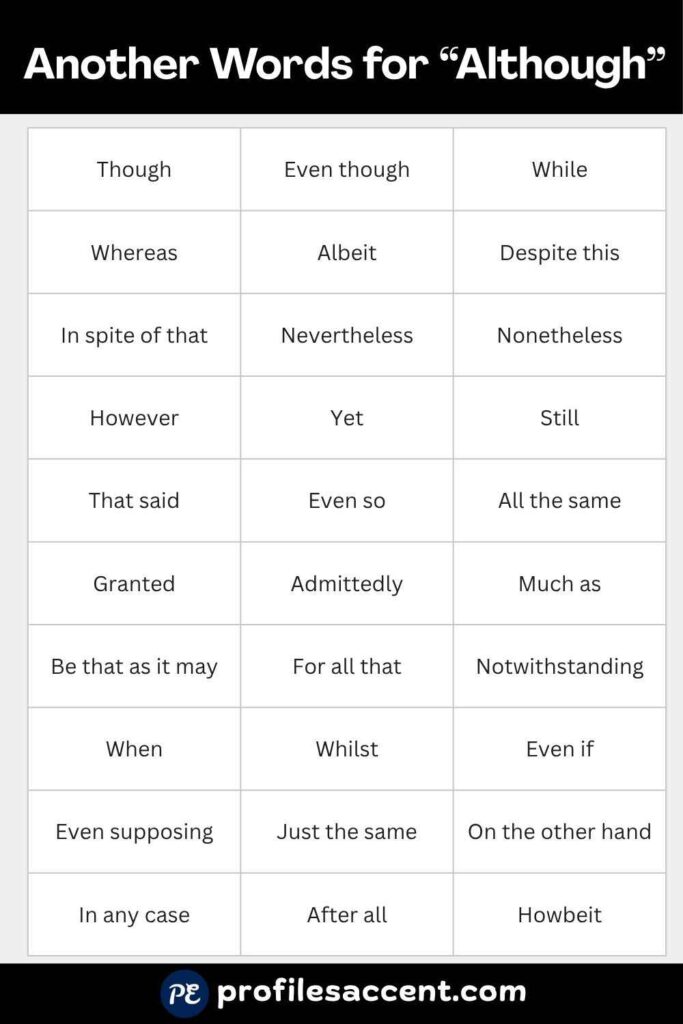
30+ Synonyms for Although at a Glance: Quick-Reference Table
| Word / Phrase | Tone | Best Used When | Quick Example |
| Though | Casual | Everyday writing or speech | It was cold, though we stayed outside. |
| Even though | Neutral | Emphasizing a strong contrast | Even though she studied, she failed. |
| While | Neutral | Comparing two ongoing facts | While he talks a lot, he says little. |
| Whereas | Formal | Showing clear opposites | He loves coffee, whereas she prefers tea. |
| Albeit | Formal | Adding a small qualification | She agreed, albeit with some hesitation. |
| Despite this | Neutral | Starting a follow-up sentence | Despite this, they pushed forward. |
| In spite of that | Neutral | Acknowledging then contrasting | In spite of that, results were strong. |
| Nevertheless | Formal | Academic or professional writing | It rained. Nevertheless, the event continued. |
| Nonetheless | Formal | Essays or reports | The plan had flaws. Nonetheless, it worked. |
| However | Formal | Between two separate thoughts | Sales dropped. However, profits grew. |
| Yet | Mixed | Surprising or poetic contrast | He’s quiet, yet deeply confident. |
| Still | Casual | Soft, unexpected contrast | It was late. Still, we kept going. |
| That said | Casual | Softening a contradiction | It’s hard. That said, it’s worth it. |
| Even so | Casual | Surprising outcome | It was risky. Even so, they tried. |
| All the same | Casual | “Regardless” type contrast | He was rude. All the same, we helped. |
| Granted | Neutral | Admitting something before contrasting | Granted, the cost is high, but quality matters. |
| Admittedly | Neutral | Acknowledging a weakness | Admittedly, the plan wasn’t perfect. |
| Much as | Formal | Reluctant contrast | Much as I respect his opinion, I disagree. |
| Be that as it may | Formal | Formal dismissal of a point | Be that as it may, we move forward. |
| For all that | Formal | Despite everything listed | For all that effort, results were modest. |
| Notwithstanding | Very formal | Legal or official documents | Notwithstanding the delays, work continued. |
| When | Situational | Narrative or storytelling contrast | When he had everything, he wanted nothing. |
| Whilst | Formal (British) | British English writing | Whilst costs rose, output fell. |
| Even if | Conditional | Hypothetical contrast | Even if you’re tired, keep going. |
| Even supposing | Conditional | Formal hypothetical contrast | Even supposing that’s true, what changes? |
| Just the same | Casual | Informal “still” or “anyway” | She complained. Just the same, she came. |
| On the other hand | Neutral | Presenting two sides | Sales fell. On the other hand, costs dropped. |
| In any case | Casual | Wrapping up a contrast | In any case, we’ll manage. |
| After all | Casual | Reminding of a known truth | After all, nobody said it would be easy. |
| Howbeit | Archaic | Old texts only | (Historical writing contexts) |
Not All Although Synonyms Work the Same Way
Not all of these words do the same thing. Let’s break them into honest clusters.
When you want a direct swap with no grammar change, reach for “even though” or “though.” They slot in almost exactly where “although” sits. “Even though” hits harder. “Though” feels lighter.
When you want to separate the two ideas into different sentences, words like “however,” “nevertheless,” and “nonetheless” step in. But here’s the catch: they can’t connect a clause. They need a full stop or semicolon before them.
- Wrong: However it rained, we went out.
- Right: It rained. However, we went out.
When you want to drop the verb entirely and compress the contrast, “despite” and “in spite of” become your tools. They need a noun phrase after them, not a full clause.
- Wrong: Despite it was raining.
- Right: Despite the rain.
When you want to add a small, quiet qualification, “albeit” works well. It’s elegant but narrow. You can’t use it to open a sentence, and it doesn’t handle full independent clauses.
- Right: She agreed, albeit reluctantly.
- Wrong: Albeit she was tired, she continued.
From Lightest to Most Formal: Where Each Although Alternative Lands
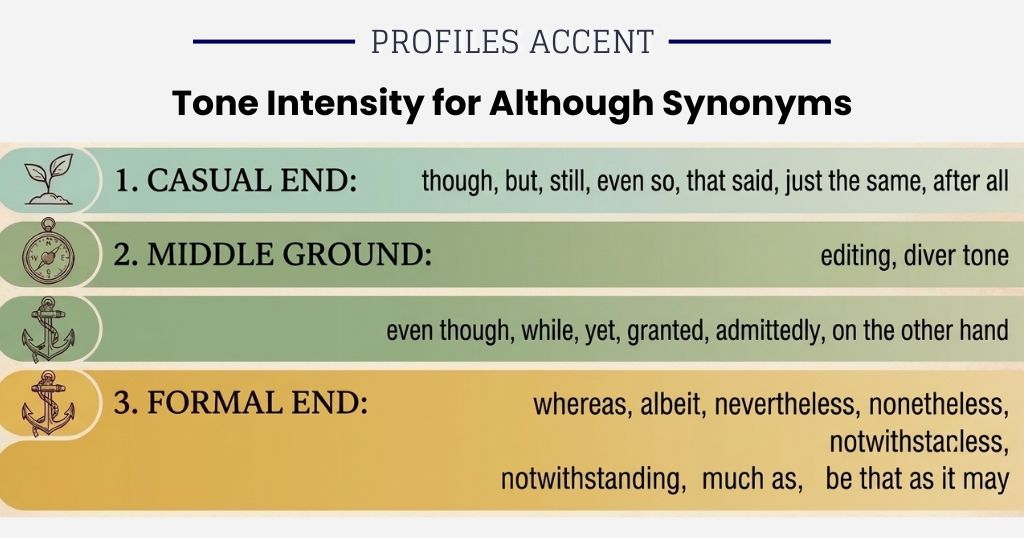
If you’re unsure which word matches your writing environment, this scale helps:
- Casual end: though, but, still, even so, that said, just the same, after all
- Middle ground: even though, while, yet, granted, admittedly, on the other hand
- Formal end: whereas, albeit, nevertheless, nonetheless, notwithstanding, much as, be that as it may
The further right you go, the more structured and distant the writing feels. Using “notwithstanding” in a casual email to a friend sounds odd. Using “but” in a legal contract sounds careless.
Match the word to your reader, not just the sentence.
Same Sentence, Four Different Tones: Although Synonyms in Action
Take this base sentence: “Although the team was exhausted, they finished the project.”
- Casual version: The team was absolutely drained. They finished the project, though.
- Formal version: Notwithstanding their exhaustion, the team completed the project on schedule.
- Academic version: Even though fatigue was a significant factor, the team successfully delivered the project within the given timeframe.
- Creative version: Worn down and running on little sleep, they crossed the finish line all the same.
Each version says the same thing. But the reader feels something different each time. That’s the real power of choosing carefully.
Another Word for Although in Essays and Academic Writing
Stick to words that don’t draw attention to themselves. The goal in formal writing is logic, not personality.
Best choices: “even though,” “whereas,” “nevertheless,” “nonetheless,” “notwithstanding,” “much as”
Avoid in academic contexts: “though” (at sentence end), “that said,” “after all,” “just the same”
One thing most guides skip: In essays, where you place the contrast matters.
- Opening with “although” or “even though” sets up the counterargument first.
- Opening with your main claim and following with “however” or “nevertheless” feels more assertive.
- Choose based on which idea you want to land harder.
Another Word for Although in Business and Professional Emails
You want clarity without sounding robotic or stiff. The best options here are:
“Granted,” “admittedly,” “even though,” and “that said” work well in business writing because they acknowledge the other side without giving up your point.
- Example: Admittedly, the timeline is tight. That said, the team is confident we can deliver.
Avoid “notwithstanding” in emails unless the context is genuinely legal or contractual. It reads as cold and overly stiff in regular business communication.
The “Though” Flexibility That Most Writers Never Use
- “Although” can only sit at the beginning or middle of a clause. It cannot close a sentence.
- “Though” can. That’s a feature that makes it uniquely flexible.
- You can write: “She didn’t agree. She came along, though.”
This tail placement creates a spoken, natural rhythm. It mimics how real people talk. In creative writing and conversational content, this trick adds personality without trying too hard.
Common Errors When Swapping Out Although
Mixing up “despite” with “although”: They’re not interchangeable without restructuring your sentence. If you swap “although” for “despite,” the rest of the sentence must change too.
Overusing “however”: It’s the most common fallback in formal writing. When every other paragraph starts with “however,” readers notice. Rotate between “nonetheless,” “even so,” and “that said.”
Using “whilst” outside British English: In American writing, “whilst” sounds affected. Stick to “while.”
Starting sentences with “albeit”: It simply doesn’t work that way grammatically. Keep “albeit” mid-sentence, after a comma.
Using “even if” when you mean “even though”: “Even if” is conditional (it refers to hypothetical situations). “Even though” refers to something that actually happened.
- “Even if it rains, I’ll go.” (Might rain. Not sure yet.)
- “Even though it rained, I went.” (It did rain.)
Words That Live Near Although But Work Differently
A few words that come up near this topic but serve slightly different functions:
Regardless signals you’re dismissing an obstacle entirely, not just contrasting it.
Except that narrows the contrast to one specific limitation rather than a general opposition.
Only can sometimes replace “although” when the contrast is minor: “I’d go, only it’s too far.”
Rather shifts a preference or correction, not a concession. It’s often confused with contrast words but operates differently.
Picking the Right Although Synonym: The Short Version
Before you replace “although,” ask yourself two things: What tone does my reader expect? And where in the sentence does my contrast land?
If the ideas need to stay connected in one sentence, use “even though,” “while,” or “though.”
If you’re separating them, use “however,” “nevertheless,” or “nonetheless” and start a fresh sentence.
If you’re compressing the contrast into a phrase, use “despite” or “in spite of.”
Get those three scenarios clear in your head, and you’ll never make an awkward swap again.
Discover More Articles:

I’m Rowan, a language addict who loves exploring how words work in everyday communication. I’ve spent years studying English vocabulary and helping others express themselves more clearly. My goal is simple: make learning new words easy and practical. I focus on real-life examples that show when and how to use different terms. Through clear explanations and honest guidance, I help readers choose the right words for any situation with confidence.