You finished a sentence. You look at the next one and it starts with “This.” Again. The third time in a row. Your teacher circled it. Your editor flagged it. Or maybe you just feel it, that vague sense that your writing sounds a little lazy right there.
The problem is not the word itself. “This” is a perfectly useful word. The problem is that it often points at nothing solid. The reader has to guess what “this” refers to. And that guessing breaks the flow of good writing.
This guide fixes that. You will get real alternatives, organized by how and where you actually write, along with sentence rewrites that show the difference clearly.
What “This” Actually Does (And Why It Gets Slippery)
“This” is a demonstrative word. It points. It says: look here, right now, close to me. It works as a pronoun (“This is interesting”) or as a determiner before a noun (“This idea is interesting”).
The trouble starts when it becomes a habit. Writers use it as a shortcut to avoid naming things directly. “This shows…” What shows? The quote? The data? The whole paragraph? The reader deserves to know.
Knowing the function helps you pick the right replacement.
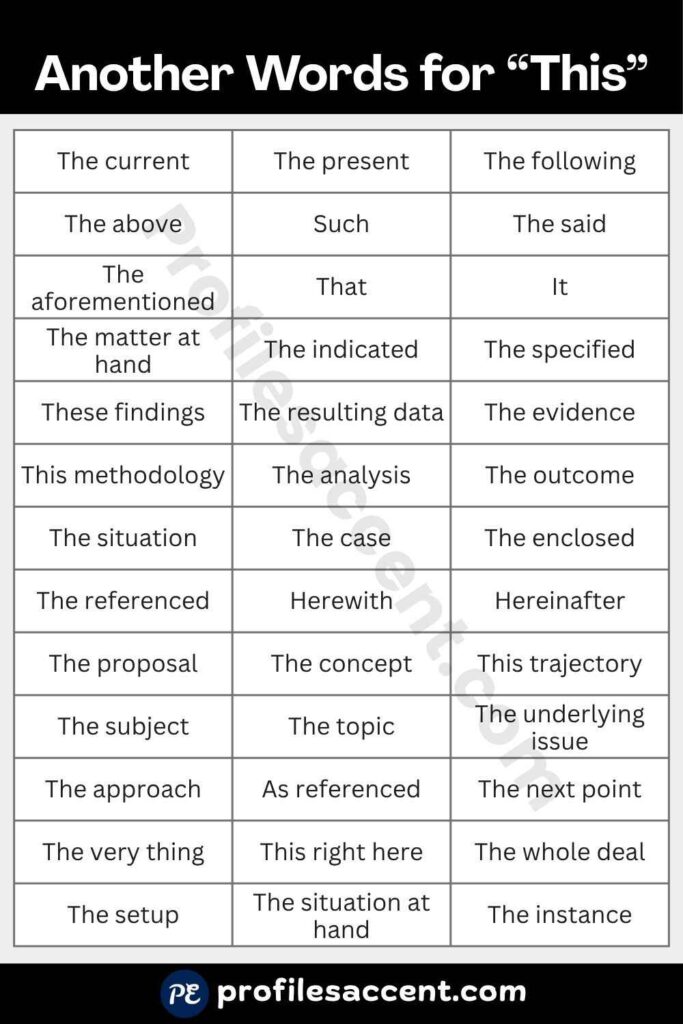
Quick Table: 40+ Synonyms for “This” Organized the Way You Actually Write
| Word / Phrase | Tone | Best Used When | Example |
| The current | Neutral/Formal | Describing ongoing situations | The current approach works well |
| The present | Formal | Academic or official writing | The present study examines… |
| The following | Formal | Introducing upcoming content | The following steps apply |
| The above | Formal | Referring to previous content | The above findings confirm |
| Such | Formal | Replacing “this kind of” | Such behavior is unacceptable |
| The said | Legal | Contracts and legal documents | The said agreement shall… |
| The aforementioned | Formal | After already naming something | The aforementioned rule applies |
| That | Neutral | Distance in reference or tone | That result surprised everyone |
| It | Casual/Neutral | Re-referencing a known thing | It explains the outcome |
| The matter at hand | Professional | Business and email writing | The matter at hand requires action |
| The indicated | Technical | Specifications and instructions | The indicated measurement is correct |
| The specified | Technical | Documentation contexts | The specified value must match |
| These findings | Academic | Research papers | These findings suggest a pattern |
| The resulting data | Research | After presenting data | The resulting data indicates… |
| The evidence | Academic | Supporting arguments | The evidence confirms the claim |
| This methodology | Academic | Research writing | This methodology produced clear results |
| The analysis | Research | After any analysis | The analysis reveals an inconsistency |
| The outcome | Neutral | Results-based writing | The outcome proves the point |
| The situation | Neutral | Referring to a context | The situation changed quickly |
| The case | Formal/Neutral | Logical or legal discussion | In the case described above |
| The enclosed | Business | Emails with attachments | Please review the enclosed report |
| The referenced | Professional | After citing something | The referenced document explains it |
| Herewith | Formal/Legal | Submitting documents | Please find the report herewith |
| Hereinafter | Legal | Long legal documents | Hereinafter referred to as the buyer |
| The proposal | Business | Referring to a document | The proposal outlines three phases |
| The concept | Academic | Referring to an idea | The concept requires further testing |
| This trajectory | Formal | Projections and trends | This trajectory leads to growth |
| The subject | Neutral/Formal | General reference | The subject requires attention |
| The topic | Academic | Essays and papers | The topic raises key questions |
| The underlying issue | Professional | Problem-solving contexts | The underlying issue is resource gaps |
| The approach | Neutral | Method or strategy | The approach reduces errors |
| As referenced | Business | Linking to prior content | As referenced in the last email |
| The next point | Instructional | Step-by-step writing | The next point covers timing |
| The very thing | Conversational | Emphasis in speech | That is the very thing I meant |
| This right here | Slang/Casual | Strong informal emphasis | This right here is the real issue |
| The whole deal | Casual | Informal reference | I am tired of the whole deal |
| The setup | Casual | Describing a situation or plan | I like the setup so far |
| The situation at hand | Formal | Professional problem-solving | The situation at hand needs a solution |
| The instance | Formal | Specific examples or cases | In this instance, caution is needed |
| The point in question | Formal | Debating or discussing | The point in question remains unclear |
| Such a scenario | Academic | Hypothetical or research context | Such a scenario is unlikely but possible |
The Floating Pronoun Problem Nobody Talks About
Most skip this part. But it is the single most useful thing you can understand about replacing “this.”
When you write “This shows that the program works,” your reader pauses. What shows it? The graph? The quote you just used? The study? “This” is floating, attached to nothing specific.
The fix is not finding a synonym. It is naming the thing.
- Before: This shows that the method is effective.
- After: The trial results show that the method is effective.
- Before: This helps students learn faster.
- After: This structured approach helps students learn faster.
See the difference? You added a noun before the verb. That noun anchors the sentence. It tells the reader exactly what you are talking about. Writers call this the anchor method, and it works better than any single synonym.
Synonyms for “This” in Essays and Academic Writing
Academic graders and editors have a specific frustration with sentences that start with “This” followed directly by a verb. It reads as imprecise.
Here is a practical upgrade chart for the most common academic constructions:
“This shows…”
Stronger options: These findings demonstrate / The data illustrates / The evidence confirms / This pattern reveals
“This helps…”
Stronger options: This framework facilitates / The model enables / The approach supports / This structure promotes
“This has…”
Stronger options: This method contains / The study encompasses / This framework includes / The structure exhibits
“This will…”
Stronger options: This outcome is expected to / The trajectory is projected to / This shift is likely to / The process is predicted to
Each swap does two things. It removes the vague pronoun. And it adds a real noun that carries meaning.
Choosing the Right “This” Synonym by Tone and Register
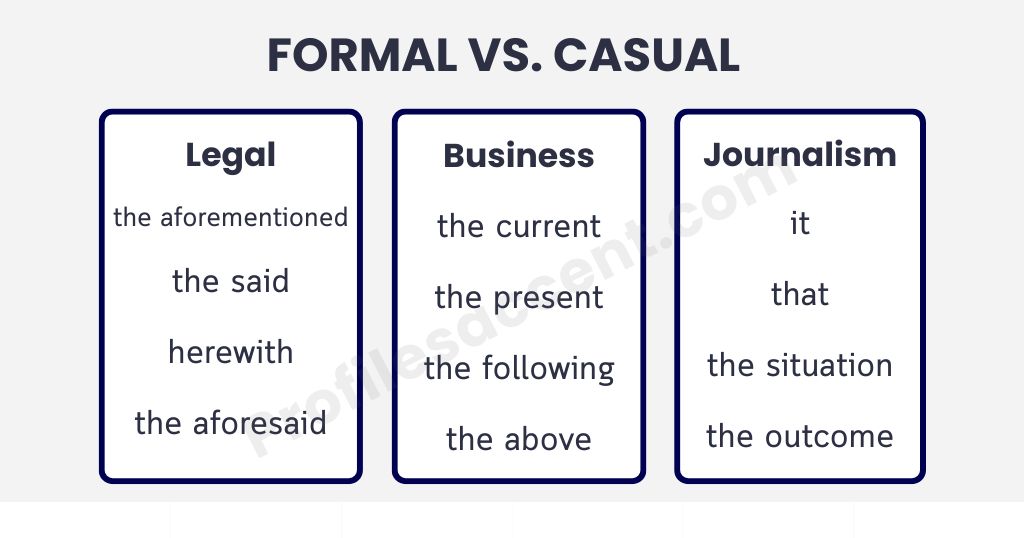
Not every context needs an academic upgrade. Here is how the options break down by tone.
- Very Formal (Legal, Official Documents)
Use: the aforementioned, the said, herewith, the aforesaid, the within-described
These belong in contracts, formal reports, and legal correspondence.
- Formal (Business, Academic Essays)
Use: the current, the present, the following, such, the above, the matter at hand
These feel professional without sounding stiff.
- Neutral (General Writing, Journalism)
Use: it, that, the situation, the outcome, the point
Natural and clear without any tonal weight.
- Casual (Conversations, Social Media, Informal Posts)
Use: this right here, the whole deal, the setup, this thing
These carry energy and personality.
A common mistake is mixing tones. Using “the aforementioned” in a text message sounds strange. Using “this right here” in a research paper will get flagged immediately.
See It in Action: Same Sentence, Four Different Words for “This”
Take this weak sentence: “This is a problem we need to address.”
- Formal: The matter at hand requires immediate attention from all departments.
- Academic: The identified issue necessitates systematic intervention and further investigation.
- Casual: Honestly, we need to deal with the whole situation before it gets worse.
- Creative: A quiet crisis had been growing, one that everyone noticed but nobody named.
Each version says the same thing. Each one lands differently. The word “this” disappeared in every version, and the sentence got stronger each time.
Why “That” Is Not Always Another Word for “This”
Most list “that” as a direct synonym for “this.” It is not always interchangeable.
- “This” signals closeness. Something nearby, recent, or emotionally present.
- “That” signals distance, something removed in space, time, or emotion.
“This book I am holding” versus “That book on the shelf across the room.”
If you swap them carelessly, you shift the tone of the whole sentence. In academic writing especially, using “that” where “this” belongs can confuse the reference entirely.
The Conversational “This” Every Synonym List Ignores
There is one use of “this” almost everyone ignores. It shows up in storytelling and spoken conversation.
“I ran into this quiet woman who knew everything about plants.”
Here, “this” is not a demonstrative. It is a softener. It creates closeness, familiarity, a sense that the speaker is bringing you into a personal moment. It works like an informal article, stronger than “a” but less clinical.
In this case, you are not replacing “this” with a grammar word. You are replacing the descriptive weight it carries.
Options: a remarkably quiet woman / someone soft-spoken and observant / a reserved woman who…
This is the version that professional storytellers think about. Most synonym lists never mention it.
Mistakes Writers Make When Replacing “This”
1. Using “aforementioned” too early
You can only use “aforementioned” if you already named the thing earlier in the same document. Using it without a prior reference confuses readers.
2. Replacing “this” with “such” incorrectly
“Such” replaces “this kind of,” not “this” on its own. “Such behavior” works. “Such is ready” does not.
3. Stacking transitions instead of nouns
Replacing “This proves” with “Consequently, it proves” does not solve anything. The “it” still floats. Name the thing.
4. Using formal options in casual writing
“The aforesaid concern” in a friendly email will make you sound oddly stiff. Match your register to your audience.
Words That Live Near “This” (And How They Differ)
- These – The plural form of “this.” Use when referring to multiple things close at hand. Not interchangeable with “those” any more than “this” and “that” are.
- Such – Formal and precise. Replaces “this type of” or “this kind of” cleanly in academic writing.
- The following – Moves the reader forward. Great for lists and instructions.
- The above – Pulls the reader back to something just mentioned. Works well in formal documents.
- It – Simple and effective for re-referencing something already named. Only works when the reference is clear.
- Whereas – A connector that introduces a contrast or condition. Useful when “this” is being used to set up a comparison.
Picking Your Synonym with Confidence
When you catch yourself writing “this” and something feels off, ask one question: What specifically is “this”?
If you can name it, name it. Add that noun and your sentence will almost always improve on its own. If the sentence is casual, lean into natural alternatives like “the whole situation” or “the setup.” If you are writing formally, reach for “the present,” “the current,” or “such.”
The goal is never to eliminate “this” entirely. It is a useful word. The goal is to stop using it as a placeholder when a real word would work better.
Discover More Articles:

I’m Rowan, a language addict who loves exploring how words work in everyday communication. I’ve spent years studying English vocabulary and helping others express themselves more clearly. My goal is simple: make learning new words easy and practical. I focus on real-life examples that show when and how to use different terms. Through clear explanations and honest guidance, I help readers choose the right words for any situation with confidence.