Most writers never think twice about the word “which.” It shows up, it does its job, and the sentence moves on. But spend an hour editing a long essay or report, and you start noticing it everywhere. “The study, which was published last year, which included 500 participants, which showed remarkable results…” That repetition is quietly draining your writing’s energy.
Replacing “which” is not always about finding a direct synonym. Sometimes it means restructuring your sentence entirely. This guide gives you both.
What “Which” Actually Does Means
“Which” is a relative pronoun. It connects extra information to a noun that has already been identified. It can also work as a question word, asking someone to choose between options. The word itself is neutral in tone, suitable for both casual writing and formal documents, depending on how it is used.
Understanding this dual role is what makes finding the right replacement so important. A swap that works in a question will completely fail inside a descriptive clause.
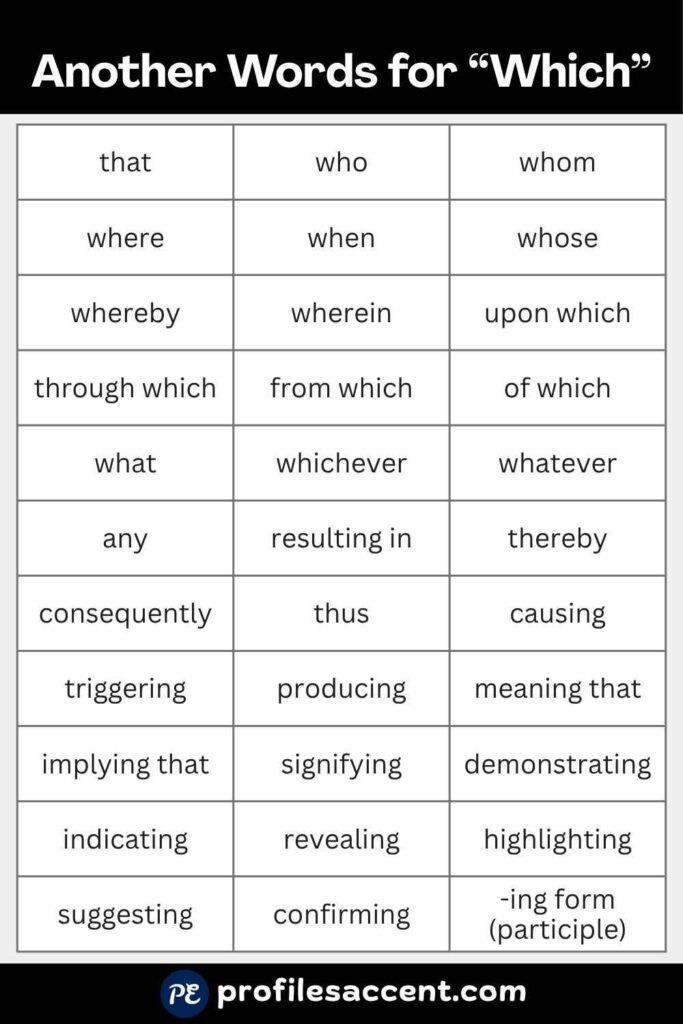
35+ Quick Synonym Table for Which
| Word / Phrase | Tone | Best Used When |
| Replacing “which” in relative clauses | ||
| that | Neutral | The clause is essential to the sentence meaning. No comma before it. |
| who | Neutral | The noun is a person or group of people. |
| whom | Formal | The person is the object of the clause (“the editor whom I contacted”). |
| where | Neutral | Replacing “in which” or “at which” when referring to a place. |
| when | Neutral | Replacing “at which time” or “during which” for time references. |
| whose | Neutral | Showing possession (“the report whose findings were disputed”). |
| whereby | Formal | Meaning “by which method.” Common in contracts and policy writing. |
| wherein | Academic | Meaning “in which” for a document, place, or situation. |
| upon which | Formal | An action immediately follows (“the signal was given, upon which they moved”). |
| through which | Formal | Indicating a process or channel used to achieve something. |
| from which | Formal | Showing origin or source in academic or legal contexts. |
| of which | Academic | Possession in complex clauses (“the findings, one of which was surprising”). |
| Replacing “which” as a question word | ||
| what | Casual | Open-ended questions where the options are unknown or unlimited. |
| whichever | Neutral | The choice is free from a defined set (“take whichever suits you”). |
| whatever | Casual | Completely unrestricted choice, often informal. |
| any | Casual | Suggesting selection without specifying (“use any method you prefer”). |
| Replacing “which leads to / which results in” | ||
| resulting in | Neutral | Showing a direct consequence clearly and cleanly. |
| thereby | Formal | Linking an action to its consequence in formal or academic prose. |
| consequently | Formal | Starting the next clause to show cause and effect. |
| thus | Academic | Concise formal connection, common in research writing. |
| causing | Neutral | Direct, active replacement (“The error occurred, causing delays.”). |
| triggering | Neutral | When the effect is sudden or reactive. |
| producing | Formal | Showing an output or outcome with a neutral, precise tone. |
| Replacing “which means / which shows” | ||
| meaning that | Casual | Casual explanation of what something implies. |
| implying that | Academic | Suggesting a conclusion without stating it directly. |
| signifying | Formal | Formal contexts where something represents a larger meaning. |
| demonstrating | Academic | Replacing “which shows” in research and reports. |
| indicating | Academic | Data or evidence points to a conclusion. |
| revealing | Neutral | Something was previously unknown and is now made clear. |
| highlighting | Neutral | Drawing attention to a specific point or finding. |
| suggesting | Academic | A softer, more tentative version of “demonstrating.” |
| confirming | Neutral | Evidence supports something already expected. |
| Structural rewrites (no synonym needed) | ||
| -ing form (participle) | Academic | “…which allows” → “…allowing.” Cuts words and tightens prose. |
| -ed form (past participle) | Academic | “…which was written” → “…written by.” Removes passive weight. |
| prepositional phrase | Formal | “The year in which it happened” → “The year it happened.” |
| noun phrase | Neutral | “The book, which won an award” → “The award-winning book.” |
Four Ways “Which” Works (and What to Use Instead)
“Which” splits into four distinct roles, and each one needs a different approach.
When “which” adds bonus detail
This is the most common use. The noun is already identified, and “which” introduces bonus detail. These clauses always sit between commas. You can drop the entire clause without losing the core meaning.
Here, your best swaps are structural. Convert the clause into a shorter modifier. “The report, which was submitted on Friday” becomes “the Friday report.” Clean and compact.
When “which” defines the noun
No commas here. The clause is the meaning. Remove it and the sentence falls apart. In this case, replace “which” with “that.” This is not optional. “The path which you take” and “the path that you take” feel similar, but in formal writing, “that” signals the clause is essential. “Which” signals it is optional. Mixing them up changes meaning quietly.
When “which” is asking a question
“Which option is better?” Here you are choosing from a known, limited set. This is different from “what,” which opens the field wide. “What should I do?” has no boundaries. “Which should I do, A or B?” has two. Use “which” when options are defined, “what” when they are open.
When “which” links cause to effect
“The server overloaded, which caused the crash.” This is where most writers weaken their prose without realizing it. Replacing this pattern transforms a passive, trailing sentence into an active one. “The server overloaded, causing the crash.” Five words become three. The writing moves faster.
Matching the Tone: Synonyms for “Which” from Casual to Formal
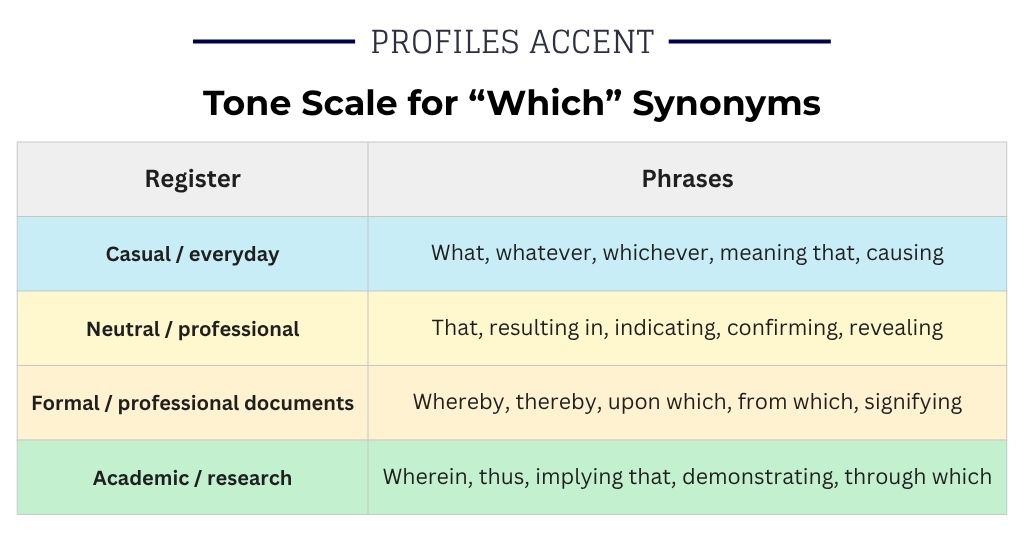
Not every swap fits every situation. Here is a rough scale to help you match the right word to the right context.
- Casual / everyday: what, whatever, whichever, meaning that, causing
- Neutral / professional: that, resulting in, indicating, confirming, revealing
- Formal / professional documents: whereby, thereby, upon which, from which, signifying
- Academic / research: wherein, thus, implying that, demonstrating, through which
The higher you go on this scale, the more distance you create between yourself and the reader. Academic writing benefits from that distance. A marketing email does not.
See the Difference: Sentence Rewrites Using “Which” Synonyms
Here is where theory becomes practice. Watch how the same idea shifts in feel depending on the swap.
Original: The team introduced a new process, which improved response times.
- Formal: The team introduced a new process, thereby improving response times.
- Academic: The team introduced a new process, resulting in measurably faster response times.
- Casual: The team changed their process, and response times improved.
- Creative: A new process changed everything: response times dropped almost overnight.
Original: She submitted the form, which triggered an automatic confirmation.
- Formal: She submitted the form, upon which an automatic confirmation was generated.
- Simple: Submitting the form triggered an automatic confirmation.
- Academic: The form submission initiated an automatic confirmation, as indicated by the system log.
Original: The guidelines, which were written in 2019, are still in use.
- Formal: The 2019 guidelines remain in use today.
- Academic: The guidelines published in 2019 continue to inform current practice.
- Casual: The guidelines from 2019 are still being followed.
Notice that the cleanest rewrites often eliminate “which” without replacing it at all. They restructure the sentence entirely.
Choosing Between Formal and Informal Alternatives for Which
If you are writing an essay, a research paper, or a professional report, avoid using “what” as a substitute for “which.” It reads as informal. Also avoid “whatever” in any serious document. It carries a dismissive tone that professional readers will notice.
For business emails, “that” and simple restructuring work best. Heavy formal alternatives like “wherein” or “whereby” can make workplace writing feel stiff and unapproachable.
For storytelling and creative writing, abandon the thesaurus entirely. Rewrite the sentence. Break it into two. Let the rhythm guide the structure.
Common Mistakes When Swapping Out Which
Using “that” for people. Never write “the person that called.” Use “who.” This is one of the clearest grammar markers separating careful writers from careless ones.
Treating “which” and “that” as identical. They are not.
- “The car that hit me was red” tells you which car.
- “The car, which was red, hit me” just adds color as an aside.
Swapping them quietly changes the sentence.
Overloading “whereby.” This word fits legal and procedural contexts well. In casual or journalistic writing, it sounds pretentious. Match it to the register.
Starting a sentence with “which.” This is a common mistake in academic writing. “Which shows that the data is reliable.” It creates a dangling modifier. Either attach it to the previous sentence with a comma, or rewrite: “This finding shows that the data is reliable.”
Replacing “which” when restructuring would work better. Sometimes the cleanest fix is not a synonym. It is a shorter sentence. “The experiment, which ran for six months, was inconclusive” becomes “The six-month experiment was inconclusive.” No synonym needed.
One Warning Before You Replace “Which” in Legal Writing
In legal documents, replacing “which” carelessly can create ambiguity. Courts and contracts rely on precise language. If you are writing anything with legal weight, restructure your sentences rather than swapping terms. Even small shifts in relative pronoun use can change what a clause legally refers to.
Words Often Confused with “Which” Synonyms
Wherein and whereby are frequently misused. “Wherein” refers to a place or document. “Whereby” describes a mechanism or method. They are not interchangeable.
That which is a formal phrase acting almost like a noun. “That which matters most” means “the thing that matters most.” It sounds elevated and works in speeches or literary writing but feels out of place in a simple paragraph.
Whichever and whatever both express open choice, but “whichever” implies a defined group. “Whatever” implies no limits at all.
Which Synonym Should You Actually Use?
When you spot “which” piling up in your draft, ask one question first:
Does the sentence actually need it? Many “which” clauses can be cut entirely or folded into a shorter phrase. When the word is truly needed, match your replacement to the clause type, not the nearest-sounding synonym.
Use “that” for essential clauses, “who” for people, structural rewrites for academic prose, and transition phrases like “thereby” or “resulting in” when you are connecting an action to its consequence. The right swap is the one the reader does not notice.
Discover More Articles:

I’m Rowan, a language addict who loves exploring how words work in everyday communication. I’ve spent years studying English vocabulary and helping others express themselves more clearly. My goal is simple: make learning new words easy and practical. I focus on real-life examples that show when and how to use different terms. Through clear explanations and honest guidance, I help readers choose the right words for any situation with confidence.