You write a sentence. It works. But something feels off. You read it again and notice you have dropped the word “used” three times in two paragraphs. It just sits there, flat and colorless, doing the bare minimum.
The problem is not that “used” is wrong. The problem is that it is often too vague to carry any real meaning. A used car is not the same thing as a used person. And “she used her skills” lands very differently from “she wielded her skills.” Same idea, completely different feeling.
This guide breaks down every major meaning of “used” and gives you the exact replacement for each one.
What “Used” Is Really Doing in Your Sentence
“Used” is a shape-shifter. It acts as a verb: He used the report to make his case. It acts as an adjective: She bought a used laptop. And it appears in expressions like “used to” and “used up,” each carrying its own meaning entirely.
Because the word does so many jobs, no single synonym fits all situations. The right replacement depends on what role “used” is playing, what tone you want, and who is reading.
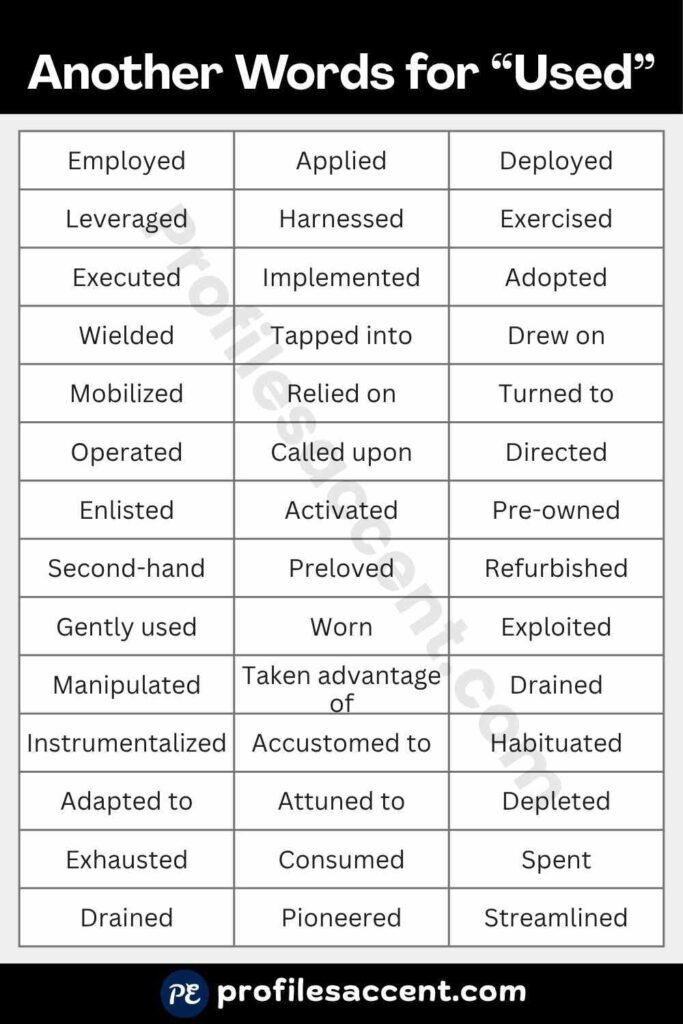
40+ Quick-Access Used Synonym Table
| Word | Tone | Best When | Quick Example |
| Employed | Formal | Academic or essay writing | She employed a new research method |
| Applied | Neutral | Skills, rules, or methods | They applied the formula correctly |
| Deployed | Professional | Tech, strategy, management | The team deployed the new tool |
| Leveraged | Business | Gaining an advantage | He leveraged his network to find clients |
| Harnessed | Positive/Strong | Energy, talent, emotion | She harnessed her frustration into focus |
| Exercised | Formal | Rights or authority | He exercised his right to remain silent |
| Executed | Professional | Plans or tasks | They executed the plan with precision |
| Implemented | Formal | Systems or policies | The school implemented a new reading program |
| Adopted | Neutral | Approaches or methods | The team adopted a simpler process |
| Wielded | Creative/Strong | Power, skill, or influence | She wielded her words with confidence |
| Tapped into | Casual | Potential or resources | They tapped into local knowledge |
| Drew on | Literary | Experience or memory | He drew on years of fieldwork |
| Mobilized | Active | People or resources | The community mobilized its volunteers |
| Relied on | Neutral | Trust or dependency | She relied on the same tools for years |
| Turned to | Casual | Seeking a solution | They turned to solar energy instead |
| Operated | Technical | Machines or systems | The engineer operated the software remotely |
| Called upon | Formal | Abilities or people | The director called upon her expertise |
| Directed | Formal | Effort or attention | He directed all resources toward the goal |
| Enlisted | Casual/Warm | Help or support | She enlisted help from her colleagues |
| Activated | Technical | Features or tools | The user activated the backup system |
| Pre-owned | Marketing | Items for resale | A pre-owned vehicle in great condition |
| Second-hand | Neutral | Everyday objects | He found a second-hand copy at the library |
| Preloved | Warm | Fashion, sustainability | A preloved coat from a charity shop |
| Refurbished | Formal | Restored tech or items | She bought a refurbished phone at a discount |
| Gently used | Marketing | Lightly worn items | Gently used furniture in excellent shape |
| Worn | Negative | Visible deterioration | The worn jacket needed replacing |
| Exploited | Negative | Unfair advantage | He felt exploited after months of unpaid overtime |
| Manipulated | Negative | Psychological control | She realized she had been manipulated |
| Taken advantage of | Informal | Personal relationships | He felt taken advantage of by his boss |
| Drained | Emotional | Emotional or financial exhaustion | The project left her drained and frustrated |
| Instrumentalized | Formal/Psychological | Treated as a tool | She felt instrumentalized rather than valued |
| Accustomed to | Neutral | Past habit or familiarity | He grew accustomed to the long hours |
| Habituated | Formal | Repeated exposure | They became habituated to the noise |
| Adapted to | Neutral | Adjustment over time | She adapted to the new schedule quickly |
| Attuned to | Positive | Emotional or sensory familiarity | He was attuned to the subtle changes in mood |
| Depleted | Negative | Resources that are gone | The budget was completely depleted |
| Exhausted | Strong | Complete use of a resource | All options were exhausted before the deadline |
| Consumed | Neutral | Time, money, or energy | The project consumed six months of effort |
| Spent | Casual/Formal | Used up entirely | Their energy was fully spent by noon |
| Drained | Strong | Emptied of resources | The account was drained within weeks |
| Pioneered | Resume | First use or innovation | She pioneered a new tracking system |
| Streamlined | Resume | Made more efficient | He streamlined the reporting process |
| Optimized | Resume | Improved performance | They optimized the workflow across departments |
Same Word, Different Worlds: The Meaning Groups
Another Word for Used as a Deliberate Action
This is the most common meaning: someone made a choice to use a tool, method, or skill. The right synonym here depends on how deliberate and skilled that action was.
- Applied is clean and neutral. It works well in academic and professional writing when you want something direct without flair.
- Employed carries a slight formal weight. It suggests the person made a considered decision, not just a casual one.
- Deployed hints at strategy. Use it when the action had a specific goal behind it, like a military operation but in a business or tech setting.
- Harnessed is the most vivid of this group. It implies capturing something wild or powerful and putting it to work. Think talent, energy, creativity.
Used Synonyms for Second-Hand Objects
This is where the adjective form lives. A used car. A used book. The synonym you choose here changes the emotional value of the object.
- Pre-owned softens the stigma. Car dealerships love it because it makes the item feel almost new.
- Preloved goes even further emotionally. It implies the item was cared for, not discarded. Common in UK thrift culture and sustainable fashion.
- Refurbished belongs in the tech world. It means the item was restored to working order, which actually adds value in buyers’ minds.
- Worn is honest but slightly negative. It works in creative writing but would be a poor choice for a product listing.
Another Word for Being Used by Someone
This is where word choice carries real emotional weight. Someone searching for “another word for being used by someone” is not looking for a grammar lesson. They are trying to name a feeling.
- Exploited is the clearest formal option. It captures the imbalance of power without making the person sound weak.
- Manipulated focuses on the method. The other person used psychological tactics rather than outright force.
- Instrumentalized is a more academic word. It means being treated as a means to someone else’s end rather than as a person with value.
In casual speech, people say things like “she played me” or “he milked the situation” to describe the same feeling. These slang versions are vivid but informal.
If you want to describe being used in a positive way, the language flips entirely. Words like mobilized, called upon, instrumental, or commissioned carry no negativity at all. “She was instrumental in launching the campaign” feels very different from “she was used to launch the campaign.”
How Strong Is Your Word? A Tone Scale for “Used” Synonyms
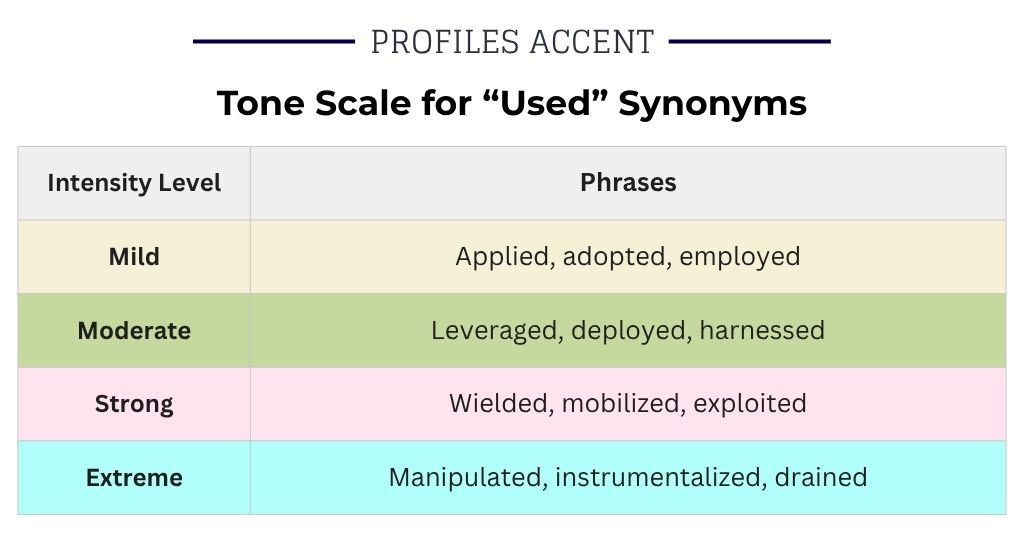
Not every synonym carries the same force. Here is how intensity builds, especially in professional and emotional contexts:
- Mild: Applied, adopted, employed
These are calm and neutral. No strong feeling in either direction.
- Moderate: Leveraged, deployed, harnessed
These suggest skill and intention. They imply the person knew what they were doing.
- Strong: Wielded, mobilized, exploited
These carry real power. Wielded can be positive or negative depending on context. Exploited almost always signals wrongdoing.
- Extreme: Manipulated, instrumentalized, drained
These belong in emotionally charged situations. They are not appropriate for neutral professional writing.
Watch What Changes: Sentence Rewrites Using Synonyms for “Used”
Original: She used her experience to lead the team.
- Formal: She drew on her extensive experience to guide the team through a difficult transition.
- Resume-ready: She leveraged a decade of experience to lead cross-functional team operations.
- Academic: She applied her professional background to inform each leadership decision.
- Creative: She wielded experience like a compass, steering the team through uncertain terrain.
Notice how each version shifts what you feel about the person. The formal version sounds reflective. The resume version sounds results-driven. The academic version sounds measured. The creative version sounds commanding.
Original: He used the data.
- Professional: He analyzed the data to identify cost-saving opportunities.
- Academic: He applied the data set to test the original hypothesis.
- Casual: He tapped into the numbers and found some surprising patterns.
“He used the data” could mean almost anything. Each rewrite adds a specific action, which makes the sentence far more useful to a reader.
Formal vs. Informal: Which “Used” Synonym Belongs Where
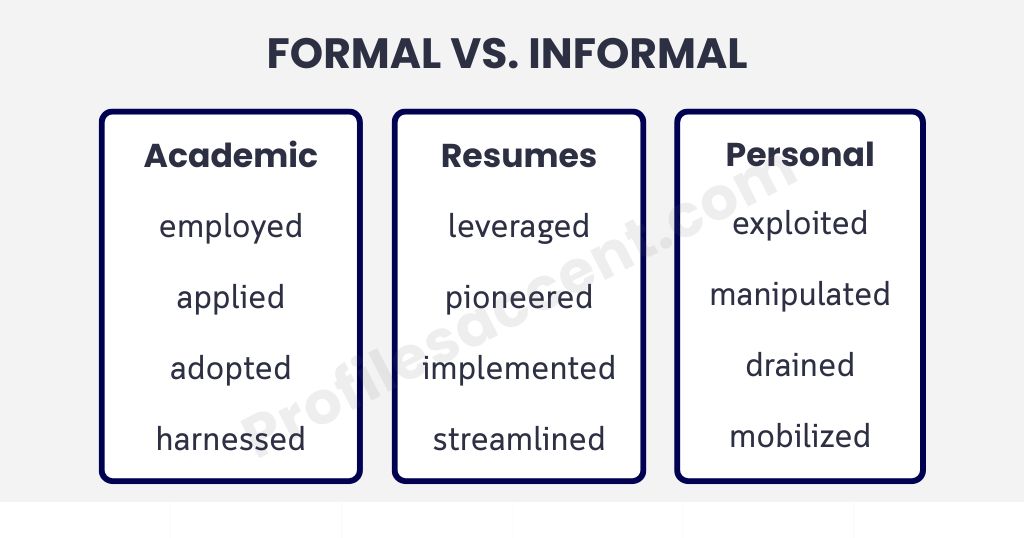
For essays and academic writing: employed, applied, adopted, harnessed, deployed. Avoid “utilized” unless you specifically mean using something for a purpose it was not originally designed for. Many writers use it as a fancy version of “used,” but in academic contexts, it has a narrower, specific meaning.
For resumes: leveraged, pioneered, implemented, streamlined, executed, optimized. Never just “used.” Recruiters want to see what you accomplished, not just what tools you had access to.
For personal or emotional writing: exploited, manipulated, drained, taken advantage of, or the positive alternatives like called upon, mobilized, valued.
For product descriptions: pre-owned, preloved, refurbished, gently used, restored. Avoid “worn” or “second-hand” if you want to keep the value perception high.
Words to avoid in formal contexts: played, milked, jerked around. These are casual and would feel out of place in any professional or academic document.
Common Mix-Ups When Replacing the Word “Used”
Swapping “used” with “utilized” everywhere. This is the most common error in writing. “Utilize” has a specific shade of meaning. If a researcher picks up a telescope to look at stars, they used it. If a community uses an abandoned warehouse as a flood shelter, they utilized it because that was not its original purpose.
Picking the wrong form for objects. “Employed” works beautifully for verbs but would sound odd describing a second-hand bike. Know whether you are describing an action or a thing before you choose.
Using “leveraged” in personal writing. It belongs in business and strategy contexts. In a personal essay, it sounds cold and out of place.
Forgetting that “used to” is its own category. If you want to say someone is familiar with something from the past, the right synonyms are accustomed to, habituated, adapted to, or attuned to. None of the action synonyms work here.
Replacing “used up” with “used.” When something is completely gone, the word should signal depletion: depleted, exhausted, consumed, spent.
Words Close to “Used” But Not Quite the Same
Wielded vs. Employed: Both suggest deliberate action, but wielded carries physical or symbolic force. A character in a story wields a sword or wields authority. A researcher employs a method.
Consumed vs. Depleted: Consumed often describes things used over time, like energy or money. Depleted implies the supply has been reduced to a dangerously low or zero level.
Leveraged vs. Harnessed: Leveraged is a strategy word. It means using what you have to get more. Harnessed is an energy word. It means capturing something raw and directing it usefully.
Exploited vs. Drawn upon: These are near opposites in tone. Exploited implies harm or unfairness. Drew upon implies respectful use of existing resources.
Choosing the Right Synonym for Used Comes Down to This
“Used” is not a bad word. It is just often too broad to do real work. Before you replace it, ask two things: what is being used, and by whom or for what?
- A person making a strategic business decision leverages or deploys.
- A student applying a theory employs or applies.
Someone who felt taken advantage of was exploited or manipulated. And a product sold at a garage sale is pre-owned or preloved, not just “used.”
Match the synonym to the moment. That is the whole skill.
Discover More Articles:

I’m Rowan, a language addict who loves exploring how words work in everyday communication. I’ve spent years studying English vocabulary and helping others express themselves more clearly. My goal is simple: make learning new words easy and practical. I focus on real-life examples that show when and how to use different terms. Through clear explanations and honest guidance, I help readers choose the right words for any situation with confidence.