There’s a moment most writers know well. You’ve just written “I’m so proud of you” for the third time in the same paragraph, and something feels off. The word starts to lose its meaning. It becomes noise. Or worse, you use “proud” in a professional email and realize, only after sending it, that it sounded slightly arrogant rather than grateful.
That’s the real problem with “proud.” It carries wildly different emotional weight depending on how and where you use it. One version describes a parent watching their child walk across a graduation stage. Another describes a person who refuses to apologize because their ego won’t allow it. Same word. Opposite meanings.
This guide cuts through the confusion. You’ll find synonyms that actually fit, organized by what you’re really trying to say.
What Proud Actually Means
At its core, proud describes a feeling of satisfaction tied to worth. That worth can come from your own actions, someone else’s success, or simply a sense of identity. But the emotional direction shifts depending on context. Healthy pride looks inward with warmth. Unhealthy pride looks outward with superiority. Most synonyms only capture one version.
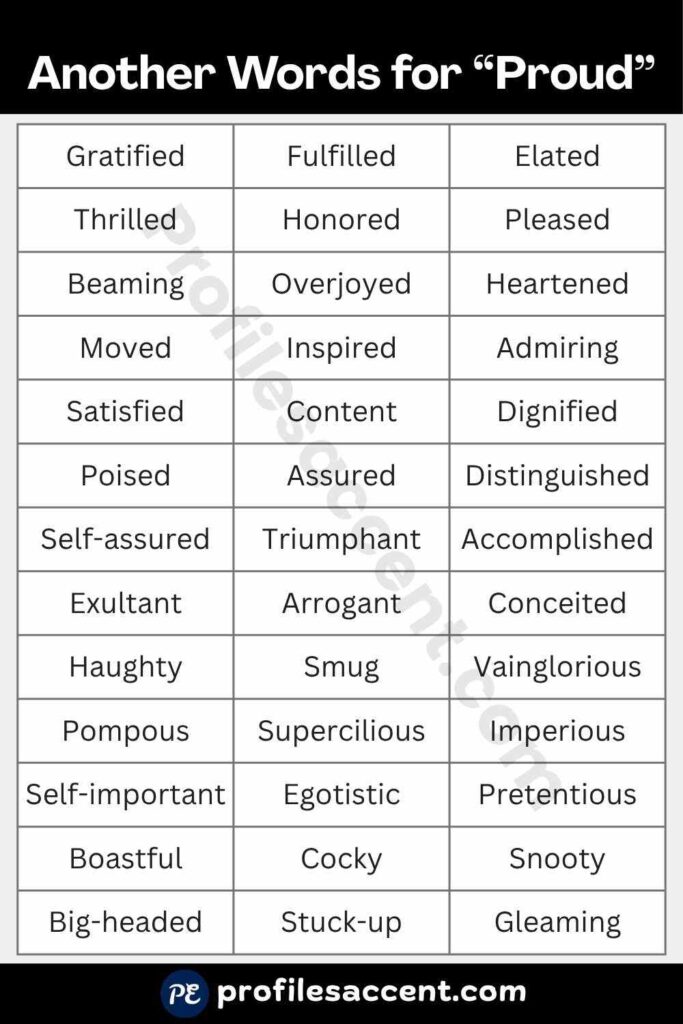
45+ Synonyms for Proud: The Complete At-a-Glance Table
| Word | Tone | Best For | Quick Example |
| Gratified | Warm, positive | Personal achievement | “She felt gratified by the result.” |
| Fulfilled | Deep, positive | Life goals, purpose | “He left the career feeling fulfilled.” |
| Elated | Joyful, strong | Big wins, celebrations | “They were elated after the win.” |
| Thrilled | Excited, warm | Sharing others’ success | “I’m thrilled by what you’ve built.” |
| Honored | Respectful, formal | Recognition, ceremony | “I’m honored to receive this award.” |
| Pleased | Mild, neutral | Everyday satisfaction | “She was pleased with the feedback.” |
| Beaming | Visual, emotional | Parental pride, joy | “He was beaming with happiness.” |
| Overjoyed | Intense, joyful | Relational pride | “They were overjoyed at the news.” |
| Heartened | Encouraged, soft | When someone improves | “I’m heartened by your progress.” |
| Moved | Emotionally deep | Touching moments | “She was moved by his dedication.” |
| Inspired | Uplifting | Watching someone grow | “You’ve inspired me more than you know.” |
| Admiring | Warm, relational | Pride in another person | “I’m truly admiring of your work.” |
| Satisfied | Calm, steady | Work or outcome quality | “I’m satisfied with how this turned out.” |
| Content | Quiet, peaceful | Personal accomplishment | “She felt content with her choices.” |
| Dignified | Formal, composed | Professional settings | “He carried himself in a dignified way.” |
| Poised | Controlled, elegant | Under pressure | “She remained poised throughout.” |
| Assured | Confident, calm | Self-belief | “He was assured in his decision.” |
| Distinguished | Earned, formal | Career or reputation | “A distinguished professional presence.” |
| Self-assured | Balanced, confident | Personal tone | “She spoke in a self-assured way.” |
| Triumphant | Victory-focused | After overcoming a challenge | “The team felt triumphant.” |
| Accomplished | Achievement-based | Skills, goals | “He felt deeply accomplished.” |
| Exultant | Strong, celebratory | Victories, rare wins | “The crowd was exultant.” |
| Arrogant | Negative | Excessive self-importance | “He came across as arrogant.” |
| Conceited | Negative | Vanity, self-obsession | “She seemed conceited in interviews.” |
| Haughty | Cold, negative | Looking down on others | “His haughty tone alienated people.” |
| Smug | Irritating, negative | Self-satisfaction after being right | “He gave a smug smile.” |
| Vainglorious | Strongly negative | Boasting, showing off | “A vainglorious speech no one enjoyed.” |
| Pompous | Negative, formal | Inflated self-importance | “The pompous response surprised everyone.” |
| Supercilious | Cold, dismissive | Contempt toward others | “Her supercilious attitude caused tension.” |
| Imperious | Domineering | Acting entitled | “An imperious tone rarely works.” |
| Self-important | Mildly negative | Overestimating oneself | “He became self-important after the promotion.” |
| Egotistic | Strongly negative | Self-centeredness | “Egotistic leadership damages teams.” |
| Pretentious | Negative, social | Faking superiority | “The review sounded pretentious.” |
| Boastful | Negative, casual | Bragging, oversharing wins | “He grew boastful at dinner.” |
| Cocky | Casual, negative | Overconfidence | “She was cocky before the game.” |
| Snooty | Informal, negative | Social superiority | “A snooty response to a simple question.” |
| Big-headed | Slang, British | After unexpected success | “Don’t let it make you big-headed.” |
| Stuck-up | Informal, negative | Social distance, attitude | “She seemed stuck-up at first.” |
| Gleaming | Poetic, positive | Radiating visible pride | “His gleaming expression said everything.” |
| Swelling with pride | Phrase, emotional | Parental, relational pride | “She was swelling with pride.” |
Same Feeling, Different Situations: How Context Shifts the Word
The word you choose should match the emotional situation, not just the dictionary definition. Here’s how these break down in real life.
Pride in someone you love
When a parent watches a child succeed, or a friend sees you reach a goal, words like thrilled, overjoyed, beaming, and heartened feel natural. They carry warmth without sounding formal. “I’m thrilled by what you’ve accomplished” feels genuine. “I’m gratified by your output” does not, unless you’re writing a performance review.
Pride in yourself
This is where writers get stuck. Saying “I’m proud of myself” can feel uncomfortable, even when deserved. Alternatives like satisfied, accomplished, fulfilled, or content soften the intensity while still honoring the feeling. “I feel fulfilled by this project” sounds grounded. It doesn’t read as boasting.
Professional and public pride
In work settings, pride needs to wear business clothes. Words like honored, distinguished, poised, and dignified shift the emotional register toward respect and credibility. “I’m honored to be part of this team” works in a speech or email. “I’m beaming with pride” probably doesn’t.
Pride gone wrong
When pride becomes ego, the vocabulary shifts entirely. Smug, arrogant, haughty, conceited these words describe people who believe their worth makes others lesser. Using them accurately is important in storytelling, feedback, or analysis. Mixing them with positive synonyms by accident is one of the most common tone errors in writing.
How Strong Is That Pride? A Tone Scale from Gentle to Intense
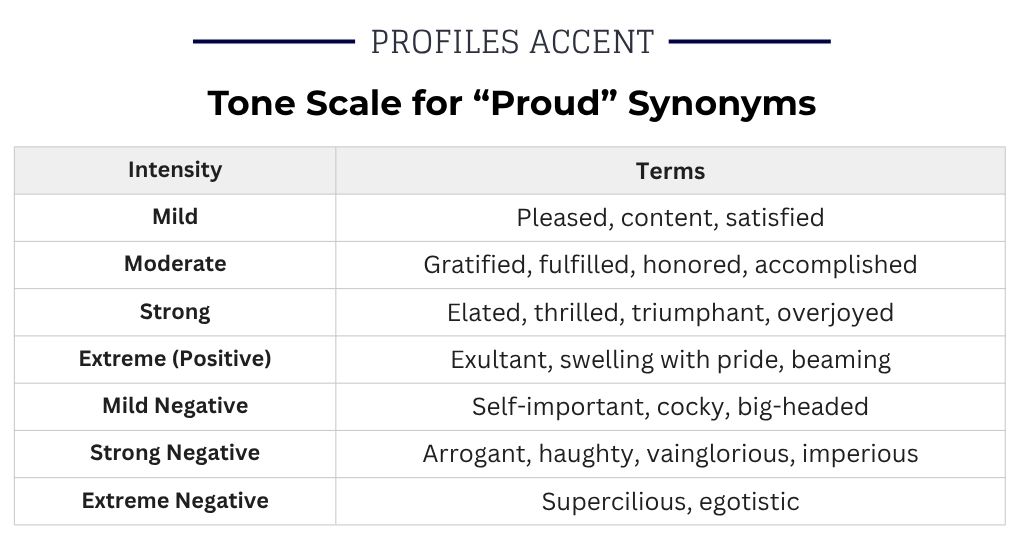
Not every feeling lives at the same volume. Here’s how words for pride scale emotionally:
- Mild: Pleased, content, satisfied
- Moderate: Gratified, fulfilled, honored, accomplished
- Strong: Elated, thrilled, triumphant, overjoyed
- Extreme (Positive): Exultant, swelling with pride, beaming
- Mild Negative: Self-important, cocky, big-headed
- Strong Negative: Arrogant, haughty, vainglorious, imperious
- Extreme Negative: Supercilious, egotistic
This scale matters most when writing fiction or delivering feedback. Calling someone smug hits differently than calling them self-important. Both are true in different situations. Choosing the wrong intensity makes your writing feel off, even if the basic meaning is correct.
Proud in a Sentence: Before and After Rewrites
Sometimes the fix isn’t finding a synonym. It’s restructuring the whole sentence.
Original: “I’m proud of how far you’ve come.”
- Formal: “I have deep admiration for the growth you’ve shown.”
- Casual: “You’ve come so far. Honestly, it’s amazing to watch.”
- Creative: “The person you’ve become would surprise the version of you from three years ago.”
- IELTS / Academic: “Your progress reflects both discipline and genuine commitment.”
Original: “She was proud after winning the award.”
- Formal: “She carried herself with quiet dignity after accepting the honor.”
- Casual: “She was absolutely glowing when they called her name.”
- Creative: “Something settled in her chest that night. Not relief. Certainty.”
Original: “He was too proud to ask for help.”
- Formal: “His reluctance to seek assistance stemmed from excessive self-reliance.”
- Casual: “He wouldn’t ask, even when he needed to. That was the problem.”
- Critical: “His arrogance cost him the opportunity entirely.”
Each rewrite tells the reader something new. The synonym alone rarely does that job.
The Regional Gap Nobody Talks About in Proud Synonyms
In some parts of the American South, “proud” functions as a casual synonym for happy or pleased. “I’m proud to meet you” doesn’t mean the speaker feels superior. It means they’re genuinely glad you’re there. This usage confuses many non-native speakers and is almost never explained in standard synonym lists.
For IELTS and academic writing, this matters. Using proud in an essay without context can read as either self-congratulatory or emotionally vague. Safer choices for formal writing include gratified, honored, or accomplished, all of which sound considered rather than casual.
Words That Look Like Synonyms for Proud But Aren’t
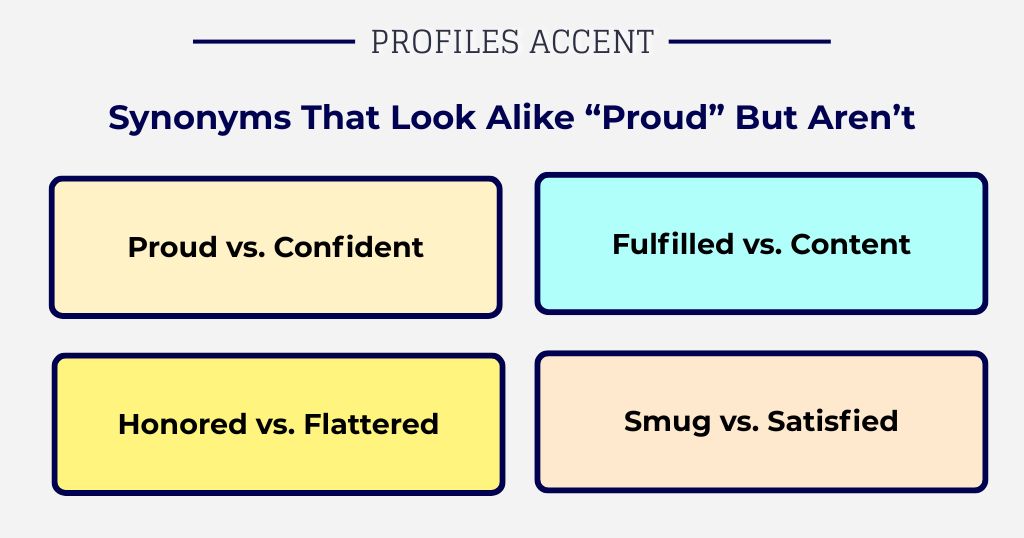
- Proud vs. Confident: Confidence is about belief in your ability. Pride is about satisfaction in what you’ve done or who you are. You can be confident before a result and proud after it.
- Fulfilled vs. Content: Fulfilled suggests a sense of completion tied to a bigger purpose. Content is quieter. It means things feel okay right now, without needing more.
- Honored vs. Flattered: Being honored implies genuine respect and weight. Being flattered suggests something lighter, sometimes even a little suspicious, as if the praise might not be entirely deserved.
- Smug vs. Satisfied: Both involve being pleased with an outcome. Smugness includes a layer of superiority over others. Satisfaction doesn’t.
Proud Antonyms: The Other End of the Spectrum
Understanding the opposite of a word sharpens how you use it.
- Humble sits directly across from arrogant pride.
- Ashamed is the opposite of healthy, positive pride.
- Modest counters self-importance without the emotional sting.
- Uncertain and self-doubting contrast with the assured, confident versions of pride.
These are useful when you want to show character change in writing. A character who moves from vainglorious to humble has gone through something real.
So Which Word for Proud Should You Actually Use?
Here’s the simplest decision tool:
- Proud of a child or loved one? Try thrilled, overjoyed, or beaming.
- Proud of your own work? Try fulfilled, accomplished, or satisfied.
- Proud in a formal or professional setting? Try honored, dignified, or gratified.
- Describing arrogance in someone else? Try haughty, conceited, or smug depending on intensity.
- Writing for IELTS or academic English? Stick to gratified, distinguished, or accomplished.
The right synonym doesn’t just replace a word. It changes what the reader feels. That’s the whole point of choosing carefully.
Discover More Articles:

I’m Rowan, a language addict who loves exploring how words work in everyday communication. I’ve spent years studying English vocabulary and helping others express themselves more clearly. My goal is simple: make learning new words easy and practical. I focus on real-life examples that show when and how to use different terms. Through clear explanations and honest guidance, I help readers choose the right words for any situation with confidence.