There’s a moment every writer knows. You’ve typed “on time” for the third time in the same paragraph and it suddenly looks wrong. Not grammatically wrong. Just flat. Overused. Like it stopped carrying any real meaning.
The truth is, “on time” is a phrase that does a lot of heavy lifting in English. It shows up in emails, resumes, stories, project reports, and casual texts. But it’s one phrase trying to serve a dozen different purposes. And when you stretch one phrase that thin, your writing starts to feel thin too.
This guide gives you a full toolkit of replacements, organized by situation and tone. Not a word dump. A real guide with enough context to help you pick the right word with confidence.
On Time Holds More Meaning Than You Think
Most people think “on time” has one meaning: arriving or finishing when expected. But it actually carries two very different meanings in English.
- The first is about punctuality: showing up or delivering exactly when planned.
- The second, less commonly discussed, is about payment: buying something “on time” means paying in installments, not all at once.
This guide focuses on the first meaning. But knowing the second exists helps you avoid confusion in financial or business writing where “on time payments” could read ambiguously.
Beyond these two, there’s also an emotional layer. “On time” can mean barely making it. It can also mean arriving comfortably ahead of a deadline. The word you choose signals which version of “on time” you actually mean.
35+ Synonyms for On Time: Quick Table
| Word / Phrase | Tone | Best Used When | Quick Example |
| Punctual | Formal / Neutral | Describing a person’s habit | She is always punctual |
| Prompt | Professional | Referring to quick action | Send a prompt response |
| Timely | Formal | Action at the right moment | A timely decision saved the deal |
| On schedule | Business | Projects and logistics | Work is proceeding on schedule |
| On the dot | Casual | Exact clock time | He arrived at 8 on the dot |
| Sharp | Informal | Paired with a specific time | Meeting starts at 9 sharp |
| Right on cue | Conversational | Timing that feels perfect | She walked in right on cue |
| Expeditious | Formal/Legal | Fast and efficient completion | An expeditious review process |
| In good time | Relaxed | Arriving with time to spare | We got there in good time |
| Within the deadline | Professional | Task delivery | Submitted within the deadline |
| As planned | Business | Matching a pre-set schedule | Everything went as planned |
| On target | Project-focused | Tracking progress | The team is on target |
| Ahead of schedule | Positive | Finishing earlier than expected | Delivered ahead of schedule |
| At the appointed hour | Formal / Literary | Ceremonial or written contexts | He arrived at the appointed hour |
| Consistent | Resume / HR | Long-term reliability | A consistent performer |
| Reliable | General | Character or work description | A reliable team member |
| Without delay | Urgent / Formal | Immediate action needed | Please respond without delay |
| In a timely manner | Business writing | Formal correspondence | Addressed in a timely manner |
| On the button | Casual British | Exact timing | Finished on the button |
| Clockwork | Descriptive | Something regular and precise | Ran like clockwork |
| Disciplined | Resume / Character | Internal time management | A disciplined professional |
| Pronto | Very Casual | Urgent informal requests | Get it done pronto |
| Bang on time | Casual British | Exactly when expected | The train came bang on time |
| Within the timeframe | Formal | Reports and proposals | Completed within the timeframe |
| Met the deadline | Task-specific | Project completion | They met every deadline |
| At the right moment | Narrative / Creative | Story timing | She called at the right moment |
| Without tardiness | Formal / Legal | Official documentation | Delivered without tardiness |
| Prepared | Context-based | Readiness before something begins | He came fully prepared |
| To the minute | Precise / Casual | Perfect time accuracy | She arrived to the minute |
| Per the schedule | Business / Ops | Operational reporting | Tasks completed per the schedule |
| Steadfast | Character writing | Long-term commitment | A steadfast and reliable colleague |
| Responsive | Professional | Emails, client work | Quick and responsive at all times |
| Present and ready | Situational | Attendance and readiness | Present and ready before the call |
| Well within time | Relaxed / Confident | Finishing early with ease | Wrapped up well within time |
| As agreed | Business | Honoring a commitment | Delivered as agreed |
| Efficiently | Broader professional | Speed plus quality | Handled it efficiently |
| Not a minute late | Emphatic / Storytelling | Dramatic or expressive writing | He arrived not a minute late |
| By the clock | Precise / Formal | Strict time compliance | Managed everything by the clock |
| Ahead of the curve | Strategic writing | Going beyond mere punctuality | Her work was always ahead of the curve |
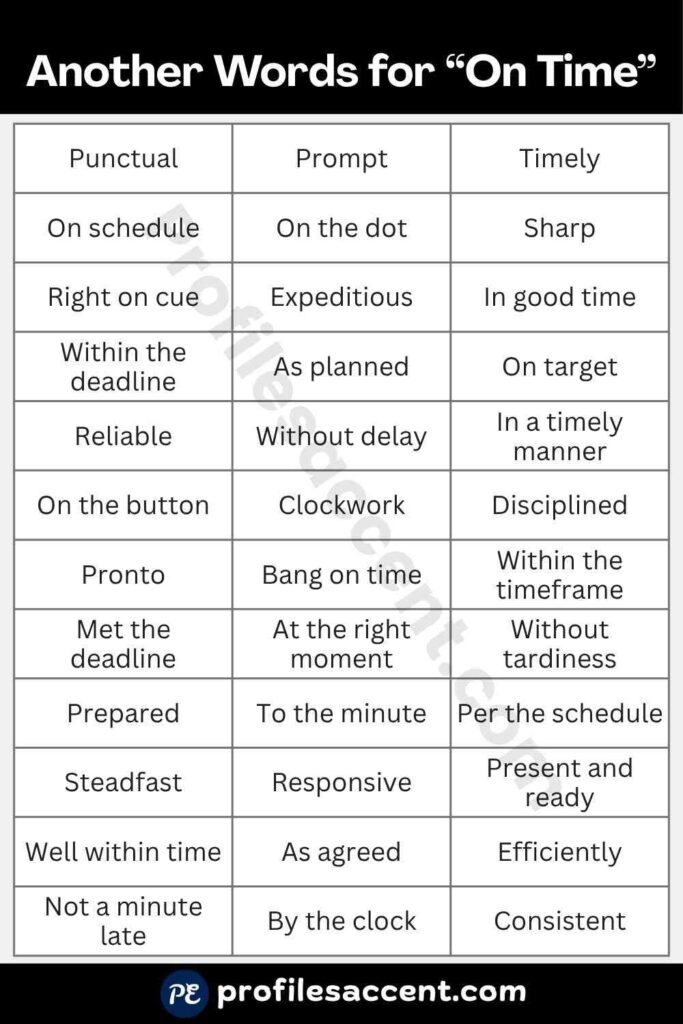
Same Idea, Different Signal: Meaning Clusters for On Time Synonyms
These synonyms are not interchangeable. Each one carries a slightly different signal. Grouping them by meaning helps you see the difference.
When you want to describe a person’s character:
Words like punctual, reliable, disciplined, and consistent are about who someone is, not just what they did. Use these on resumes, in recommendation letters, or in performance reviews. They suggest a pattern, not a single event.
When you’re describing an event or task:
“On schedule,” “met the deadline,” “as planned,” and “per the schedule” are about outcomes. They describe what happened to a project or delivery, not who made it happen.
When precision matters
“To the minute,” “on the dot,” “sharp,” and “by the clock” all signal exact timing. These are the words for situations where being five minutes early still counts as close enough.
When tone needs to be warm or casual:
“In good time,” “bang on time,” “pronto,” and “right on cue” feel relaxed and human. They belong in texts, friendly emails, and everyday conversation.
When you’re ahead of schedule:
This is where most guides drop the ball. “Ahead of schedule,” “well within time,” and “ahead of the curve” are for situations where someone didn’t just meet expectations; they exceeded them. This matters especially in resumes, where “on time” is the baseline and “ahead of schedule” is the achievement.
How Strong Is Your Word? A Tone Scale for On Time Alternatives
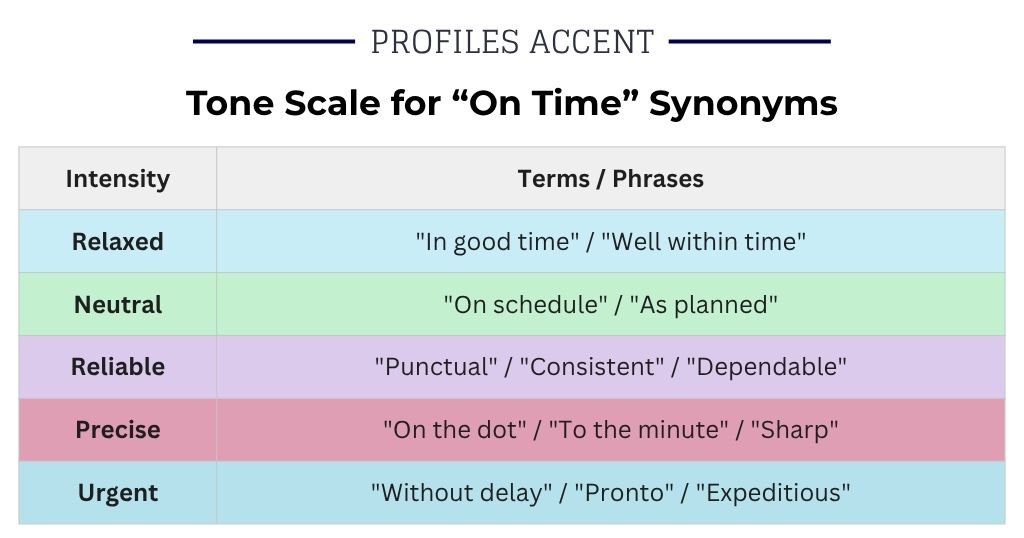
Not every synonym carries the same energy. Here’s how urgency and precision shift across the range:
- Relaxed → “In good time” / “Well within time”
These feel almost leisurely. No stress, no rushing, just steady progress.
- Neutral → “On schedule” / “As planned”
Professional and calm. These don’t imply urgency or praise. They just report facts.
- Reliable → “Punctual” / “Consistent” / “Dependable”
These carry a quiet confidence. They describe steady, trustworthy behavior over time.
- Precise → “On the dot” / “To the minute” / “Sharp”
Clock-based accuracy. These feel almost mathematical. Use them when the exact time matters.
- Urgent → “Without delay” / “Pronto” / “Expeditious”
These words push. They suggest speed is critical and any lag is a problem.
- Exceptional → “Ahead of schedule” / “Ahead of the curve”
These go beyond punctuality. They signal that someone isn’t just meeting the bar; they’re raising it.
Watch How the Right On Time Synonym Transforms a Sentence
Seeing how a swap changes the feel of a sentence is more useful than any definition. Here are real rewrites.
Original: “She is always on time.”
- Formal: “She consistently meets all scheduled commitments without exception.”
- Resume: “Maintains a strong track record of punctuality and schedule adherence.”
- Casual: “She’s never late, not once.”
- Creative: “Every meeting, every deadline, she was there to the minute.”
The original is fine. But each rewrite tells you something about the person that “on time” simply cannot.
Original: “Please be on time for the meeting.”
- Formal email: “Kindly ensure your attendance at the scheduled start time.”
- Firm but polite: “Please arrive promptly, as we’ll begin immediately at 10 AM.”
- Team message: “Let’s all be there sharp at 10, no stragglers this time.”
Original: “The project was completed on time.”
- Business report: “All deliverables were submitted within the approved timeframe.”
- Achievement statement: “The project was completed ahead of schedule, allowing early review.”
- Simple recap: “Everything finished right on cue.”
Notice that “ahead of schedule” in the third rewrite turns a neutral fact into an accomplishment. On a resume, that difference matters enormously.
On Time vs. In Time: The Mix-Up That Slips Past Most Writers

This gap rarely gets addressed, but it’s one of the most common mix-ups in English writing.
- “On time” means exactly when expected. No earlier, no later. The train arrived on time. The report was submitted on time.
- “In time” means soon enough before something happens. You got there in time to grab a seat. She finished in time to review the draft.
The key difference is purpose. “On time” is about meeting a set schedule. “In time” is about making it before something important occurs.
If you write “he arrived on time to catch the flight,” it sounds slightly off. He didn’t arrive at a scheduled arrival time; he arrived early enough to board. “In time” would be cleaner there.
When You Can’t Be On Time: Professional Phrases That Keep Trust Intact
Most synonym guides skip this entirely. But many people searching for “how to say be on time professionally” actually need help phrasing a situation where they won’t be on time.
These soft, professional phrases can manage expectations without damaging your reputation:
- “I am running slightly behind my projected timeline.”
- “I anticipate a brief delay and will update you within the hour.”
- “This task is taking longer than expected; I’ll have it to you by end of day.”
- “I want to flag a minor schedule shift and ensure we stay aligned.”
None of these say “I’m late.” They all communicate accountability, and they keep the relationship intact.
Words That Look Like On Time Synonyms But Aren’t
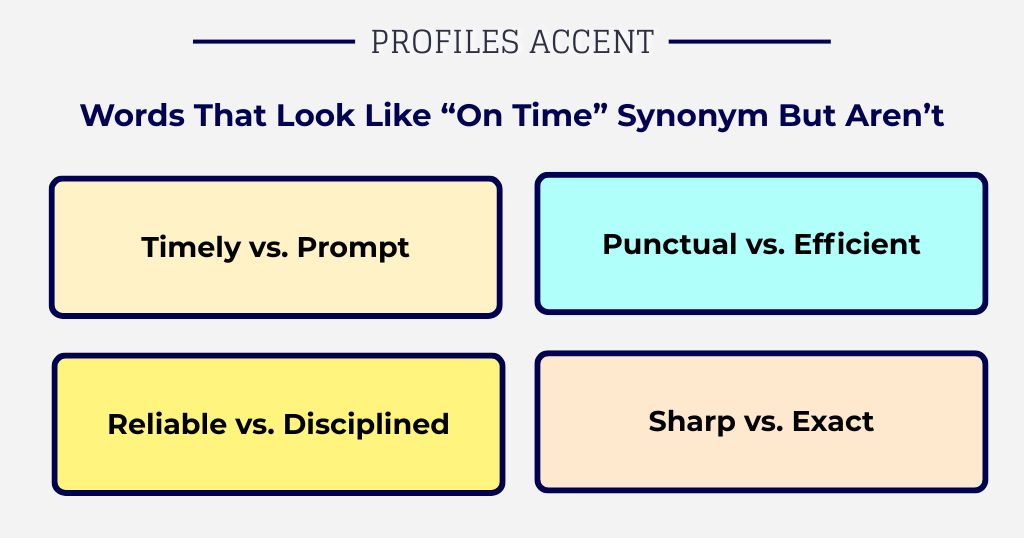
Timely vs. Prompt: “Timely” means happening at the right moment, which isn’t always the earliest possible moment. “Prompt” means fast, almost immediate. A timely warning could come days before danger. A prompt response means you replied right away.
Punctual vs. Efficient: Punctual is about time. Efficient is about how you use time. A punctual person shows up when expected. An efficient person gets more done in less time. Very different compliments.
Reliable vs. Disciplined: “Reliable” is about outcomes; you can count on them. “Disciplined” is about internal behavior; they work hard to stay organized. Both are good resume words but they describe different qualities.
Sharp vs. Exact: “9 AM sharp” is a common usage and sounds natural. “9 AM exact” sounds unusual. Context determines which precision word fits naturally.
Words Worth Knowing Beyond Punctual and On Time
- Diligent: Goes beyond being on time. Describes someone who works carefully and consistently. Better for resumes when you want to say more than “I meet deadlines.”
- Meticulous: Focused on getting details right. Useful when precision is the point, not just timing.
- Proactive: Often better than “on time.” Being proactive means you acted before something became urgent. It suggests you prevented the delay, not just avoided it.
- Systematic: Useful when describing how someone organizes their schedule. A systematic worker builds structures that keep them on track reliably.
The Right On Time Word for the Right Situation
Here’s a quick decision guide before you close this page.
- Writing a resume? Use: punctual, consistent, met all deadlines, ahead of schedule.
- Writing a professional email? Use: prompt, timely, without delay, as agreed.
- Writing a story or creative piece? Use: to the minute, right on cue, not a minute late, at the appointed hour.
- Casual message to a friend? Use: bang on time, on the dot, sharp, pronto.
- Project update or business report? Use: on schedule, within the timeframe, per the plan, on target.
- Explaining a delay professionally? Use the accountability phrases listed earlier. Own the timeline, stay clear, and keep trust intact.
“On time” is not a bad phrase. It’s just a starting point. The word you reach for next is the one that actually tells your reader something.
Discover More Articles:

I’m Rowan, a language addict who loves exploring how words work in everyday communication. I’ve spent years studying English vocabulary and helping others express themselves more clearly. My goal is simple: make learning new words easy and practical. I focus on real-life examples that show when and how to use different terms. Through clear explanations and honest guidance, I help readers choose the right words for any situation with confidence.