You finally finish your resume. You read it back. The word “confident” appears three times. In three different sentences. Describing three different things. It starts to feel flat, almost meaningless, like you copy-pasted your own personality.
That’s the real problem with overusing “confident.” It’s not wrong. It’s just tired.
The right synonym doesn’t just replace a word. It adds a layer of meaning. It tells the reader exactly what kind of confidence you mean, how strong it is, and whether it’s a strength or a flaw. That precision is what separates forgettable writing from writing that actually lands.
What Does “Confident” Really Mean?
At its core, confident means trusting yourself or trusting that something is true. It carries a quiet sense of belief, without needing outside approval. The emotional weight sits somewhere between calm certainty and bold self-assurance. It’s a positive word by default, but the moment you push it too far, it tips into arrogance territory.
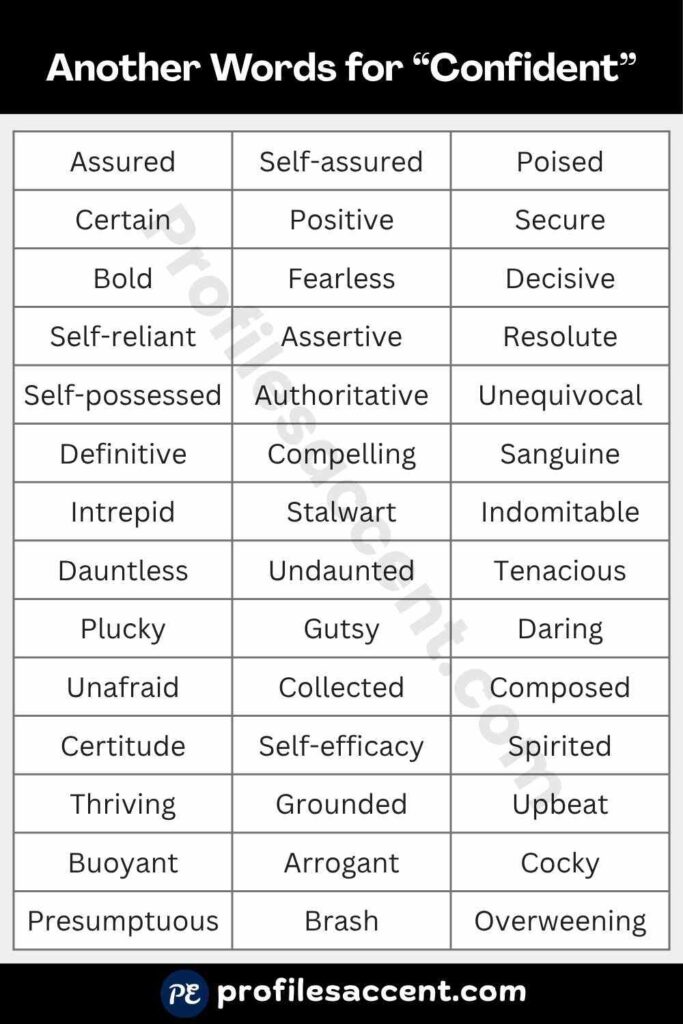
40+ Quick Table: Synonyms for Confident at a Glance
| Word | Tone | Best Used When | Quick Example |
| Assured | Calm, polished | Professional writing | “She gave an assured performance.” |
| Self-assured | Personal, warm | Describing character | “He walked in self-assured and ready.” |
| Poised | Graceful, controlled | Under pressure | “She stayed poised during questioning.” |
| Certain | Factual, firm | Strong conviction | “I’m certain this is the right call.” |
| Positive | Emphatic | Absolute conviction | “I’m positive about the decision.” |
| Secure | Grounded, stable | Inner peace | “He felt secure in his choices.” |
| Bold | Energetic, daring | Risk-taking | “A bold move in a tough market.” |
| Fearless | Intense, dramatic | Facing danger | “She gave a fearless speech.” |
| Decisive | Action-focused | Leadership | “A decisive manager earns respect.” |
| Self-reliant | Independent | Trusting your own judgment | “She is self-reliant under stress.” |
| Assertive | Direct, firm | Standing your ground | “Be assertive in salary talks.” |
| Resolute | Unwavering | Commitment | “He remained resolute under doubt.” |
| Self-possessed | Calm, composed | Social pressure | “She was fully self-possessed.” |
| Authoritative | Expert, commanding | Academic or factual | “An authoritative source on the topic.” |
| Unequivocal | Zero doubt | Absolute clarity | “His answer was unequivocal.” |
| Definitive | Final, clear | Conclusions | “A definitive study on the subject.” |
| Compelling | Persuasive | Essay writing | “A compelling argument.” |
| Sanguine | Hopeful, calm | Tough situations | “She remained sanguine throughout.” |
| Intrepid | Courageous | Facing new challenges | “An intrepid explorer of ideas.” |
| Stalwart | Strong, steady | Character description | “A stalwart leader in hard times.” |
| Indomitable | Unbreakable | Resilience | “Her indomitable spirit won them over.” |
| Dauntless | Brave, firm | Literary writing | “A dauntless approach to reform.” |
| Undaunted | Unflinching | Challenges | “Undaunted by the criticism.” |
| Tenacious | Persistent | Long-term effort | “A tenacious negotiator.” |
| Plucky | Light, spirited | Informal or creative | “A plucky young entrepreneur.” |
| Gutsy | Casual, bold | Informal writing | “That was a gutsy decision.” |
| Daring | Adventurous | Innovation | “A daring new idea.” |
| Unafraid | Simple, direct | Everyday language | “She was unafraid to speak up.” |
| Collected | Calm under fire | Crisis moments | “He stayed collected through it all.” |
| Composed | Neat, calm | Professional settings | “She was composed and clear.” |
| Certitude | Deep certainty | Formal or emotional | “She spoke with total certitude.” |
| Self-efficacy | Psychological | Belief in ability | “Strong self-efficacy drives results.” |
| Spirited | Lively, energetic | Positive personality | “A spirited and capable team member.” |
| Thriving | Full of life | Growth contexts | “She’s thriving in her new role.” |
| Grounded | Stable, real | Emotional balance | “He’s grounded and clear-headed.” |
| Upbeat | Positive, light | Informal or tone | “An upbeat and capable presenter.” |
| Buoyant | Light, resilient | Mood-based confidence | “She stayed buoyant despite setbacks.” |
| Arrogant | Negative | Describing overconfidence | “His arrogant tone pushed people away.” |
| Cocky | Informal, negative | Casual criticism | “Too cocky to accept feedback.” |
| Presumptuous | Overstepping | Social/formal criticism | “That assumption was presumptuous.” |
| Brash | Loud, aggressive | Negative character trait | “His brash attitude backfired.” |
| Overweening | Excessive pride | Literary negative use | “His overweening confidence cost him.” |
| Hubristic | Pride-driven failure | Academic or literary | “A hubristic choice with real costs.” |
Not All Confident Synonyms Are Created Equal
“Confident” doesn’t mean just one thing. The synonyms above split into very different flavors depending on what kind of confidence you’re describing.
Quiet, inner confidence reads through words like secure, grounded, and self-possessed. These describe someone who doesn’t need to prove anything. Their belief in themselves is internal, calm, almost invisible.
Active, outward confidence shows up in words like assertive, bold, and decisive. These people don’t just feel confident. They show it through action and language. This is the type of confidence a resume or leadership bio should highlight.
Confidence in knowledge or evidence belongs to words like authoritative, definitive, and unequivocal. These aren’t really about personality. They’re about the strength of an argument or a claim. Use these in essays, reports, or research writing.
Courage-based confidence lives in words like fearless, intrepid, dauntless, and undaunted. These carry a story inside them. There’s some challenge involved, and this person faces it anyway.
Overconfidence (the darker side) shows up in arrogant, cocky, brash, and hubristic. These seem like confidence from the outside, but they cross a line into self-delusion or disrespect. Knowing these helps you avoid accidentally writing the wrong version of “confident.”
How Strong Is Your Word? A Tone Scale for Confident Synonyms
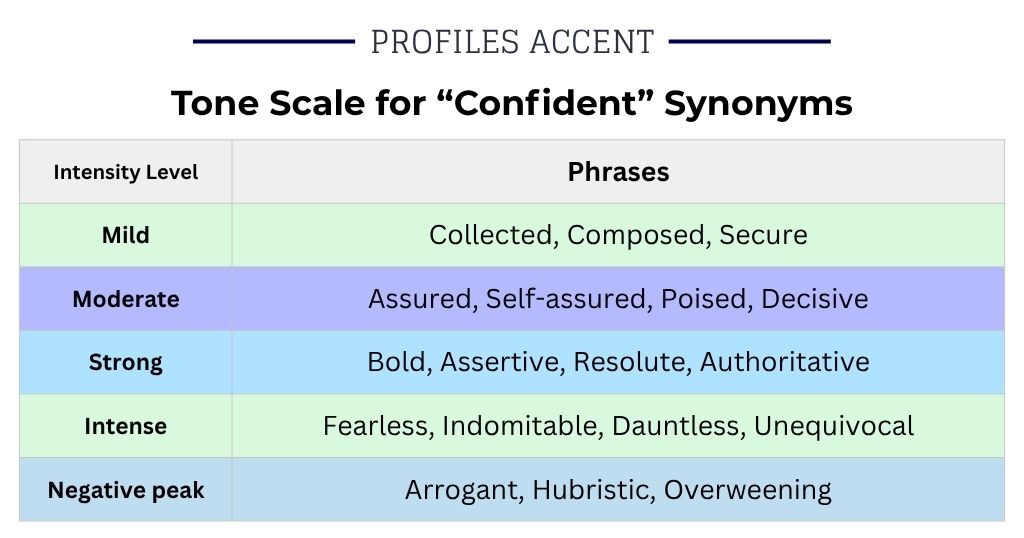
Not all synonyms carry the same weight. Here’s how confidence builds from soft to extreme:
- Mild: Collected, Composed, Secure
These feel steady and low-key. No drama, no edge. Good for calm characters or professional profiles.
- Moderate: Assured, Self-assured, Poised, Decisive
The sweet spot for most writing. Competent without being pushy. Works on resumes, cover letters, character descriptions.
- Strong: Bold, Assertive, Resolute, Authoritative
These make a statement. Use when the confidence matters to the point. Leadership roles, persuasive essays, strong characters.
- Intense: Fearless, Indomitable, Dauntless, Unequivocal
Reserved for high-stakes moments. These words feel earned. Drop one of these in the wrong sentence and it will sound overstated.
- Negative peak: Arrogant, Hubristic, Overweening
These signal that the confidence has gone wrong. Great for antagonists, cautionary writing, or contrast moments.
Rewrites in Action: Replacing “Confident” the Smart Way
See how swapping “confident” shifts the entire feel of a sentence.
Original: “She felt confident during the meeting.”
- Formal: “She remained composed and authoritative throughout the discussion.”
- Casual: “She walked into that meeting like she owned it.”
- Academic: “Her self-efficacy was notably high in a high-pressure setting.”
- Creative: “Every word she spoke carried the quiet certainty of someone who had already decided.”
Original: “He is a confident person.”
- Resume: “He brings a decisive and self-assured presence to every project.”
- Storytelling: “He never needed the room’s approval. He already had his own.”
- Informal: “He’s gutsy and doesn’t overthink it.”
Original: “I feel confident about this choice.”
- Strong: “I am resolute in this decision.”
- Casual: “I feel really good about this, no doubts.”
- Academic: “There is compelling evidence to support this course of action.”
Each rewrite serves a different reader in a different moment. That’s the power of the right synonym.
Formal or Casual? Choosing the Right Alternative to Confident
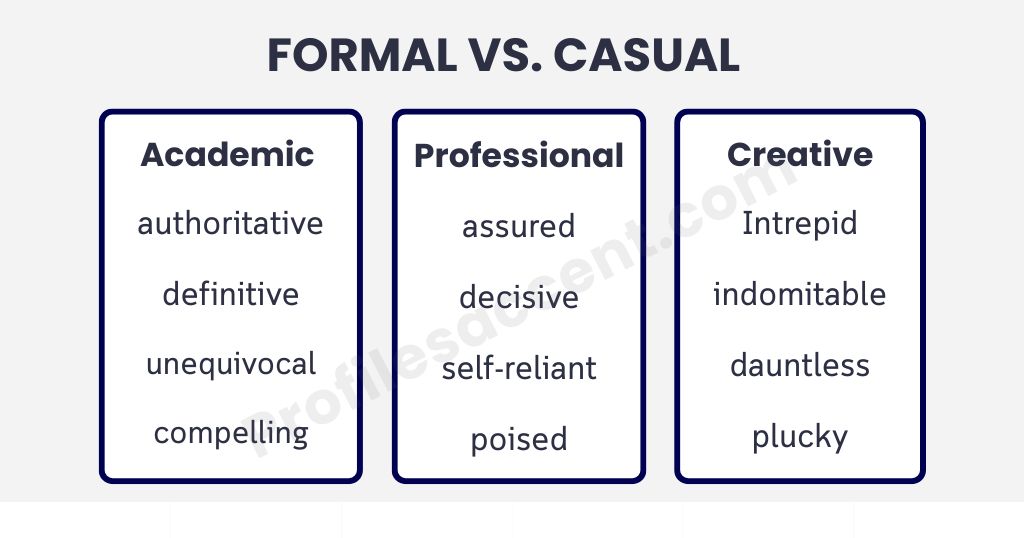
If you’re writing an essay or academic paper, reach for: authoritative, definitive, unequivocal, compelling, resolute. These words tie confidence to evidence, not emotion.
For a resume or professional bio, the strongest picks are: assured, decisive, self-reliant, poised, assertive. They suggest someone who acts, leads, and handles pressure without making noise about it.
In creative or fiction writing, you have full freedom. Intrepid, indomitable, dauntless, plucky, sanguine all carry personality. They can build a character in a single word.
For casual conversation or informal content, simple works best: bold, gutsy, upbeat, grounded, unafraid. No one sounds natural saying “I felt indomitable today.” Save that for the page.
Words to avoid in formal writing: cocky, gutsy, plucky, brash. These read as too casual or, worse, as unintentional insults in a professional context.
When These Words for Confident Backfire
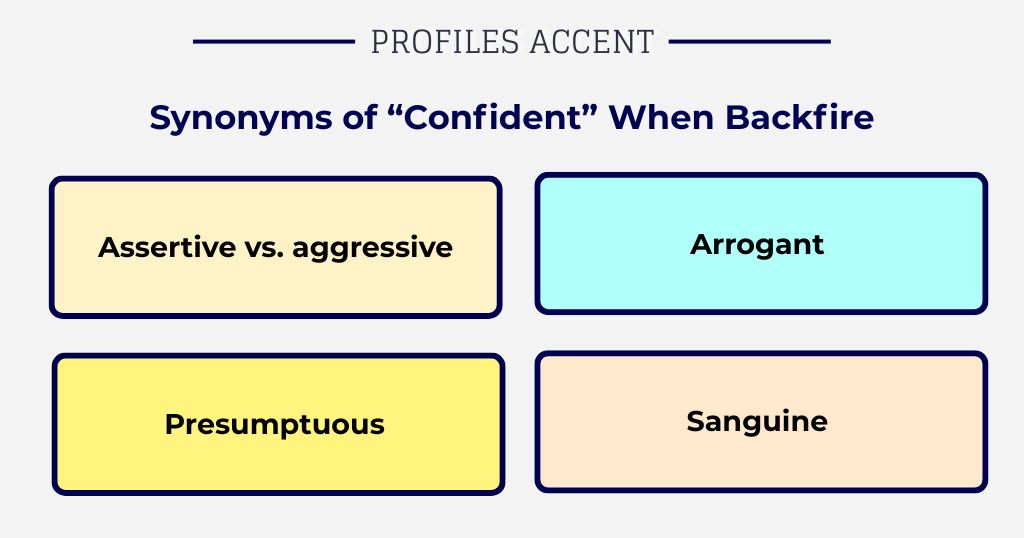
Some of these words carry risks if you use them carelessly.
Assertive vs. aggressive is a real distinction that writers miss. Assertive means speaking up confidently. Aggressive means pushing past someone else’s comfort. Mixing them up in a description of a woman especially can come across as unintended bias.
Arrogant should never be used when you mean bold. They don’t overlap. Arrogant implies looking down on others. Bold just means willing to take risks.
Presumptuous is a social word, not just a personality word. It describes someone acting without permission or overstepping boundaries. It’s not just “very confident.” Context changes everything.
Sanguine is often mistaken for “cheerful” or “calm.” It actually means optimistically confident that things will go well, even when the odds say otherwise. It’s positive but carries a faint note of ignoring reality. Use it carefully.
Self-efficacy is a psychological term with a precise meaning: belief in your ability to complete a specific task. Using it loosely to mean “general confidence” is technically incorrect and can undermine credibility in academic writing.
The Flip Side: Opposites of Confident Worth Knowing
Understanding what confidence is not helps sharpen how you use its synonyms.
- Diffident is the most precise opposite. It describes someone quiet and hesitant because they don’t trust themselves, not because they’re shy by nature.
- Hesitant captures a lack of confidence in action. You want to move, but you don’t.
- Apprehensive points toward fear of what might go wrong, which blocks confidence before it can form.
- Presumptuous and overweening are the sneaky opposites: too much confidence, crossing into entitlement. The opposite of confident isn’t always fear. Sometimes it’s hubris.
Words That Often Travel With “Confident” (But Mean Something Different)
These aren’t exact synonyms, but they often show up in the same conversations:
Optimistic leans forward into the future. Confident looks at the present moment. You can be confident without being optimistic, and optimistic without being confident.
Ambitious suggests wanting more. Confident suggests believing you can get it. They’re related, but one is about drive and the other is about belief.
Resilient is about bouncing back after failure. Confident is about believing before anything happens. Writers mix these up in character descriptions.
Courageous involves fear and action despite it. Confident often doesn’t involve fear at all. A courageous act is harder. A confident one is natural.
So Which Synonym for Confident Should You Actually Use?
- If you’re updating your resume, go with assured or decisive.
- If you’re describing a character, try self-possessed, resolute, or poised.
- If your essay needs a stronger claim, replace “confident” with definitive or unequivocal.
- If you want the negative shade, cocky or presumptuous will do the work cleanly.
The word “confident” isn’t the problem. Using it for every shade of meaning is. Pick the one that fits the exact moment you’re writing, and your reader will feel the difference even if they never notice the swap.
Discover More Articles:

I’m Rowan, a language addict who loves exploring how words work in everyday communication. I’ve spent years studying English vocabulary and helping others express themselves more clearly. My goal is simple: make learning new words easy and practical. I focus on real-life examples that show when and how to use different terms. Through clear explanations and honest guidance, I help readers choose the right words for any situation with confidence.