There’s a moment in writing when you type “saddest” and immediately feel it isn’t quite right. Not because it’s wrong. Because it’s flat. “The saddest day of my life” gets the point across, but it doesn’t make anyone feel anything. The word carries meaning without carrying weight.
That’s the real problem with “saddest.” It’s accurate, but it’s empty. Swapping it for a more precise word doesn’t just improve your writing. It changes how the reader experiences what you’re describing.
This guide helps you find the right alternative, not just any alternative.
What Does Saddest Really Mean?
“Saddest” is the superlative form of “sad.” It describes the highest possible degree of unhappiness or emotional pain. But here’s what most people don’t realize: the word originally had nothing to do with crying.
In Old English, “sad” meant full or sated, like someone who had eaten too much. Over centuries, it shifted to mean weary, then heavy-hearted, then sorrowful. That history matters, because it tells you something interesting. Deep sadness isn’t just an absence of happiness. It’s a kind of heaviness, a feeling of being full of something you can’t put down.
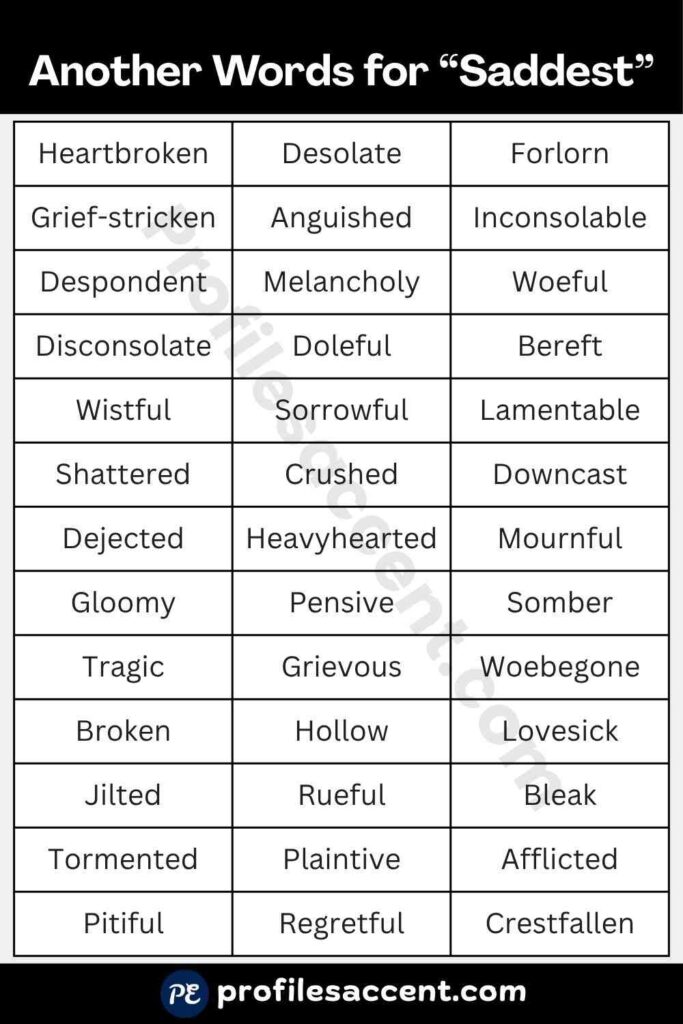
40+ Synonyms for Saddest at a Glance
| Word | Tone | Best Used When | Short Example |
| Heartbroken | Emotional, personal | Romantic or deep personal loss | She left him heartbroken |
| Desolate | Cold, empty, alone | Complete isolation or grief | The house felt desolate |
| Forlorn | Quiet, abandoned | Someone feels left behind | A forlorn figure by the window |
| Grief-stricken | Heavy, raw | Death or serious loss | He was grief-stricken for weeks |
| Anguished | Sharp, intense | Emotional or physical torment | Her anguished cry echoed out |
| Inconsolable | Overwhelming | When nothing can help | The child was inconsolable |
| Despondent | Hopeless | Loss of motivation or will | She felt despondent after the news |
| Melancholy | Reflective, soft | A lingering thoughtful sadness | A melancholy song filled the room |
| Woeful | Sorrowful, visible | Situations of deep regret | A woeful expression crossed his face |
| Disconsolate | Beyond comfort | Can’t be cheered or soothed | He sat disconsolate in the corner |
| Doleful | Mournful, quiet | Describes tone or expression | Her doleful eyes told the truth |
| Bereft | Empty, hollow | After a loss of something precious | She felt utterly bereft |
| Wistful | Gentle, nostalgic | Longing for something past | He gave a wistful smile |
| Sorrowful | Deep, personal | Grief tied to a specific cause | A sorrowful farewell at the gate |
| Lamentable | Regretful, serious | A situation deserving grief | A lamentable end to something good |
| Shattered | Broken, sudden | Shock mixed with deep pain | She was shattered by the news |
| Crushed | Heavy, immediate | Disappointment or loss | He felt completely crushed |
| Downcast | Low, quiet | Daily discouragement | She walked in looking downcast |
| Dejected | Discouraged, flat | Failing or being rejected | He returned dejected from the interview |
| Heavyhearted | Burdened, slow | Carrying emotional weight | She left the funeral heavyhearted |
| Mournful | Grief-toned | Funerals, loss, endings | A mournful silence fell over them |
| Gloomy | Dark, low | Mood or atmosphere | A gloomy feeling settled in |
| Pensive | Thoughtful, subdued | Quiet reflection with sadness | He sat pensive by the river |
| Somber | Serious, dark | Tone, mood, or setting | The ceremony had a somber tone |
| Tragic | Dramatic, heavy | Events with irreversible loss | A tragic end no one expected |
| Grievous | Formal, painful | Serious harm or deep loss | A grievous mistake with real cost |
| Woebegone | Visibly sad | Appearance-based sadness | She looked utterly woebegone |
| Broken | Raw, total | Complete emotional collapse | He was completely broken inside |
| Hollow | Empty, numb | Grief that feels like nothing | A hollow feeling replaced the tears |
| Lovesick | Romantic pain | Longing or unrequited love | A lovesick letter never sent |
| Jilted | Romantic, bitter | Abandoned by a partner | A jilted lover rarely forgets |
| Rueful | Quiet regret | Wishing something were different | A rueful glance at old photos |
| Bleak | Cold, hopeless | When the future looks dark | A bleak outlook on what’s ahead |
| Tormented | Restless pain | Ongoing inner suffering | Tormented by memories of the past |
| Plaintive | Sound-based sadness | A voice, song, or tone | A plaintive note in her voice |
| Afflicted | Burdened, suffering | Emotional or physical trouble | Afflicted by years of quiet grief |
| Pitiful | Evoking sympathy | When something deserves pity | A pitiful end to a hard life |
| Regretful | Soft, thoughtful | Wishing for a different outcome | A regretful goodbye at the door |
| Crestfallen | Sudden letdown | Visible disappointment | He came home crestfallen |
| Devastated | Total, powerful | Catastrophic emotional blow | She was devastated by the loss |
How Sadness Actually Works in Language
Not all sadness is the same. A person grieving a death feels something completely different from someone who missed a flight. Yet writers often reach for the same two or three words regardless. That’s the real gap in most synonym lists: they give you options but don’t tell you which option fits your situation.
- Think about sadness in three basic textures.
Sadness as weight. Some words carry a sense of being burdened. Heavyhearted. Grief-stricken. Afflicted. These words suggest sadness that is slow and hard to carry. Use them when someone is dragging through their day, not just feeling a little low.
Sadness as emptiness. Other words describe a hollow feeling, a sense that something is missing. Bereft. Hollow. Desolate. These are the right words after loss. Not crying-sad. Numb-sad. The kind where you walk into a room and don’t know why you went there.
Sadness as a sharp pain. Then there are words that feel like impact. Shattered. Crushed. Anguished. Devastated. These are for sudden, intense emotional pain. The moment the call comes. The moment you read the message.
Knowing which texture you’re describing makes the difference between a sentence that’s accurate and one that actually lands.
How Strong Is the Sadness? A Scale of Saddest Synonyms
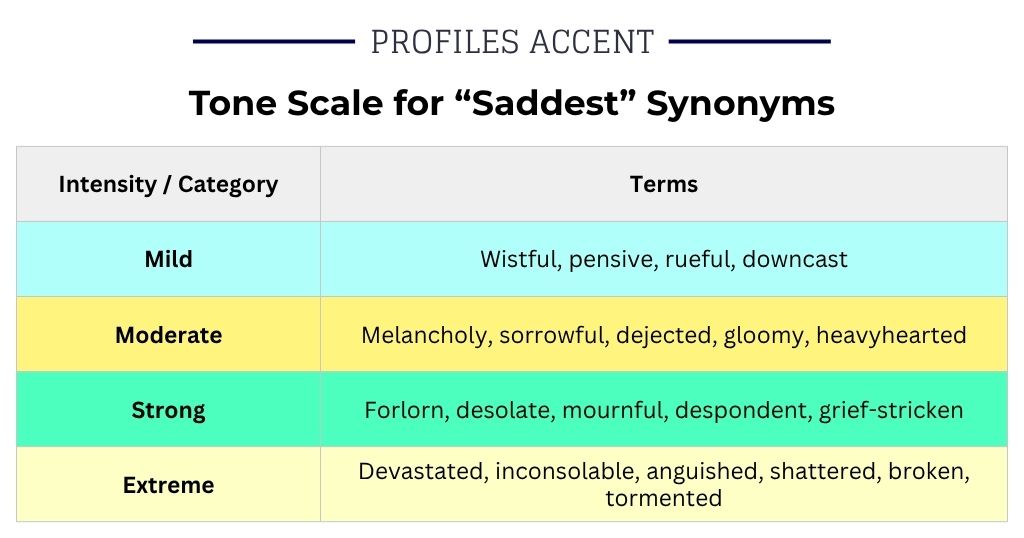
It helps to see these words on a spectrum. This is something most lists skip entirely.
- Mild: Wistful, pensive, rueful, downcast
These suggest sadness that doesn’t overwhelm. A person can still function. They might be quiet, reflective, or a little low.
- Moderate: Melancholy, sorrowful, dejected, gloomy, heavyhearted
Here, sadness is more present and visible. It affects the mood. Others might notice. But it’s not a crisis.
- Strong: Forlorn, desolate, mournful, despondent, grief-stricken
These words suggest deep sadness. Loss of hope. Visible grief. Something significant has happened.
- Extreme: Devastated, inconsolable, anguished, shattered, broken, tormented
These are for complete emotional collapse. The kind of sadness that needs time, support, or both.
Matching the right level to your context is everything. Calling a bad hair day “devastating” isn’t just wrong. It makes your writing sound careless.
Saddest in a Sentence: Before and After Rewrites
Seeing word swaps in action is more useful than any list.
Original: It was the saddest moment of the whole trip.
- Formal: The moment carried a grief that no one had expected.
- Casual: Everyone went quiet. Nobody had words for it.
- Creative: Something broke open in that moment, quietly and completely.
Original: She looked like the saddest person in the room.
- Descriptive: She sat apart from everyone, hollow-eyed and still.
- Emotional: There was a kind of desolation in her face that made people look away.
- Simple: She looked utterly lost, even surrounded by people.
Original: It was the saddest story I ever heard.
- Formal: The account was genuinely lamentable, one that stayed with me long after.
- Creative: I didn’t cry. I just sat with it for days.
- Conversational: I’ve heard hard stories, but this one was something else entirely.
Notice what happens. The word “saddest” disappears, but the feeling gets stronger. That’s the point. Precision beats superlatives almost every time.
When Sad Synonyms Go Wrong
A few common mistakes writers make when picking sadness synonyms:
Using “tragic” for personal feelings. “Tragic” describes situations and events, not inner emotional states. A tragic accident. A tragic ending. Not “she felt tragic.” That sounds off because it is.
Confusing “melancholy” with “depression.” Melancholy is a mood, a soft and reflective kind of sadness. It’s not a clinical condition. Using it to describe severe grief undersells the emotion. Using it when you actually mean thoughtful or quiet nostalgia is perfect.
Overusing “heartbroken” for non-romantic sadness. Heartbroken works for deep personal pain, not just romantic loss. But overuse has made it feel almost decorative. If you want impact, consider “shattered” or “grief-stricken” instead.
Choosing “wistful” when you mean “regretful.” Wistful is gentle. It’s nostalgia with a soft ache. Regret is different. It implies you wish something had gone differently. They are related but not interchangeable.
Another Word for Saddest Person, Feeling, Situation, and Love
- For a sad person: forlorn, desolate, grief-stricken, woebegone, crestfallen, broken
- For a sad situation: lamentable, grievous, tragic, bleak, somber, woeful
- For a sad feeling: hollow, heavy, anguished, bereft, despondent, tormented
- For sad love: heartbroken, lovesick, jilted, bereft, shattered, inconsolable
Related Words Close to Saddest but Not Quite the Same
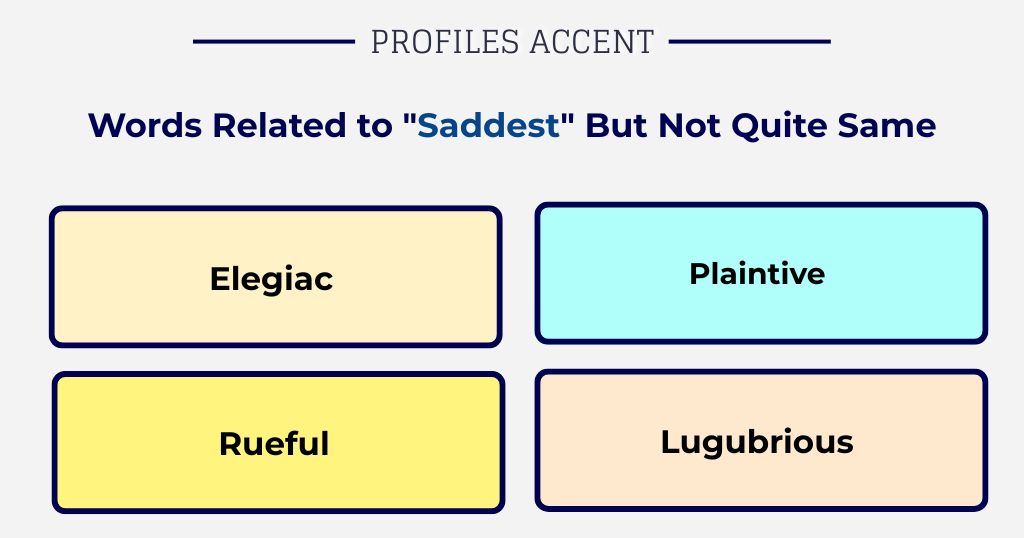
- Elegiac describes something that expresses sadness for a loss, often in writing or music. It’s more poetic than emotional.
- Plaintive is about sound. A plaintive voice, a plaintive cry. It’s not for inner states.
- Rueful holds regret quietly. It’s almost gentle. Someone rueful has made peace with something while still wishing it had gone differently.
- Lugubrious means excessively mournful, almost overdone. It can carry a slightly ironic tone. Use it carefully, because it can sound theatrical.
- Dirge-like is an atmosphere word, not an emotion word. Useful for describing music, tone, or mood rather than a person’s feelings.
How to Spell and Say Saddest
Saddest is spelled S-A-D-D-E-S-T. The double “d” follows the rule for short vowel sounds in one-syllable adjectives: when you add a suffix, you double the final consonant. It’s pronounced SAD-ist (rhymes with “maddest”), not “say-dest” or “say-dist.”
If you’re searching for “is saddest a word,” the answer is yes, fully standard, and widely used in both formal and casual writing.
Picking the Right Synonym for Saddest: Final Thoughts
Here’s what it comes down to. Ask yourself two questions before picking a synonym.
- First: How intense is this sadness? Mild? Deep? Total?
- Second: What kind of sadness is it? A weight? An emptiness? A sharp pain?
Once you know those two things, the right word usually becomes obvious. “Wistful” is for gentle longing. “Desolate” is for emptiness. “Shattered” is for sudden, breaking grief. “Inconsolable” is for sadness so complete that nothing helps.
The word “saddest” tells readers what to think. The right synonym makes them feel it instead. That small difference is what separates writing that’s clear from writing that stays with someone.
Discover More Articles:

I’m Rowan, a language addict who loves exploring how words work in everyday communication. I’ve spent years studying English vocabulary and helping others express themselves more clearly. My goal is simple: make learning new words easy and practical. I focus on real-life examples that show when and how to use different terms. Through clear explanations and honest guidance, I help readers choose the right words for any situation with confidence.