You’re halfway through an essay. You’ve already used “despite” three times. You know it’s getting repetitive, but nothing else feels quite right. So you settle. The writing stays flat.
That’s exactly the kind of moment this guide is built for.
“Despite” is a reliable word, but it’s also an overworked one. The real problem isn’t just repetition. It’s that writers often don’t realize how many better, sharper options exist, each carrying its own weight, tone, and attitude. Swapping the right word in the right place can completely change how confident, polished, or persuasive your writing feels.
What Does “Despite” Actually Do in a Sentence?
At its core, “despite” means something happened even though something else tried to stop it. There’s a built-in surprise: the obstacle was real, but it lost. That contrast is the heart of the word. It’s neutral in tone, works in both formal and casual writing, and sits comfortably in academic essays, professional reports, and everyday conversation.
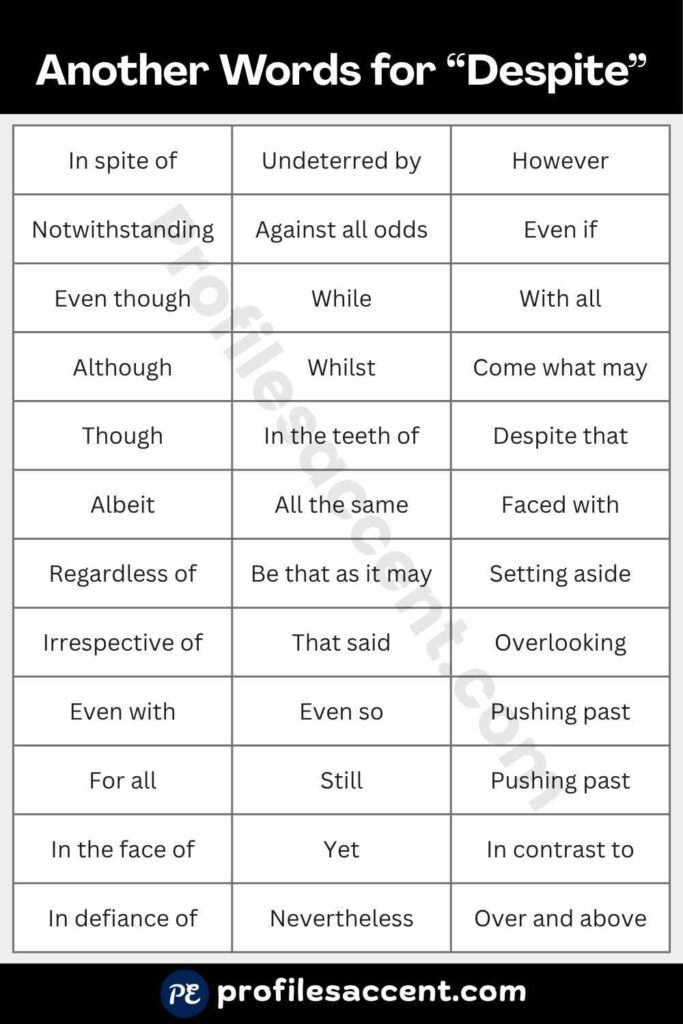
Quick Table: 40+ Synonyms for “Despite”
| Word / Phrase | Tone | Best Used When | Example |
| In spite of | Neutral | Everyday contrast | In spite of the noise, she slept. |
| Notwithstanding | Very formal | Legal, academic writing | Notwithstanding the delay, work continued. |
| Even though | Semi-formal | Full clause contrast | Even though he practiced, he lost. |
| Although | Neutral-formal | Starting a sentence | Although it rained, they played. |
| Though | Informal | End or mid-sentence | He finished the race, though. |
| Albeit | Formal-literary | Short qualifications | It worked, albeit slowly. |
| Regardless of | Neutral | When outcome is unaffected | She attended regardless of the weather. |
| Irrespective of | Formal | Objective, policy writing | Open to all, irrespective of age. |
| Even with | Casual | Soft, conversational contrast | Even with help, she struggled. |
| For all | Idiomatic | Highlighting something large that failed | For all his talent, he quit. |
| In the face of | Dramatic | Adversity, heroism, hardship | Calm in the face of pressure. |
| In defiance of | Strong | Resistance, rebellion | She spoke in defiance of the rules. |
| Undeterred by | Active | Showing persistence | Undeterred by failure, he tried again. |
| Against all odds | Emphatic | Overcoming unlikely barriers | She won against all odds. |
| While | Neutral | Simultaneous contrast | While I understand, I disagree. |
| Whilst | British-formal | UK English formal writing | Whilst the results varied, the trend held. |
| In the teeth of | Vivid/literary | Strong opposition | They advanced in the teeth of criticism. |
| All the same | Casual | Informal spoken or written | It was hard. All the same, she smiled. |
| Be that as it may | Formal spoken | Acknowledging and moving on | Be that as it may, the plan stands. |
| That said | Conversational | Transitioning after a concession | The food was cold. That said, it tasted great. |
| Even so | Casual-neutral | Continuing after a setback | It was expensive. Even so, worth it. |
| Still | Neutral adverb | Casual contrast in spoken form | It rained. We still went. |
| Yet | Literary-formal | Elegant contrast | He was exhausted, yet he continued. |
| Nevertheless | Formal | Academic, formal essays | The sample was small. Nevertheless, results were clear. |
| Nonetheless | Formal | Same as above, slightly softer | Nonetheless, the outcome surprised many. |
| However | Neutral | Most writing types | It was difficult. However, they managed. |
| Even if | Conditional | Hypothetical contrast | Even if she fails, she’ll try again. |
| With all | Casual | Informal concession | With all the confusion, we made it work. |
| Come what may | Idiomatic | Determination regardless of outcome | Come what may, I’ll be there. |
| Despite that | Transitional | After mentioning an obstacle | The plan had flaws. Despite that, it worked. |
| Faced with | Active framing | Introducing a challenge context | Faced with the loss, they adapted. |
| Setting aside | Formal spoken | Moving past a fact | Setting aside the cost, the idea has merit. |
| Overlooking | Conditional | Consciously ignoring a factor | Overlooking the delay, the result impressed. |
| In light of the obstacles | Phrase | Formal narrative | In light of the obstacles, the outcome stood out. |
| Against the backdrop of | Literary | Adding context | Against the backdrop of failure, she thrived. |
| Turning a blind eye to | Idiomatic | Deliberate ignoring | Turning a blind eye to doubt, he moved forward. |
| Over and above | Formal | Layered concession | Over and above the challenges, results held. |
| In contrast to | Neutral-formal | Comparison-based writing | In contrast to expectations, she succeeded. |
| Brushing aside | Casual-active | Dismissing an obstacle | Brushing aside the criticism, he launched anyway. |
| Pushing past | Action-oriented | Narrative or motivational writing | Pushing past every doubt, she finished. |
The Rule Every “Despite” Synonym Hides From You
This is where most synonym lists fail writers. They hand you a list. They don’t tell you what breaks when you use the wrong one.
Grammar shapes your choice more than meaning does.
“Despite” is a preposition. It needs a noun or an action word ending in -ing directly after it. That’s the structure. You cannot follow “despite” with a full sentence containing a subject and a verb.
- Correct: Despite the cold, they walked.
- Correct: Despite losing, the team stayed confident.
- Wrong: Despite he was tired, he kept going.
That last sentence is one of the most common mistakes writers make. It happens because they treat “despite” like “although.” But “although” is a conjunction. It connects two complete sentences. “Despite” does not.
So before you swap any word from the table above, ask one question: do I need a noun after this, or a full sentence?
- If you need a noun: use “despite,” “in spite of,” “notwithstanding,” “regardless of,” “even with.”
- If you need a full sentence: use “although,” “even though,” “though,” “while,” “albeit.”
“Despite” vs. “Regardless Of”: Two Words, Two Different Attitudes
These two are almost always treated as the same. They’re not. The difference is small but meaningful.
- “Despite” says: the obstacle was real, and it nearly stopped things, but it didn’t.
- “Regardless of” says: the obstacle didn’t matter at all. We weren’t even considering it.
Here’s the contrast in action:
She was hired despite her lack of experience. (Surprise. The experience gap was a real issue that almost counted against her.)
She was hired regardless of her experience. (It wasn’t even a factor. Experience played no role in the decision.)
If you’re writing about someone overcoming something, use “despite.” If you’re writing about something that simply didn’t apply, use “regardless of.”
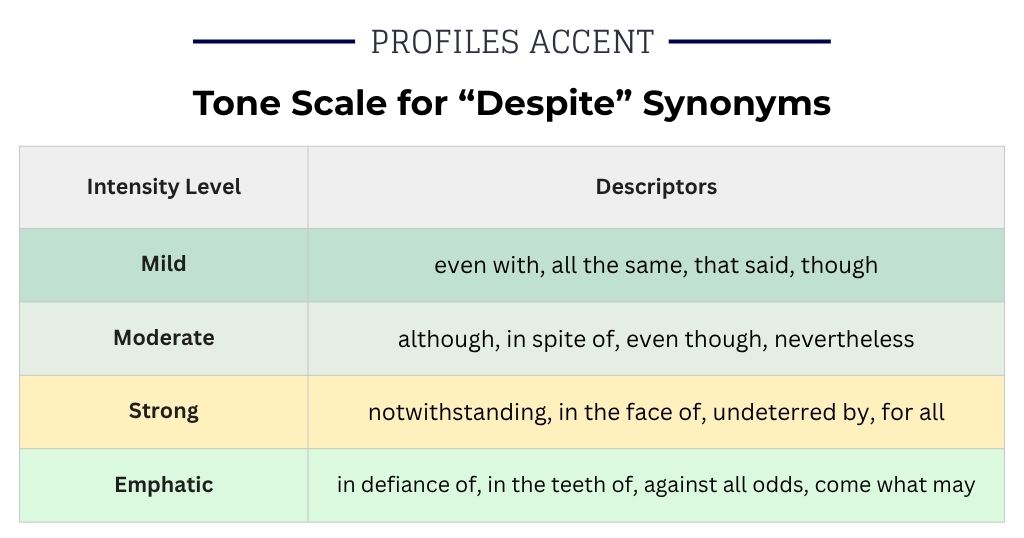
How Strong Is Your Word? A Tone Scale for “Despite” Synonyms
Not every synonym carries the same emotional weight. Here’s how they rank from softest to strongest:
- Mild: even with, all the same, that said, though
- Moderate: although, in spite of, even though, nevertheless
- Strong: notwithstanding, in the face of, undeterred by, for all
- Emphatic: in defiance of, in the teeth of, against all odds, come what may
When you’re writing something low-stakes or conversational, stay in the mild zone. Academic writing lives comfortably in the moderate-to-strong range. Narrative writing, where you want readers to feel the weight of what someone overcame, is where the emphatic options earn their place.
Same Sentence, Four Different Voices: Rewriting With Other Words for “Despite”
Let’s take one weak sentence and reshape it across different contexts.
Original: Despite the rain, the event continued.
- Formal version: Notwithstanding the adverse weather conditions, the event proceeded as scheduled.
(Stronger authority. Works in official reports or press statements.) - Casual version: Even with the rain coming down, the event kept going.
(Warmer. More human. Good for blogs or social posts.) - Academic version: Although meteorological conditions were unfavorable, event proceedings were uninterrupted.
(Reframed with a conjunction. The sentence structure shifts entirely.) - Creative version: The clouds opened up, the ground turned slick, and yet not a single chair moved inside.
(No synonym needed. The contrast is built into the rhythm itself.)
Which Synonym for “Despite” Belongs in Your Writing?
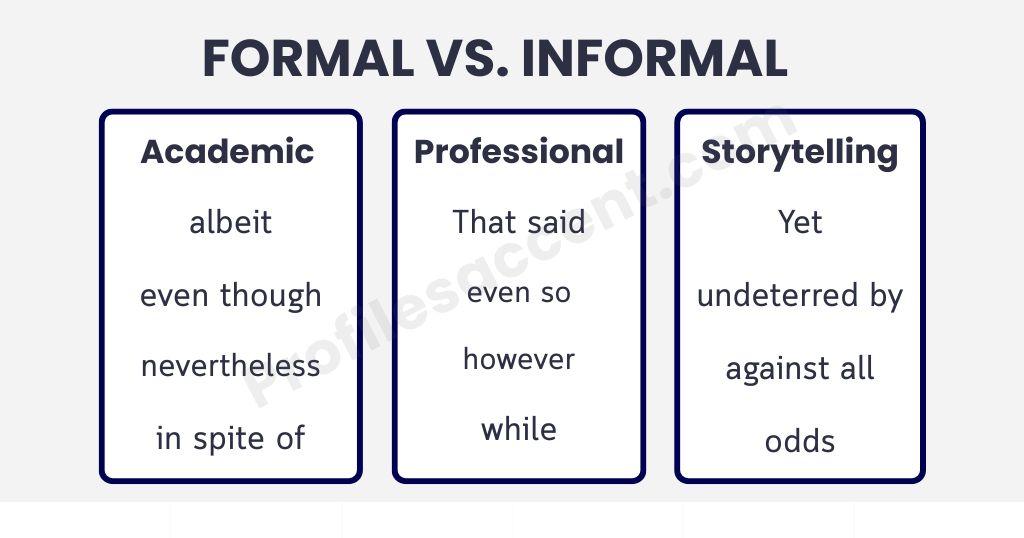
For essays and research papers:
- Notwithstanding, albeit, even though, nevertheless, in spite of. These carry precision without sounding stiff.
For professional emails:
- That said, even so, however, while. These are clean and respectful without being heavy.
For storytelling:
- Yet, in the face of, undeterred by, against all odds. These carry emotional texture that flat synonyms can’t match.
Avoid in formal writing:
All the same, come what may, brushing aside, turning a blind eye to. These idioms lower the register fast and can make professional writing sound sloppy.
Three Mistakes Writers Make When Replacing “Despite”
1. Writing “despite of”
This is wrong. Always. It happens because “in spite of” includes “of,” and people merge the two by accident. There is no version of “despite” that takes “of” after it. If you want the three-word version, write “in spite of.” If you want the one-word version, write “despite.”
2. Treating “nevertheless” and “however” as identical
Both introduce contrast, but “nevertheless” tends to emphasize that something happened in full awareness of an obstacle. “However” simply pivots direction. The difference is subtle, but in formal writing it matters.
3. Using “although” when you need a noun phrase
If your sentence has “although” followed by a noun with no verb, reread it. “Although the rain” makes no sense on its own. “Although it rained” works. This is the grammar trap that trips up even confident writers.
A Quick History Behind the Word (And Why “Spite” Feels Personal)
The word “despite” didn’t always mean what it means now. Centuries ago, it carried weight closer to contempt or scorn. Doing something “in despite of” someone meant doing it to slight them, to mock them.
That sharpness faded over time. But it explains why “in spite of” still carries a faint emotional edge for some readers, especially native speakers who sense the word “spite” inside it. It’s worth knowing, even if you never use it that way.
Words That Live in the Same Neighborhood as “Despite”
- Concession: The grammatical term for the relationship “despite” creates. When you use “despite,” you’re making a concession that the obstacle existed.
- Contrast: A broader category. Not all contrast is concession. “However” shows contrast. “Despite” shows concession specifically.
- Adversative: The technical label for conjunctions and prepositions that express contrast or opposition. “Despite,” “although,” and “yet” all belong to this group.
- Obstacle: The noun most naturally paired with these synonyms. When you’re replacing “despite,” you’re almost always introducing an obstacle of some kind.
Pick the Right Word, Every Time
Here’s a quick decision guide before you write:
- Do you need a noun or phrase after the word? Use: in spite of, notwithstanding, even with, for all.
- Do you need a full sentence? Use: although, even though, whilst, albeit.
- Is the obstacle being dismissed entirely? Use: regardless of, irrespective of.
- Is the obstacle being overcome dramatically? Use: in the face of, undeterred by, against all odds.
- Are you writing casually? Use: even so, that said, all the same, still.
The best synonym isn’t always the most impressive one. It’s the one that fits the sentence so naturally the reader doesn’t notice it at all.
Discover More Articles:

I’m Rowan, a language addict who loves exploring how words work in everyday communication. I’ve spent years studying English vocabulary and helping others express themselves more clearly. My goal is simple: make learning new words easy and practical. I focus on real-life examples that show when and how to use different terms. Through clear explanations and honest guidance, I help readers choose the right words for any situation with confidence.